

From downtown to the east, neighborhood feels strain of new demands on social services
In any city, there is a line where prosperity and need meet.
That place where misfortune and fortune intertwine like September tomatoes in a community garden.
Most of us are oblivious to it.
In Sioux Falls, that line is somewhere along East Eighth Street, where the steady march of redevelopment touches social services, where the hungry, homeless and desperate gather each day to survive.
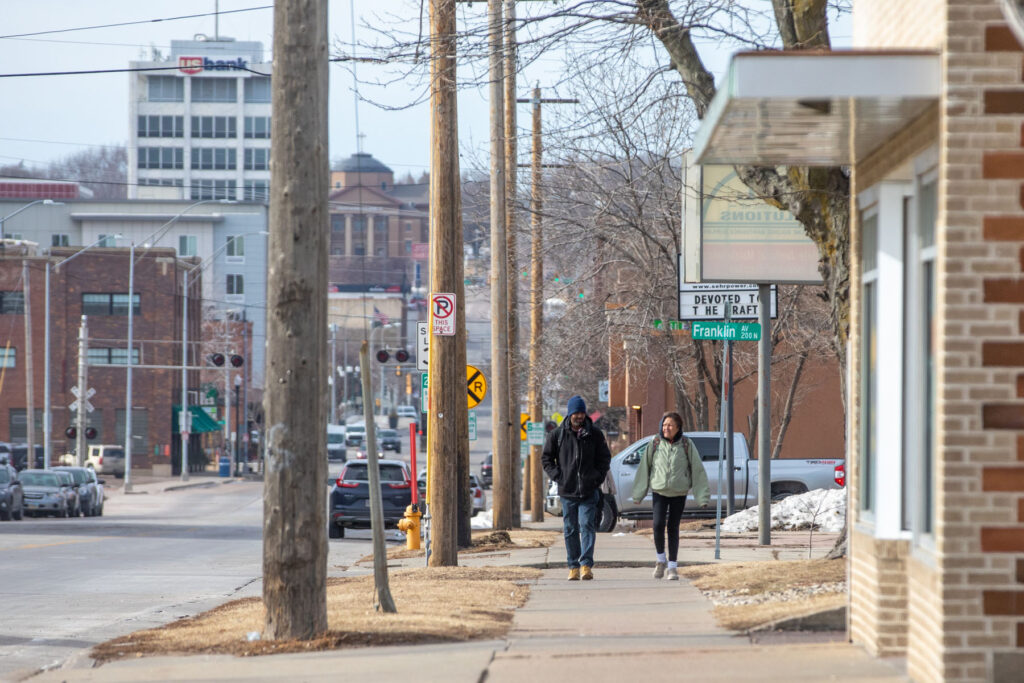
The line has been there for generations, but it grows thinner with each new riverside complex or renovation project, making space for the condos, offices and cocktail lounges that signal vibrancy.
In this regard, Sioux Falls is no different from most Midwestern cities, able to maintain an acceptable balance between opportunity and safety net. But last year, Sioux Falls surpassed 200,000 residents, adding about 7,000 people and fresh strain on the net. An additional 75,000 live in the four counties that make up the metropolitan area, which is 21 percent larger than 10 years ago.
There is an innate, inevitable contradiction in economic growth. A downtown reflects the overall health of a city. But it means a parallel increase in need. Perhaps then, as the growth accelerates, a city’s well-being is reflected not in the statement of intention but in the presence of action.
*****
Most problems of this nature don’t go away.
That was the reality in 2006, when neighborhood activists, law enforcement and city planning began to clean up the Pettigrew Neighborhood, roughly between 10th and 14th streets west of Minnesota Avenue.
The number of calls for mainly low-level incidents had steadily increased, there was visible loitering and vagrancy near aging storefronts, eventually escalating to violence and gunfire.
The revitalization of Pettigrew was largely successful.
“The call volume has decreased in Pettigrew Heights throughout the last couple years,” Police Chief Jon Thum said. “It’s noticeable. There are still issues. It was once the epicenter of alcohol-related issues, but volume has decreased. We have work to do, but there’s definitely been a decrease.”
Then, a few dozen people began congregating in Van Eps Park, no more than a patch of grass and picnic tables, near Seventh Street and Minnesota Avenue. A bit of attention and the construction of the City Center, a major office building for municipal government, took care of that.
But problems don’t go away without solutions.
In 2006, The Banquet, a ministry to prepare meals for the hungry, opened a new location on East Eighth Street, not far from the Union Gospel Mission, an overnight homeless shelter with roots in the earliest days of Sioux Falls.

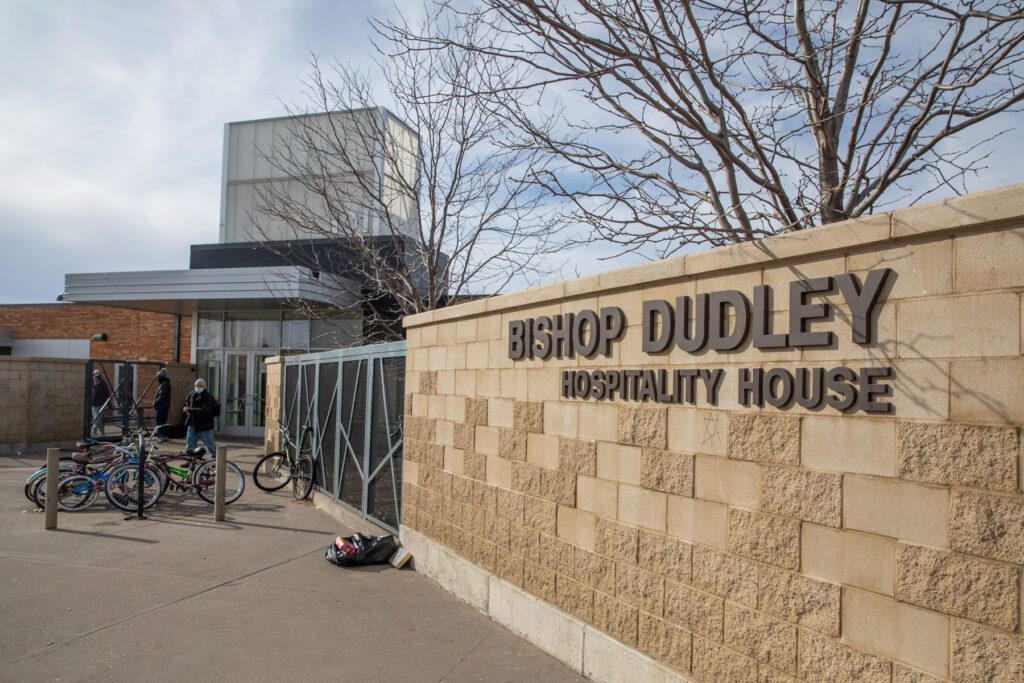
Then in 2015, following a bitterly cold winter that overwhelmed services for the homeless, the Catholic Diocese of Eastern South Dakota opened the Bishop Dudley Hospitality House at Eighth Street and Indiana Avenue, across the street from The Banquet.
The community rose to meet the need, providing privately funded solutions to a social problem.
“With The Banquet, Bishop Dudley House, Union Gospel Mission, all of it clustered, it provides a certain concentration of people,” Thum said. “Statistically, the more people, the more issues we’re going to have. A big portion of that population struggles with mental health and addiction.”
*****
The Bishop Dudley Hospitality House illustrates the strained social safety net.
The shelter was built with space for 80 men, 20 women and seven family rooms. The population fluctuates, but it’s not unusual to have 170 or 180 people spending the night.
It’s not just the numbers.
The Bishop Dudley House’s mission is to provide temporary shelter — for two weeks to 30 days. Instead, it has become the last resort for people with nowhere else to go or no way to get home, a solution for other services and institutions who don’t have the means or capacity to keep people any longer.
“We are so far from our mission,” executive director Madeline Shields said.
Shields ticks off one crushing example of desperation after another.
The double-amputee in a wheelchair, dropped off in the parking lot by the rehabilitation center that could no longer care for him.
The middle-aged man and his elderly mother who couldn’t get back to their home in a small town in Minnesota after medical treatment.
The Iraq and Afghanistan war veteran who has been living there since 2019 because the Department of Veterans Affairs can’t help her.
The gunshot victim airlifted to Sioux Falls from Rapid City and sent via Lyft after his discharge from the hospital.
“We are up against a monumental challenge here,” Shields said.
Things were tough enough before COVID-19. The pandemic altered the entire idea of communal living. Just because there’s a virus floating around doesn’t mean people don’t need help. Just the opposite. Yet the Bishop Dudley House didn’t turn away anybody and made it through with only isolated infections of residents.
“We never shut our doors,” she said. “Not one day, and we took everyone who came to us.”
Bishop Paul Dudley was a tireless advocate for the poor. He led the Catholic Diocese of Eastern South Dakota from 1978 until his retirement in 1995. Dudley, who died in 2006, is not only the namesake of the facility — his spirit permeates what they do, Shields said.
“It’s every single day trying to help the human being standing in front of you,” she said. “When we are called to serve, we are going to serve. What’s the alternative?”
*****
Rich Merkouris sees problems up close.
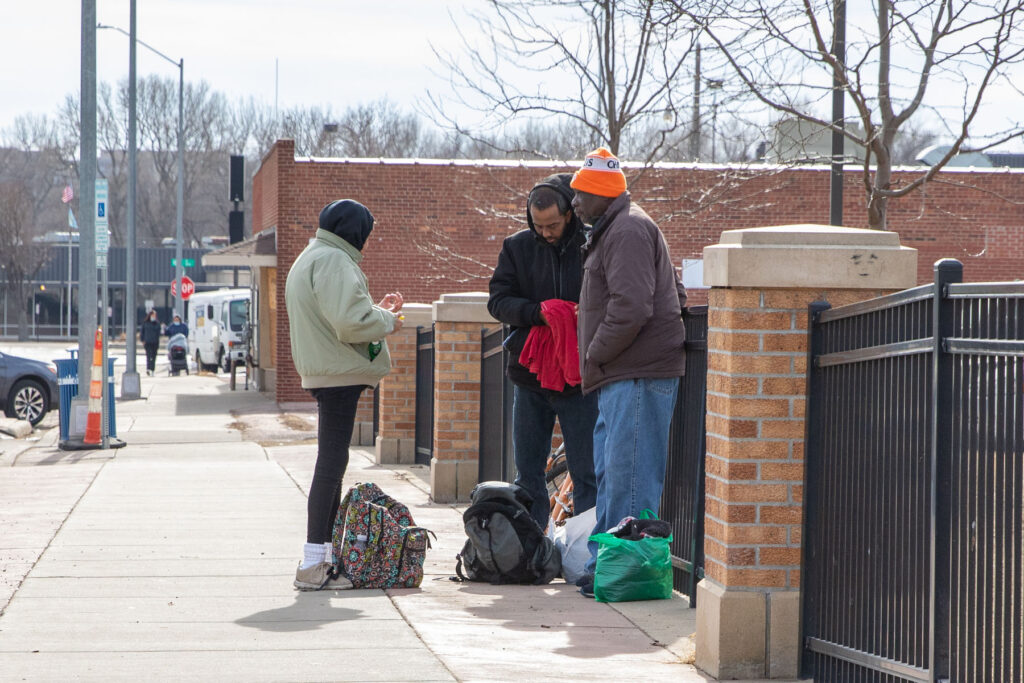
A couple of times a week, the pastor of King of Glory Church walks the streets of the Whittier Neighborhood that surrounds the social service cluster on East Eighth Street. When the people on the streets ask for money, he offers a bottle of water, a granola bar and an open heart.
It’s part of the ministry of his church to help individual people. The congregation backed two public outreach campaigns to help those in trouble, suffering or just in need of some support. “You Are Amazing” and “Notice the One” distributed more than $60,000 in gift cards and cash.

On his “care walks” through Whittier, Merkouris has noticed a shift.
“One of the things I’m seeing is a sizable uptick in a little bit rougher behavior in the interactions,” he said. “I’ve never felt unsafe, but in the last 18 months there have been some moments of discomfort.”
That’s included people pressing harder for cash and continuing to walk alongside him asking for money.
And he sees the line between the prosperous downtown and the much-needed social services blurring.
“All of a sudden, you have an apartment that’s 1,600 bucks a month next to a homeless shelter that’s two blocks away,” he said. “We are running into a situation where there isn’t transition between the high-end and social services. Sometimes, that brings challenges.”
Redevelopment will continue marching toward Cliff Avenue. It’s time for a conversation about what to do, including how to serve people with transitional housing challenges versus the chronic homeless. It needs to include the future of the aging Whittier Middle School. And how to pay for it all.
Merkouris knows there is controversy in ideas, such the “Housing First” movement, which says that paying to house the chronic homeless is a better than paying for the consequences.
And how about rolling in the cost of social services with development? For instance, when developers are given tax increment financing or other incentives, should that come with a responsibility to contribute in some way to supporting the people who already live there?
Those aren’t easy conversations, Merkouris said.
“We’ve got an interesting situation on our hands.”
*****
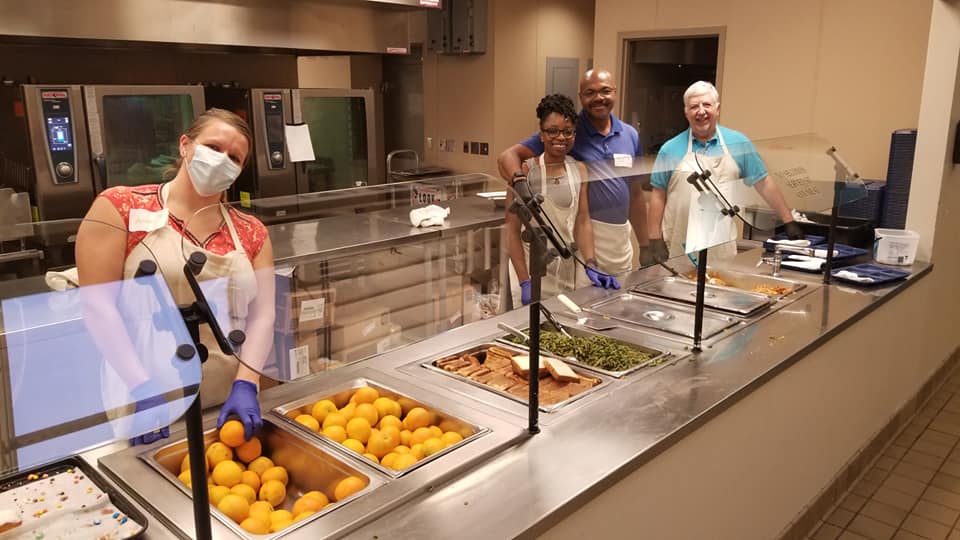
The Banquet serves dinner to more than 200 guests and breakfast to nearly that many at the downtown location every Monday through Friday. Lunch is available Saturdays.
The ministry also serves dinner at the west-side location on Marion Road.
There are 16 serving times a week that in 2020 totaled more than 200,000 meals, of which more than 25,000 were for children younger than 12.
During the pandemic, The Banquet shifted to serving food in takeout containers to avoid having people shoulder-to-shoulder in the dining room. That led to issues with trash.
The staff works hard to maintain a good relationship with the neighborhood, executive director Tamera Jerke-Liesinger said. She fielded calls from neighbors about the containers being left in their yards.
“I had a group of volunteers and staff, and we went out a minimum of once a day, and we walked the perimeter from French to Weber avenues and Sixth to Eighth streets and picked up our containers and any other trash we found,” she said. “It’s something we consistently do. We put on Banquet vests, and that’s part of what we do.”
She and her staff have made a concerted effort to stay involved with Downtown Sioux Falls Inc., the umbrella organization that promotes downtown, as well as the Eighth Street Corridor Committee.
“When they bring something to our attention, we will do everything in our power to address it,” she said.
Jerke-Liesinger knows that seeing homeless people on the streets or others lingering in nearby parks creates an impression that The Banquet or other agencies cause a congregation of problems.
At the same time, all meals at The Banquet are served by volunteers. That helps ease whatever negative impression develops because there are 70 to 100 people at any given time seeing the humanity of it all up close.
“It’s very eye-opening,” she said. “Maybe what you’re seeing on the corner or in the park, maybe that isn’t the whole story.”
*****
Problems end up on the mayor’s desk.
After nearly four years on the job, Mayor Paul TenHaken knows that.
In this instance, the issue that Sioux Falls faces is not unfamiliar. It plays out from Minneapolis to Austin to Seattle.
“Any community that gets to be our size around the country deals with this topic and this issue,” TenHaken said.
The East Eighth Street corridor probably has hit its capacity for social services, he said. That doesn’t mean those services won’t expand. They most certainly will. But it’s a matter of where and how.
“There’s no good way to say this, but we are a nice community to be homeless in,” he said. By that, he means that our social service agencies such as The Banquet and Bishop Dudley Hospitality House are strong, well-run organizations. The churches in Sioux Falls are financially stable. The people are generous.
It’s never easy, but there are options for people struggling with mental health or addiction.
“We have a lot of resources for people who are experiencing these chronic issues,” he said.
The most recent addition is The Link, a triage facility for people with mental health and substance abuse challenges.
The Link is a cooperative effort between the city of Sioux Falls, Minnehaha County, Avera Health and Sanford Health. It developed from the reality that it’s better to help people than have them end up in the emergency room or jail, which doesn’t solve the problem and costs the community more money.
Since opening in June, The Link has done more than 3,000 triages, TenHaken said.
“It’s fortuitous that we opened when we did,” he said.
TenHaken said he’s proud of the work The Link is doing. He points to an example of a man who had checked in 58 times. “On the 59th visit, he said, ‘This is enough. I need to change my life,’ and went to rehab.”

To his point, The Link is in a city building at 132 N. Dakota Ave. It’s downtown, but it’s on the west side of the Big Sioux River, several blocks from the East Eighth Street corridor.
Diffusion needs to be explored going forward, TenHaken said.
For instance, the Bishop Dudley House serves families. To the mayor, it makes sense to separate families from the rest of the population.
“I don’t think that’s a great environment for kids to be in anyway for a lot of different reasons,” he said. It’s a possibility that he has brought up in conversations with the Bishop Dudley House. It’s a small element of the issue, but it’s the kind of thing that needs to be addressed going forward.
“I wish I had a magic wand to solve it.”
*****
What exactly is the problem?
Part of it is just optics. There are people standing on street corners, holding cardboard signs, asking for money.
That’s not restricted to the East Eighth Street corridor. Panhandling has grown across the city, particularly at freeway interchanges and busy intersections. In fact, they aren’t the same people who show up at the Bishop Dudley House or The Banquet or any of the myriad agencies on the ground helping people.

Panhandling is a different problem.
It’s a hard thing to say, but that problem isn’t the panhandler, it’s us. We’re a generous community.
It’s hard to generalize, but there are panhandlers in the city, social service experts say, who take in enough money in a day that they can get a hotel room or other accommodations. They don’t need a homeless shelter or a soup kitchen.
No, the problem when it comes to chronic homelessness, alcohol addiction and substance abuse is one of community mindset.
It’s a struggle between emotion and pragmatism.
Social philosophy and economic reality.
*****
The common thread in the discussion about the growing need for social services in Sioux Falls and where they should go, goes back to the concept that launched the Safe Home.
The Safe Home is 33 units of permanent housing for chronically homeless people with severe alcohol dependence. It’s across the street from the headquarters of the Sioux Falls Police Department on Third Street.
It was developed by Minnehaha County under the Housing First model to reduce the costs of serving the chronically homeless through detox, emergency rooms, police and jails.
If it works for this group of homeless, can’t it also work for veterans, those with mental illness, substance abusers and felons?
Can we deal with the actual problem rather than the result?
“We know with addiction and mental health it’s not an easy issue to solve, and we as law enforcement can’t solve it,” said Chief Thum. “We just deal with the symptoms.”
“Homelessness is never going to go away,” said Shields of the Bishop Dudley House. “When you put a roof over someone’s head, everybody’s costs go down.”
Mayor TenHaken agrees that Safe Home has been a success. There are examples of residents getting their addiction under control and moving on, and there are people who have been there since it opened. But the overall goal of reducing costs has worked.
The question is how far can you go?
Start discussing a Safe Home for addicts or felons, and there will be a lot of resistance.
“I won’t say no, but I will say that’s a pretty liberal concept for Sioux Falls to understand and digest,” TenHaken said. “No one is jumping at the idea of opening an addiction house in Sioux Falls.”
Still, TenHaken said he’s watching the work of other cities with an open mind. The pragmatic reality is that the Housing First model is proven to save money. There’s a balance between that and what a community is willing to accept.
“I’m not close-minded to it,” TenHaken said, while adding he’s not inclined “to be the trailblazer.”
The city of Sioux Falls – the social services, the government, the citizens – isn’t going to solve substance abuse, alcoholism, mental illness, poverty or any of the factors that bring a human being to East Eighth Street.
But we have goals and aspirations for our downtown. It’s the gathering place for who we are, our community pride and ambition.
There’s no indication that people will stop coming here. As the mayor says, they aren’t all doctors, pharmacists and lawyers. Still, they are all citizens.
Problems don’t go away.
But we can change how we deal with them.
Share This Story
Most Recent
Videos



Looking amazing @dtsiouxfalls and @washpav! Thanks to @jpickthorn for capturing an incredible night.
Nov 26

Enjoy this glow headed into Halloween week! 📸: @jpickthorn
Oct 31
Hope you had a wonderful summer weekend and are recharged for the week ahead! 📸: @jpickthorn
Jun 27
Beautiful way to start a week! 📸: @jpickthorn
Jan 10
Favorite flyover of the year! Merry Christmas from our entire @pigeon605news flock. 🎄🐦 📸: @actsofnaturephotography
Dec 24
They definitely deserve to be treated like holiday royalty and they were! ❤️ these scenes from tonight’s lighting celebration at @sanfordhealth Children’s Hospital. 🎄
Dec 1
The holidays are here! Perfect night @dtsiouxfalls
Nov 27
Happy Halloween from @avera_health NICU babies! Link in bio to see more! 🎃
Oct 31
Did you know @dtsiouxfalls is filled with 👻 stories? Link in bio … if you dare 😱
Oct 8
When it comes to kids parties nobody wants to be cookie-cutter. Link in bio for the story on what’s trending.
Sep 28
Want to stay connected to where you live with more stories like this?
Adopt a free virtual “pigeon” to deliver news that will matter to you.





Are you a little bird with something to share?

Delivering news that matters to you
Years ago, homing pigeons were used to bring us news we needed. Today, your virtual “pigeon” will deliver what you want to know about the place you call home.
All pigeons are free to good homes!
Our Partners