
Sioux Falls launched a grocery store on wheels. Here’s who’s shopping there
By Steve Young, for Pigeon605
In another day, another time, Mildred would have walked a block or two down the street to the neighborhood grocery store to purchase her bread, her milk and whatever else she needed.
So roughly four months ago, when the Eat Well Sioux Falls Mobile Market trailer began to appear weekly just a few doors down from where she lives, suddenly the echoes of those bygone days reverberated in 94-year-old Mildred’s life again.
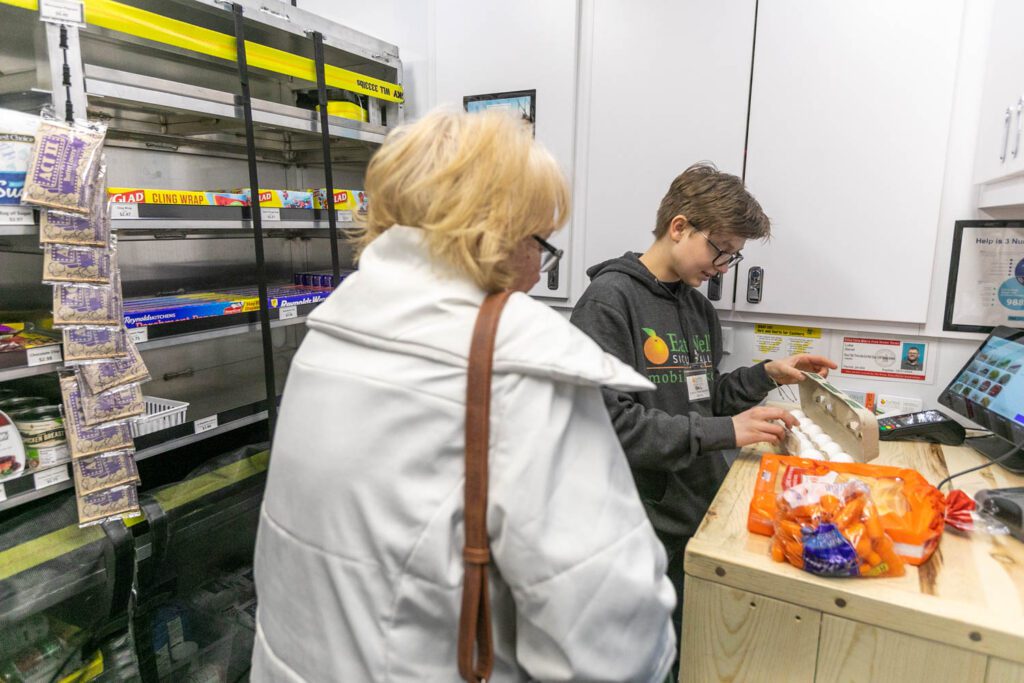
Leaning on her cane and carrying a grocery sack, she could wander the short distance from her north Sioux Falls home, purchase a few food items and just maybe get something more, said Michelle Erpenbach, president of Sioux Falls Thrive, of which the mobile market is an initiative.
“It was almost like keeping her out of assisted living,” Erpenbach said. “It’s one more option for helping folks stay independent and live their lives in ways they choose to live them.”
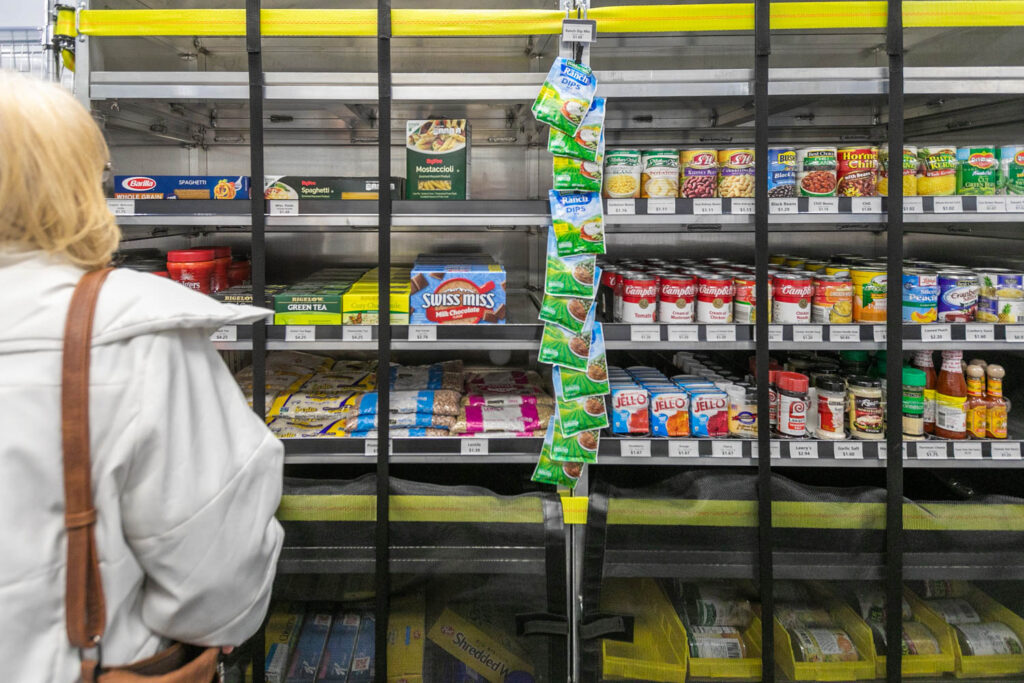
Mildred’s story is one win among many in the first months of this grand exercise to bring a mobile shopping oasis into the city’s food deserts ─ neighborhoods that are at least a mile from the nearest grocery store and populated with folks who don’t always have easy access to transportation.
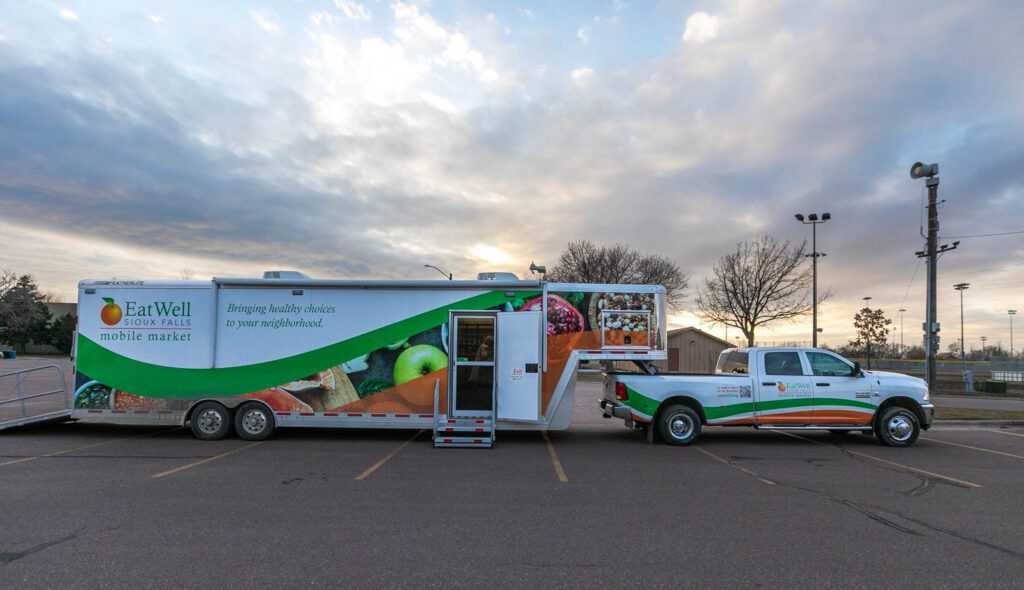
In a community where as many as 24,000 residents fit that geographic reality, Eat Well’s mobile trailer now stops weekly near the Great Plains Zoo, Active Generations on West 46th Street, Falls Community Health downtown and five other sites around the city to ensure that low-income residents in low-access neighborhoods have reliable, healthy, affordable grocery options.
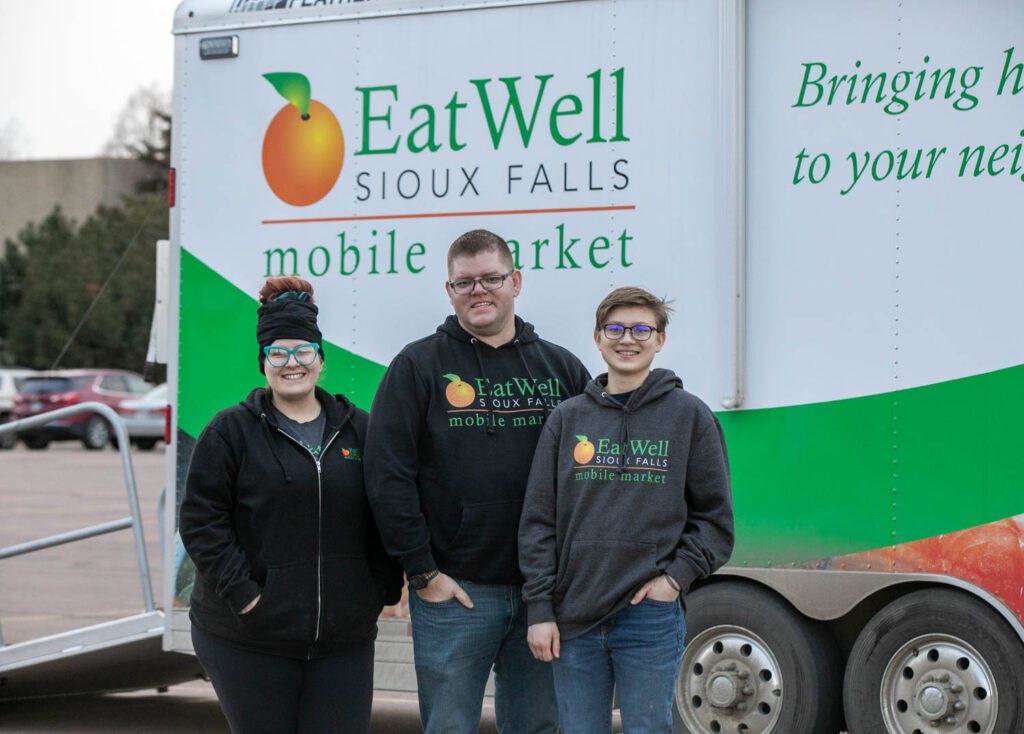
At most of those eight sites, Eat Well is seeing success, said Luke Senst, manager of the mobile market. But not all of them. Three of the stops in particular up in the northern part of the city ─ at the Habitat for Humanity ReStore, the Word of Life Church and the Furniture Mission Warehouse ─ didn’t quite catch fire, he and Erpenbach said. And so, the Furniture Mission Warehouse and Word of Life Church stops have been discontinued while others have been added.
Part of the issue up there likely is related to a new Kwik Star business in the area that offers food options for nearby residents, Senst said.
“That actually filled some of the gap we saw up there,” which is fine, he said. “We want to not be needed in neighborhoods because that means people are getting their food elsewhere.”
Erpenbach said the success of Sioux Falls Thrive’s Kid Link project in the Laura B. Anderson Elementary attendance area, including a successful after-school program, probably also impacted the Eat Well usage numbers in north Sioux Falls.
“Building relationships is key for the mobile market, and we’ve learned that we can do it based on the relationships we start with kids,” she said. “I spent a day with Luke on the truck, and we followed a school bus into that neighborhood, and there were, like, five kids on it. That’s the day I went, ‘Oh man, this is what it is, why we’re not seeing the numbers. It’s partly because of the success of other things we’ve promoted.’”
Numbers, of course, are one measure of success for the Eat Well project, which was launched with a $250,000 federal grant funneled through the city Health Department. Eat Well submits every bill it generates to the Health Department for review and reimbursement through the grant, Erpenbach said. Along with numbers served, grant managers also want to know such things as how the mobile market is helping to improve health outcomes in areas it serves, she said.
That’s an assessment Eat Well officials want to start formulating once the weather improves.
“It’s like, can we tag five to 10 people on, say, March 1 of 2024, and six months later, here’s what they’re saying about their general health and their accessibility to healthy foods,” Erpenbach said.

Though the tweaking of the three north Sioux Falls sites brought the mobile market’s visits to that part of town down to one stop, Erpenbach and Senst insist they will not abandon those neighborhoods.
“We hope that folks understand that that’s how it works when you’re starting out with something like this,” Erpenbach said. “These folks, especially with Thrive and Kid Link, are our friends and neighbors, so we won’t abandon them. But the grant requires that we figure out how to make it a sustainable business model. We’re going to do what we need to do.”
What Eat Well hopes to do, what it has projected from the start, is to reach a break-even point around 18 months into the project. Right now, it is serving the eight sites on Tuesdays, Wednesdays and Thursdays. The goal is to add three new stops monthly until it is visiting 17 sites over five to six days of operation each week.
Senst said they’re looking to replicate the early successes they’re seeing at places like near Active Generations or at Falls Community Health. There is a lot of housing near Active Generations that serves an older population with limited access to transportation.
“That’s actually one of our busier sites,” he said. “They come in, buy what they need, get some good, fresh veggies or canned goods, and it saves them having to figure out how to get to one of the bigger box stores that are a little farther away.”

In these first few months, customers initially have skewed to an older demographic – folks, Erpenbach said, who truly understand value. But places like The Banquet West, where people come for the free meal and then can purchase groceries at the nearby mobile market afterward, tend to be drawing a younger crowd, she and Senst agree.
“As that sort of ripple effect happens, we’ll get more and more younger families,” Erpenbach said. “Again, that’s part of that testing and timing and whatnot that goes into what we’re trying to accomplish.”
One of Eat Well’s newer stops is near Southeast Technical College. While that site is just a block outside of a food desert, mobile market staff members know that, like the site at Active Generations, it serves a lot of people who come from food deserts. So Southeast fills two components, Erpenbach said – a captive audience that often comes from food deserts and a busy street with the potential of drawing a lot of traffic.
One of the disconnects Eat Well has to overcome is a belief among people passing by the mobile market that they’re not poor enough to shop there, Senst said.
“Everyone can shop here, from the mayor to someone who’s living very much in poverty,” he said. “People need to understand, if they shop in the mobile market, it’s not going to take away food from somebody else. We can get more food.”
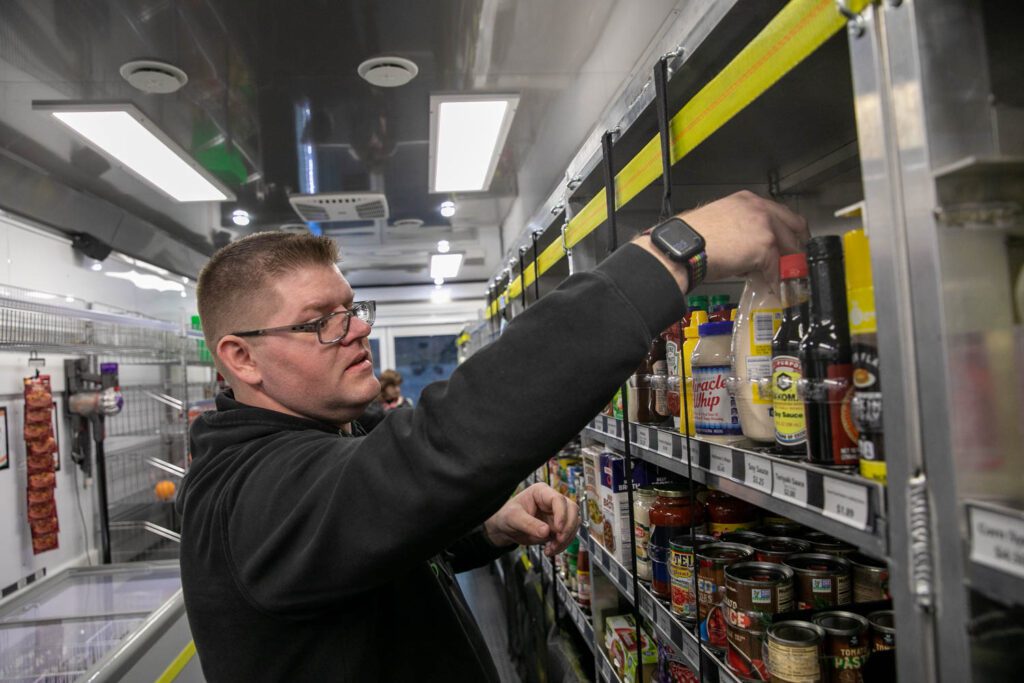
And it’s good, quality food, he added. Good, fresh vegetables. Good meat. Fresh Prairie Farms milk. All the staples such as eggs, soup, canned beans, pasta, butter, Breadsmith bread, rice and so forth. What people buy at the mobile market would be the same items they get at a big-box grocery store, Senst said. They’re just able to offer it at less expense.
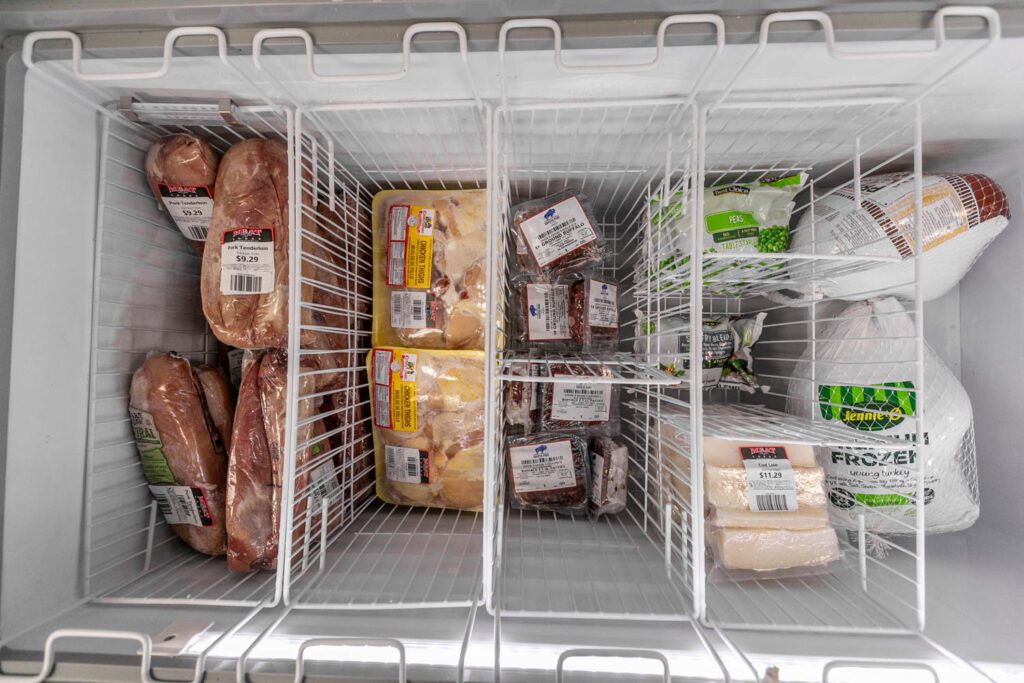
“Because they are the same items, we can maintain dignity for people too,” he said. “For us, we want to make sure there is that dignity part where you can come in and shop, take it home, put it in your cabinets, and nobody knows the difference. Your kids’ friends might come over, and they can’t tell that you went someplace that might be a little bit cheaper.”
At this point, Eat Well is not accepting cash for grocery purchases. It takes credit cards, Apple Pay, Google Pay “and all the pays,” Senst said. It takes Supplemental Nutrition Assistance Program, or SNAP, benefits and is working on a day when it might be able to accept Women, Infants and Children, or WIC, benefits as well.
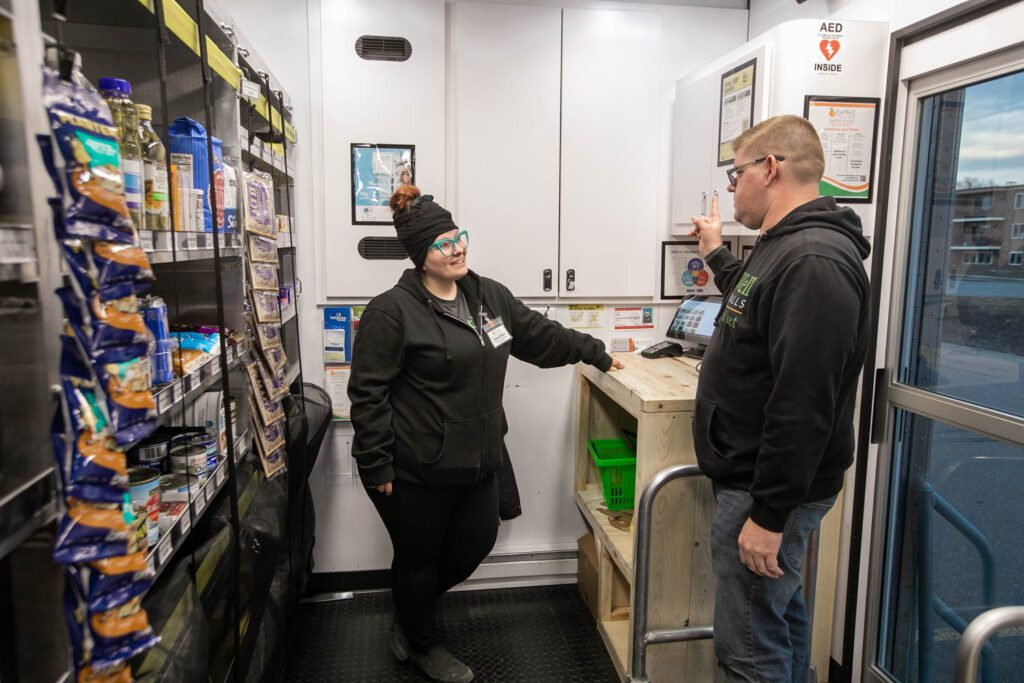
The program accepts donations and sponsorships, with information about both available at [email protected]. The mobile market has been fortunate these first few months in that organizations like Rotary West and The Breaks Coffee Roasting Co., for example, have donated funds so the mobile market can sell goods at a 10 percent discount some weeks.
The other big need they have is simply spreading the word of the mobile market’s presence in the community, Erpenbach and Senst said. It could be that, if neighborhoods host block parties, Eat Well can show up to be part of that, Senst said. Another idea they have pursued is a chili cook-off at Ben Reifel Middle School, where all the ingredients are purchased at the mobile market.
“Ben Reifel’s attendance area bumps up to and crosses over the lines into food deserts that are in the grant application,” Erpenbach said. “So we need to be creative. We see the chili cook-off as being part of that creativity.”
In the weeks and months ahead, more areas of need will be explored and the site numbers expanded, she added. The mobile market has started stopping near Tre Ministries on West 11th Street and has just begun showing up at Giving Hope Bingo on West Burnside Street on Thursday afternoons. It’s looking at areas near the Pettigrew Heights neighborhood as well and elsewhere.
Ultimately, what the mobile market brings to the community is another answer for solving hunger, Erpenbach and Senst said. On a continuum that runs the gamut from Feeding South Dakota, the Faith Temple Food Giveaway and The Banquet, all the way along the chain from the missions, the Fair Market stores and Eat Well serving the food deserts and on to the big-box stores like Walmart and Hy-Vee, Sioux Falls should not be going hungry, they said.

If the success of Eat Well and Fair Market means Faith Temple starts giving away less than 1,100 to 1,200 boxes of food at the W.H. Lyon Fairgrounds each Friday, so be it, said the Rev. Jeff Hayes, who oversees the Faith Temple effort. His son, Josh, has created a website, siouxfallshunger.com, that tells where food resources are available each day.
“I tell people, ‘We want to go out of business,’” Hayes said. “We’re hoping that people are able obtain and locate food so they’re not desperately trying to find it.”
Kristin Johnson, the executive director overseeing the two Fair Market stores, sits on Eat Well’s advisory board. Her stores sell discounted grocery and non-grocery items that are near-dated, post-dated, discontinued and salvaged at prices approximately 50 percent of other stores. While people maybe can’t get all the staples at Fair Market that they can at the mobile market, she said, they can stretch their grocery dollars even more with the good deals Fair Market can offer.
That makes Fair Market and Eat Well more complementary of each other, she believes, than competitors.
“The whole mobile idea lets them get to where the food is needed most,” Johnson said. “In the end, really, if somebody eats, whether because of Fair Market or Eat Well or The Banquet or whatever, everybody wins.”
Share This Story
Most Recent
Videos



Looking amazing @dtsiouxfalls and @washpav! Thanks to @jpickthorn for capturing an incredible night.
Nov 26

Enjoy this glow headed into Halloween week! 📸: @jpickthorn
Oct 31
Hope you had a wonderful summer weekend and are recharged for the week ahead! 📸: @jpickthorn
Jun 27
Beautiful way to start a week! 📸: @jpickthorn
Jan 10
Favorite flyover of the year! Merry Christmas from our entire @pigeon605news flock. 🎄🐦 📸: @actsofnaturephotography
Dec 24
They definitely deserve to be treated like holiday royalty and they were! ❤️ these scenes from tonight’s lighting celebration at @sanfordhealth Children’s Hospital. 🎄
Dec 1
The holidays are here! Perfect night @dtsiouxfalls
Nov 27
Happy Halloween from @avera_health NICU babies! Link in bio to see more! 🎃
Oct 31
Did you know @dtsiouxfalls is filled with 👻 stories? Link in bio … if you dare 😱
Oct 8
When it comes to kids parties nobody wants to be cookie-cutter. Link in bio for the story on what’s trending.
Sep 28
Want to stay connected to where you live with more stories like this?
Adopt a free virtual “pigeon” to deliver news that will matter to you.





Are you a little bird with something to share?

Delivering news that matters to you
Years ago, homing pigeons were used to bring us news we needed. Today, your virtual “pigeon” will deliver what you want to know about the place you call home.
All pigeons are free to good homes!
Our Partners