‘When people hear the drums, they come together’
This piece is sponsored by LSS.
Swinging open the doors of The Coliseum on a Sunday afternoon, you encounter a sound unlike any other in Sioux Falls: hypnotic chants, thunderous booms, the snaps and cracks of wood against wood. Seven members of the Royal Drumming group Abatimbo move in sync, pounding handmade instruments from their native Burundi.
Their play feels spontaneous. They jump and twirl with joy and intention, responding to one another’s beats. Their rhythm reflects the hours they’ve spent practicing in the historic gymnasium since November.
“Royal drums are a significant symbol for the Burundian community,” explained Reuben Niyubahwe, the group’s founder. “They’ve been a strong cultural tradition from the past until now. When people hear the drums, they come together.”
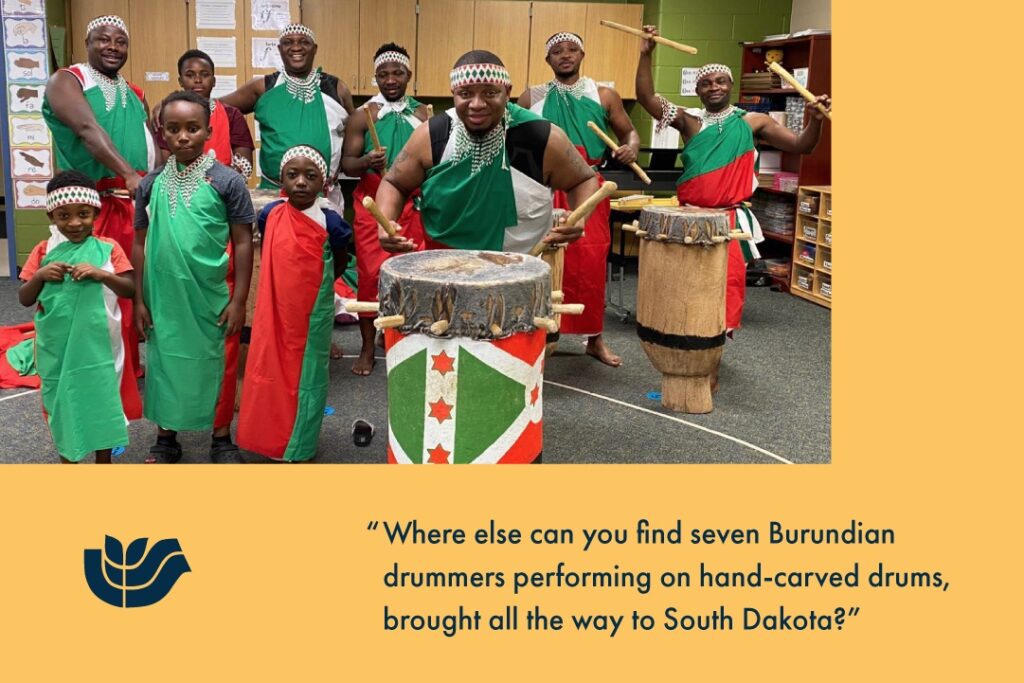
Niyubahwe’s desire to connect his children — and the wider community — to an intangible piece of his heritage spurred a partnership with the LSS Multi-Cultural Center: a program focused on making space for a wide variety of community-based, cultural or educational events in Sioux Falls.
“Every month, there’s something — different cultural or educational gatherings,” said Valeria Wicker of the Multi-Cultural Center.
Just this year, the Multi-Cultural Center has hosted Diwali with the Hindu Temple of Siouxland, the Ethiopian Orthodox Festival and a commemoration of the Rwandan genocide.
Niyubahwe’s group is one of many participating in a pilot program through the Multi-Cultural Center that gives cultural leaders and organizations regular access to space in The Coliseum for meetings or rehearsals.
“We’re now refining the process to be more of a partnership,” Wicker said. “We consider Reuben and his team a partner because they’re doing something on an ongoing basis that furthers our mission.”
Like Niyubahwe, many of Abatimbo’s members have lived in Sioux Falls since 2008.
“We felt like we were missing a part of our original place,” Niyubahwe explained. “Last year, we were finally able to bring our traditional drums here.”
Traditional Burundi drums are carved from a single, hollowed-out trunk of the Cordia africana — a flowering tree that grows only in Burundi. Dried calfskin is then stretched over the top to create the drumming surface, and the tension is tested for tone and pitch.
The unique quality and construction of the drums are key to their cultural significance. Niyubahwe spent more than four months coordinating approval before getting the drums shipped — first by taxi, then by plane.
Once they arrived, he worked with LSS to formalize the group and organize space for the seven men and their 50-pound drums to practice.
“They felt like it was a very good thing we were bringing, and so they helped find a place for us, and now we’re moving forward.”
It was something of a full-circle moment for Niyubahwe.
Born and raised in a Tanzanian refugee camp, Niyubahwe first came to Sioux Falls when he was 20 years old. His family, along with many of the 300 Burundian families here, belong to the “1972 Burundians” — those who fled an ethnic genocide that resulted in the deaths of an estimated 200,000 people.
“I’ve never even been to Burundi. I don’t know what it looked like. But we stay together as a family, and we keep in mind the memories of where we came from.”
Upon his arrival in the U.S., Niyubahwe was connected to the LSS Center for New Americans, which supports refugees and immigrants as they begin new lives in South Dakota.
“When you come from overseas, you don’t know the area or the systems. They helped me feel comfortable in the community.”
LSS gave Niyubahwe an orientation to life in the U.S., helping him find work and housing, supporting his basic needs and being a source of stability during his transition.
“They kept following up with me, asking how I was doing in the community. They showed me how to get to the hospital, where to get food. They were like my family here in the U.S.”
Almost two decades later, Niyubahwe has a wife and kids, a stable career as a machine operator and — through Abatimbo — has become a community leader, carrying forward a rich cultural and artistic practice bringing texture, energy and life to Sioux Falls.
“They’re a great example of cultural engagement,” Wicker said. “Where else can you find seven Burundian drummers performing on handcarved drums brought all the way to South Dakota?”
Learn more about how the LSS Multi-Cultural Center is celebrating culture and strengthening community in Sioux Falls.
See Abatimbo perform at the 2025 Festival of Cultures on Saturday, June 14, at the Levitt Shell in downtown Sioux Falls. The 28th annual festival is held in partnership between the LSS Multi-Cultural Center and Levitt at the Falls and presented by First PREMIER Bank/PREMIER Bankcard. Enjoy vibrant live music, local vendor booths, food trucks, fun kids’ activities and more at this free event open to the entire community.
Share This Story
Most Recent
Videos

Looking amazing @dtsiouxfalls and @washpav! Thanks to @jpickthorn for capturing an incredible night.
Nov 26

Enjoy this glow headed into Halloween week! 📸: @jpickthorn
Oct 31
Hope you had a wonderful summer weekend and are recharged for the week ahead! 📸: @jpickthorn
Jun 27
Beautiful way to start a week! 📸: @jpickthorn
Jan 10
Favorite flyover of the year! Merry Christmas from our entire @pigeon605news flock. 🎄🐦 📸: @actsofnaturephotography
Dec 24
They definitely deserve to be treated like holiday royalty and they were! ❤️ these scenes from tonight’s lighting celebration at @sanfordhealth Children’s Hospital. 🎄
Dec 1
The holidays are here! Perfect night @dtsiouxfalls
Nov 27
Happy Halloween from @avera_health NICU babies! Link in bio to see more! 🎃
Oct 31
Did you know @dtsiouxfalls is filled with 👻 stories? Link in bio … if you dare 😱
Oct 8
When it comes to kids parties nobody wants to be cookie-cutter. Link in bio for the story on what’s trending.
Sep 28
Want to stay connected to where you live with more stories like this?
Adopt a free virtual “pigeon” to deliver news that will matter to you.



Are you a little bird with something to share?
Delivering news that matters to you
Years ago, homing pigeons were used to bring us news we needed. Today, your virtual “pigeon” will deliver what you want to know about the place you call home.
All pigeons are free to good homes!
Our Partners