
Tips from a local banker: How to teach your kids good savings habits early
This paid piece is sponsored by The First National Bank in Sioux Falls.
On the “Common Cents on the Prairie”™ podcast episode “Raising Financially Successful Kids,” author Bobbi Rebell shared the mind-blowing statistic that 79 percent of parents are providing financial support to their adult children.
If you’re a parent of young kids and that little nugget of information scares you — well, it should.
But don’t worry! There’s still plenty of time for you to avoid that fate, and all you have to do is start teaching your kids about money and building good savings habits now.
Lucky for you, Jessica Ostwald — a personal banker at First National Bank’s Baltic branch — loves helping families build, teach and maintain good savings habits for their children.
“Teaching kids about saving at a young age sets the foundation for them to become financially responsible adults,” Ostwald said. “You should start as early as elementary school. Once your child has an understanding of addition and subtraction, they can begin putting those skills to use.”
Because Ostwald is so passionate about financial literacy for kids, she wanted to share some of her favorite tips and tricks for teaching kids good savings habits early.
Teach your child about wants and needs
The first step in building good saving habits is to teach your child about what they’re saving for and why they’re saving for it.
“Start by teaching them the difference between wants and needs,” Ostwald said, “and explain why we need to pay for our needs before we spend money on our wants.”
To help them understand this concept, try a practice shopping trip at home.
For example, you could set up a “store” in your house, create a shopping list and a budget with your child, and have them go shopping for necessities, like the food in your fridge or the shampoo in your bathroom, as well as their wants, like some of their favorite toys.
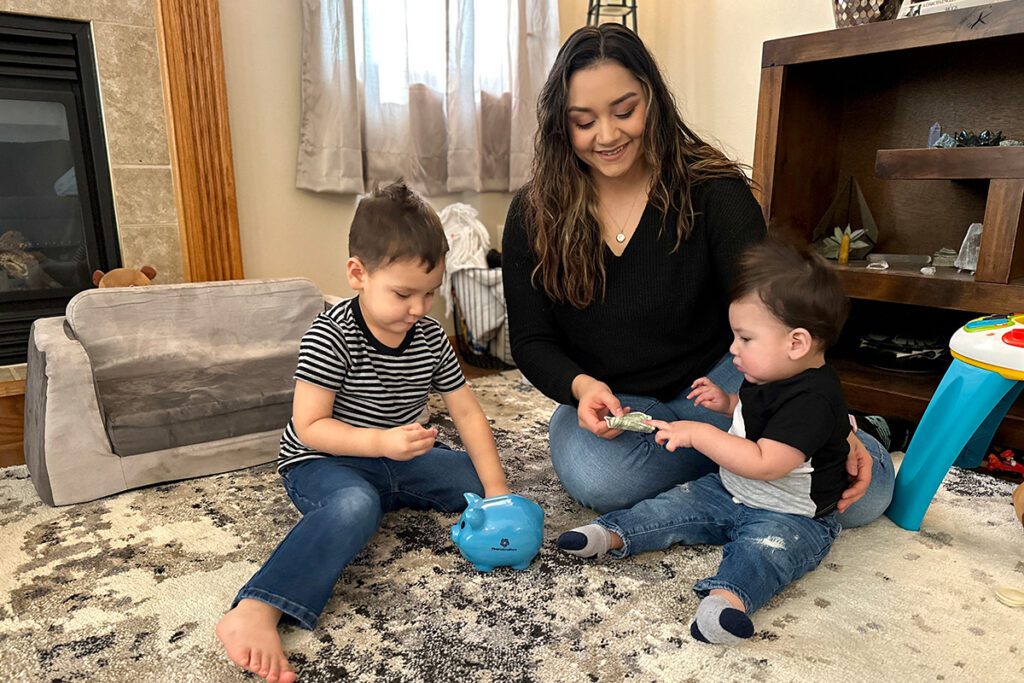
When they try to buy a Lego set instead of the gallon of milk on their list, that’s the perfect opportunity to explain the difference between wants and needs.
Let your child use cash
Whether it’s a fake shopping exercise at home or the real thing at Target, allow your child to become familiar with cash.
“Cash is tangible,” Ostwald said, “and kids can see how much they are spending and saving.”
When using cash, Ostwald recommends saving the coins and $1 bills so kids can watch how fast it grows.
Piggy banks are great for kids, but clear jars where they can see their progress also are effective tools.
Help your child create a savings plan
As your child’s money starts to grow, it’s time to take the next step: setting goals and creating their first savings plan.
Start by taking your child and their newfound savings to the bank once a month, quarterly or at the end of each year to make a deposit.
Meanwhile, help them to set goals for how much they should be depositing with each visit; these goals will stack up to create their savings plan.
“Depositing on a regular schedule helps when setting savings goals,” Ostwald said. “By achieving their goals at frequent intervals, kids will develop an understanding of how a savings plan works, and they can learn how to save for big purchases or those ‘wants’ we discussed.”
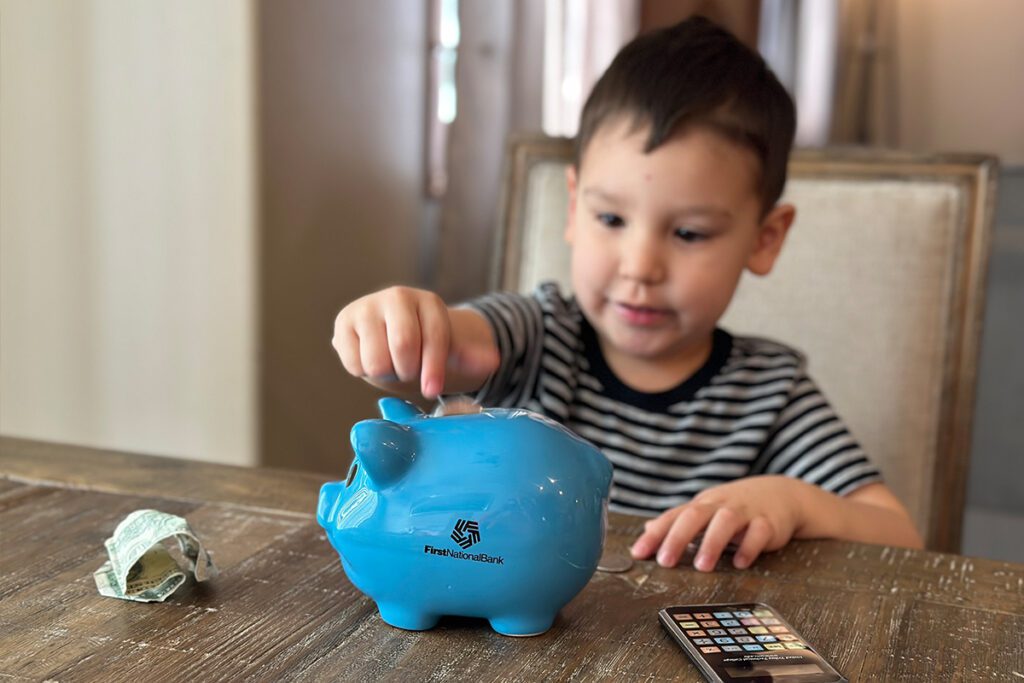
Open a savings account for your child as young as possible
Your child needs somewhere to deposit all that money they’ve become so adept at saving.
First National Bank has a great youth savings account program designed specifically to help your child become a super saver.
With the Learning to Fly Program, kids will earn a free birthday gift each year and have access to one of the bank’s experienced personal bankers, like Ostwald, to help them build good savings habits.
“Your child will receive statements to help keep track of their money,” Ostwald said, “and they can get a savings register to calculate earned interest and practice reconciling their account. Not only does this reinforce their math skills, but it also keeps saving top of mind.”
Additionally, your child will receive Savings Goal and Savings Tracker worksheets to help them practice these savings habits.
Give your child real-world experience
As your child gets older, you can start involving them in real-world savings activities. Ostwald has a couple of favorite ways to go about this.
The first is to involve your kids when grocery shopping, from creating the grocery list, to looking through ads for coupons and sale items, to making the shopping trip.
“This will teach your child how to stick to a list and budget,” Ostwald said. “They might have to decide what to put back when they find something they want that isn’t on the list.”
The second way to give your child real-world experience is to involve them in a family savings plan for a large expense such as a vacation.
“You can keep your child engaged by updating your progress often,” Ostwald said. “In the meantime, find opportunities to teach your child about emergency and unexpected expenses that might set your savings plan back.”
Offering your child this real-world experience early will give you the peace of mind that they can put their savings habits into practice in the future — and not have to rely on you for financial support as an adult.
If you’d like more information on teaching your child good savings habits, or if you’re ready to put them on the right track with a savings account, reach out to the experienced personal banking team at First National Bank!
Share This Story
Most Recent
Videos



Looking amazing @dtsiouxfalls and @washpav! Thanks to @jpickthorn for capturing an incredible night.
Nov 26

Enjoy this glow headed into Halloween week! 📸: @jpickthorn
Oct 31
Hope you had a wonderful summer weekend and are recharged for the week ahead! 📸: @jpickthorn
Jun 27
Beautiful way to start a week! 📸: @jpickthorn
Jan 10
Favorite flyover of the year! Merry Christmas from our entire @pigeon605news flock. 🎄🐦 📸: @actsofnaturephotography
Dec 24
They definitely deserve to be treated like holiday royalty and they were! ❤️ these scenes from tonight’s lighting celebration at @sanfordhealth Children’s Hospital. 🎄
Dec 1
The holidays are here! Perfect night @dtsiouxfalls
Nov 27
Happy Halloween from @avera_health NICU babies! Link in bio to see more! 🎃
Oct 31
Did you know @dtsiouxfalls is filled with 👻 stories? Link in bio … if you dare 😱
Oct 8
When it comes to kids parties nobody wants to be cookie-cutter. Link in bio for the story on what’s trending.
Sep 28
Want to stay connected to where you live with more stories like this?
Adopt a free virtual “pigeon” to deliver news that will matter to you.






Are you a little bird with something to share?
Delivering news that matters to you
Years ago, homing pigeons were used to bring us news we needed. Today, your virtual “pigeon” will deliver what you want to know about the place you call home.
All pigeons are free to good homes!
Our Partners