
Effort gains traction to restore grocery store to west-side neighborhood
Somewhere between Rice and 10th streets from Kiwanis to West avenues, Rich Merkouris hopes a building exists that will become the home of a new grocery store.
The idea is to find a space up to 10,000 square feet “that we could hopefully make into a real basic grocery, no bakery or food prepared on-site but there would produce, frozen, dry goods,” said Merkouris, president of Kingdom Capital Fund and senior pastor of King of Glory Church, who helped develop the Empower Campus.
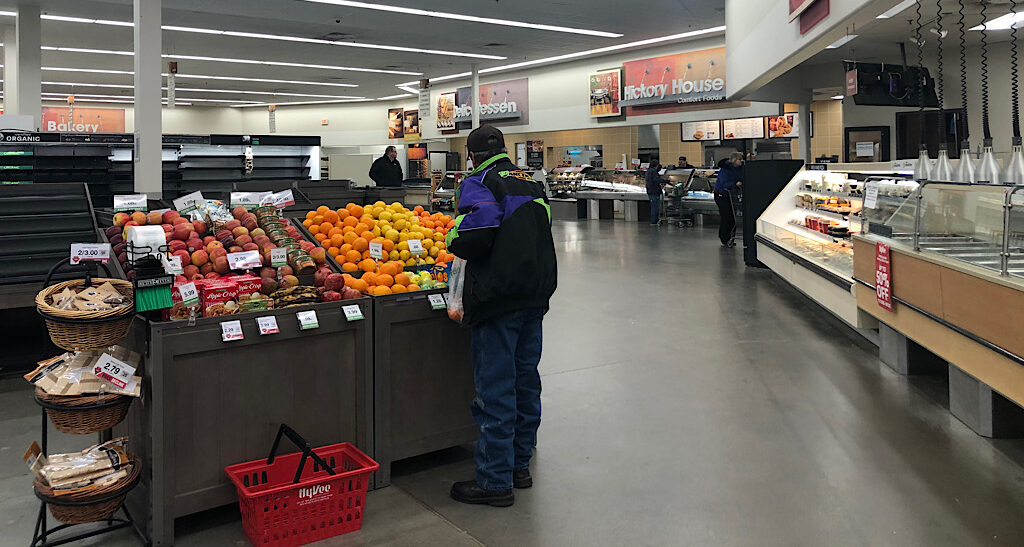
For a neighborhood that just lost a Hy-Vee store within walking distance for some, the vision is to attempt to fill the void.

“I’ve been involved in food distributions through Feeding South Dakota, and when Hy-Vee announced it was closing, multiple people reached out to see if we should have more food distributions,” he said. “There’s a group working on that, but I said let’s try something different.”
What that looks like is still taking shape, but it started with a conversation between Merkouris and Kristin Johnson, who opened the reduced price grocery store Fair Market at 2515 S. Carolyn Ave. last year. It’s been so well received she moved this past weekend to a larger east-side space.
Johnson uses a broker to secure merchandise that is sent back to warehouses by retailers. That could be because the public isn’t buying as much as expected, packaging is slightly damaged, labels are changing or expiration dates are approaching.
It allows Fair Market to sell for about half the price of what a big-box retailer does.
But simply duplicating that model isn’t the answer for a neighborhood grocery because it’s an unpredictable product flow.
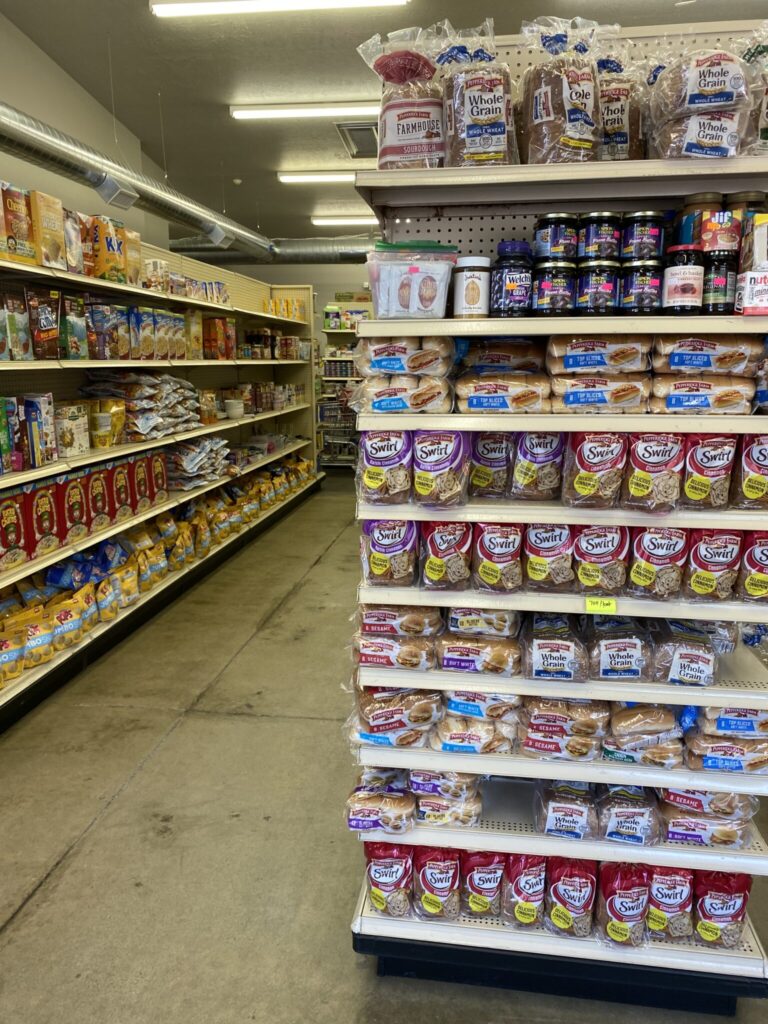
“It could be boxes of cereal or it could be spaghetti,” Merkouris said. “So we’re going to do that plus have some other brokers as well that we can order from directly.”
The store most likely would be owned by a nonprofit with a goal of breaking even. Anyone could shop there, but those in need of help affording the food could receive assistance.
“We’re really trying to find something that is sustainable without having to bring in charitable dollars consistently,” Merkouris said.
“This is going to require some seed capital. We have $150,000 of $200,000 committed, and we need $200,000 to launch.”
The group is hoping to move fast and grow, potentially being ready to share more details of a plan in a few weeks, he said.
The effort is one of several in the community to address those in need of more food security, said Michelle Erpenbach, president of Sioux Falls Thrive, which includes a food security action team.
“There are other parts of the conversation that include things like easier access to charitable food or a farmers market in the area or a community garden,” she said.
“It’s one of a bunch of building blocks of what I’m perceiving as the beginning of a way for this community to transform itself one neighborhood at a time, starting there.”
The area is “a textbook definition of a food desert,” she added. “And it may not be the last one we see.”
Sioux Falls Thrive, in partnership with the Augustana Research Institute, studied food security in the community in 2018. At that time, it found three food deserts in Sioux Falls:
- The north-central part of the city east of the airport, including the Froehlich Addition and Norton Acres neighborhoods. Though only a small portion of this area is zoned residential, it is still home to nearly 5,000 people, most of whom live far from both retail and charitable food assets. This area has among the highest rates of households receiving SNAP and of visits to the Feeding South Dakota food pantry.
- The Hayward area, bordered on the south by Skunk Creek and the north by Madison Street and between I-29 and Ellis Road, but especially the area north of 12th Street. Though this area has small grocery stores and relatively high rates of vehicle ownership compared to other food desert areas, it also has very limited access to supermarkets or charitable food assets.
- The Empire Mall area around 49th Street and Louise Avenue has low access to charitable food assets and, despite being a bustling commercial hub, is home to a high proportion of low-income families and families without vehicle access.
The primary issue is transportation, both Merkouris and Erpenbach said.
“That’s the bigger issue,” Merkouris said. “There’s already charitable food distribution, so I don’t know if there’s need for more charitable as much as there is access for those who have transportation challenges.”
And while the void created by Hy-Vee’s closure is the most recent example of a food desert, “there are possibilities we will see more develop,” Erpenbach said.
“So why not take the opportunity as a community and make something positive out of it. There are great possibilities here, but we have to go into it with that attitude. It’s a chance for our community to make a difference.”
Share This Story
Most Recent
Videos



Looking amazing @dtsiouxfalls and @washpav! Thanks to @jpickthorn for capturing an incredible night.
Nov 26

Enjoy this glow headed into Halloween week! 📸: @jpickthorn
Oct 31
Hope you had a wonderful summer weekend and are recharged for the week ahead! 📸: @jpickthorn
Jun 27
Beautiful way to start a week! 📸: @jpickthorn
Jan 10
Favorite flyover of the year! Merry Christmas from our entire @pigeon605news flock. 🎄🐦 📸: @actsofnaturephotography
Dec 24
They definitely deserve to be treated like holiday royalty and they were! ❤️ these scenes from tonight’s lighting celebration at @sanfordhealth Children’s Hospital. 🎄
Dec 1
The holidays are here! Perfect night @dtsiouxfalls
Nov 27
Happy Halloween from @avera_health NICU babies! Link in bio to see more! 🎃
Oct 31
Did you know @dtsiouxfalls is filled with 👻 stories? Link in bio … if you dare 😱
Oct 8
When it comes to kids parties nobody wants to be cookie-cutter. Link in bio for the story on what’s trending.
Sep 28
Want to stay connected to where you live with more stories like this?
Adopt a free virtual “pigeon” to deliver news that will matter to you.





Are you a little bird with something to share?

Delivering news that matters to you
Years ago, homing pigeons were used to bring us news we needed. Today, your virtual “pigeon” will deliver what you want to know about the place you call home.
All pigeons are free to good homes!
Our Partners