

Behind a new fence, a dark chapter in S.D. history draws respect for the dead
By Steve Young, for Pigeon605
There’s a fence on a golf course at the eastern edge of Canton that separates the living from the dead. A fence where the memory of man’s inhumanity to man still abides within its boundaries. A fence erected in part to ensure that the sad history of this sacred ground should never be forgotten.
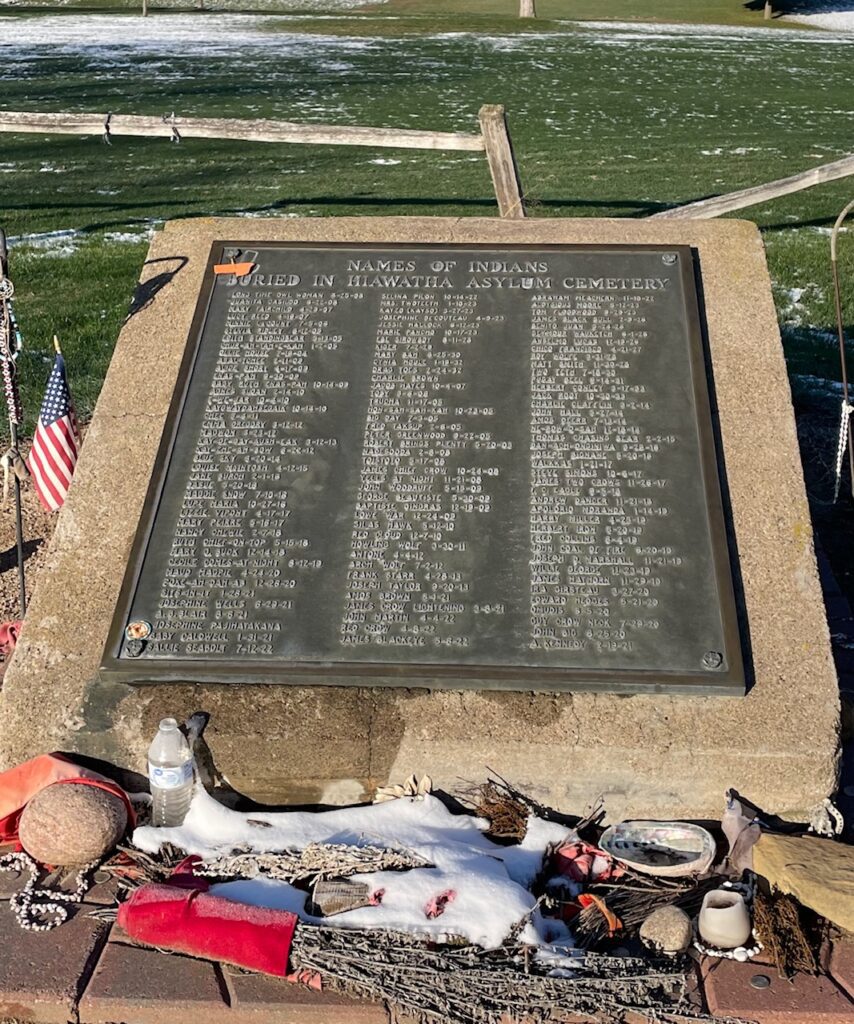
For decades, the cedar split-rail planks and posts have bordered a part of the Hiawatha Golf Club between its fourth and fifth fairways, keeping golfers out of a cemetery that existed long before golf balls began peppering the surrounding landscape.
But now with the wood dilapidated and rotting, a new fence is replacing it, with new material, a new design and renewed hope when it comes to respecting and honoring the 121 Native Americans buried there.
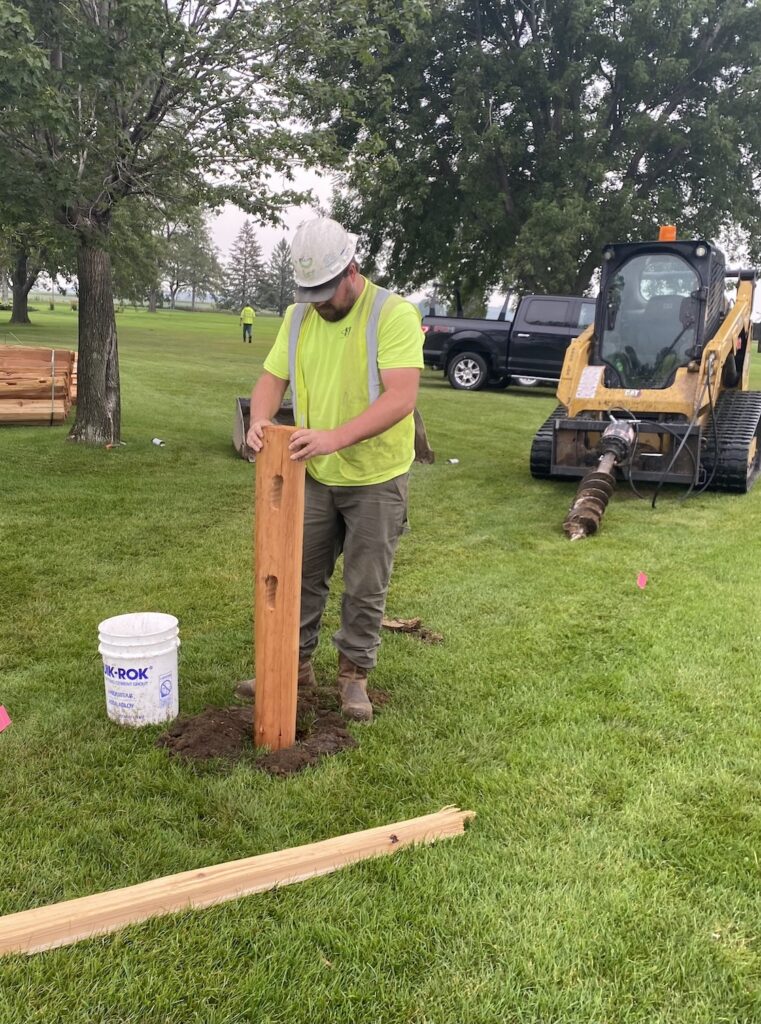
Respect was not necessarily a mandate when the Hiawatha Asylum for Insane Indians opened near the present-day cemetery in 1903. Built for $42,000 at the urging of U.S. Sen. Richard Pettigrew, the institution took in between 350 and 400 Indigenous people from across the country between 1903 and 1933 ̶ individuals who purportedly had been diagnosed with dementia, manic depression, senility, hysteria, paranoia and more.
The truth was they were often sentenced to Hiawatha for nothing more than epilepsy, or alcoholism, or for being recalcitrant because they would not abandon their Native culture and practices.
Asylum patients often spent their nights locked in their rooms with uncovered chamber pots filled with urine and excrement, according to government records. They slept on sheets blackened by coal dust that covered the floors. Isolated, many endured years of mistreatment, seldom leaving the institution except through death.
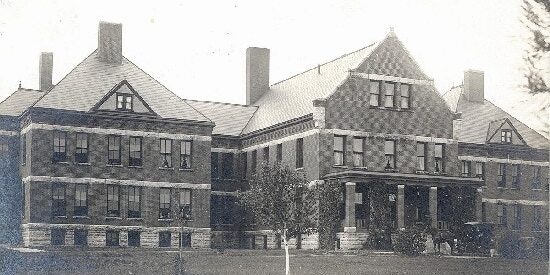
Their story, and that of a group of volunteers who have worked for more than a decade to preserve the history of the asylum while honoring the lives of those impacted by it, was told here on Pigeon 605 in November 2023. Afterward, the volunteers ̶ known as the Keepers of the Canton Native Asylum Story ̶ were made aware by a reader of a grant program that might be able to help them with one of their priorities as a group.
Replacing that old, dilapidated fence surrounding the cemetery.
“We have a lot of dreams,” said Ross Lothrop, a Citizen Potawatomi tribal member who is part of the Keepers. “One is honoring and remembering the people who were brought to the asylum. Educating the public about what happened here too. And replacing the fence … that has been a big one.”
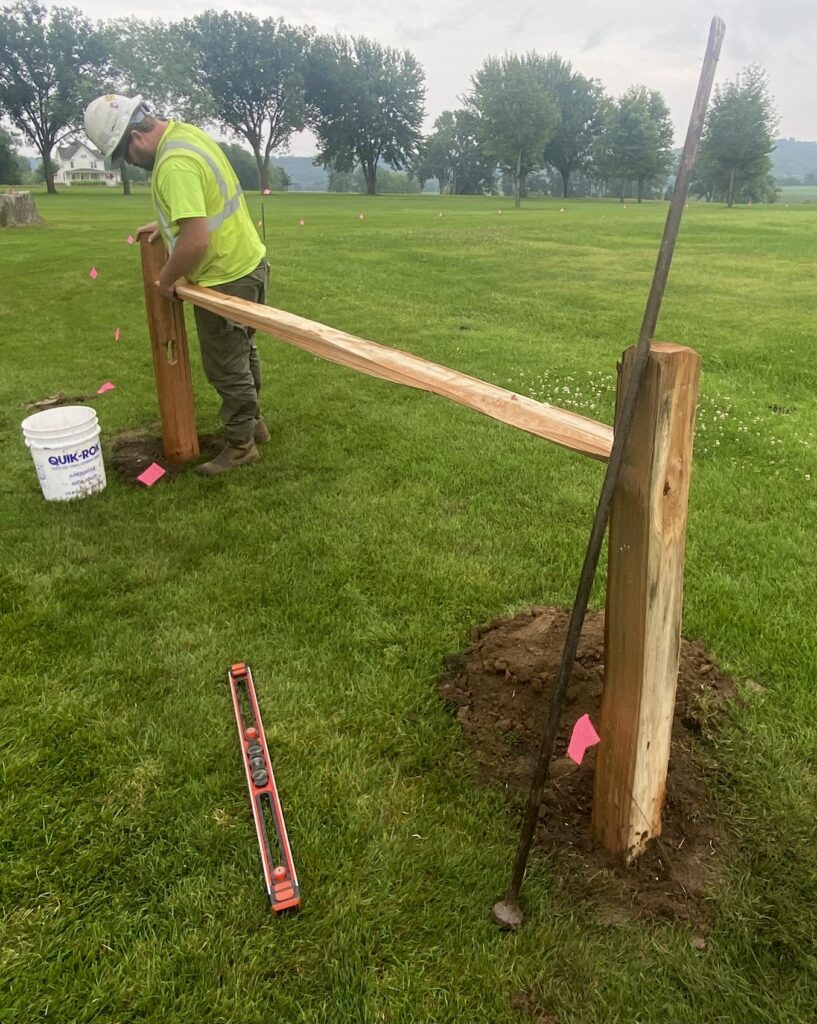
Now, the dream has become a reality thanks to a grant of $8,816 provided by the Mary Chilton Daughters of the American Revolution Foundation and Chapter in Sioux Falls. That grant has covered the cost of materials and installation of a fence, which was put up around the cemetery this week.
It’s an interesting collaboration. The National Society of the Daughters of the American Revolution was founded by women in 1890 for historical, educational and patriotic purposes. Its goals are to perpetuate the memory and spirit of men and women who helped achieve American independence. It fosters patriotism and love of country. It would like all mankind to know the blessings of liberty.
Yet the governance and democracy that the American Revolution brought about has not always shined brightly on the lives of Native Americans, as witnessed by the asylum in Canton. Today, there are groups across the country who would bury such conversations about slavery, broken treaties and other racial injustices in the past because of the shame and guilt it could bring, especially to America’s youth.
Lothrop and Tammy Noordermeer, president of the Mary Chilton DAR Foundation, are aware of such conversations.
“We do have elements of discourse in the country right now on what is to be taught and how it’s going to be taught,” Lothrop said. “That said, the history of the Canton Asylum for Insane Indians has been, shall I say, a dark spot in history. And as people have said, history can tend to repeat itself. There are things we most definitely don’t want to repeat, and how we treated Native Americans is one of them. Or how we treated other ethnic and racial groups of people. In my opinion, it has to be looked at as a way to move forward and not repeat it.”
The Daughters of the American Revolution group is a nonprofit, nonpolitical organization, Noordermeer said. It counts more than 200 women in the Sioux Falls area who can trace their lineage back to patriots who fought in the Revolutionary War. Its focus is on the three pillars of historic preservation, education and patriotism.
The cemetery fence grant “involves historic preservation,” she said. “We’re preserving what happened in history with this project. I think that’s where we came at it from in reviewing the application. We tried not to get into the politics of it, but just back to the basics of is it historic preservation?”
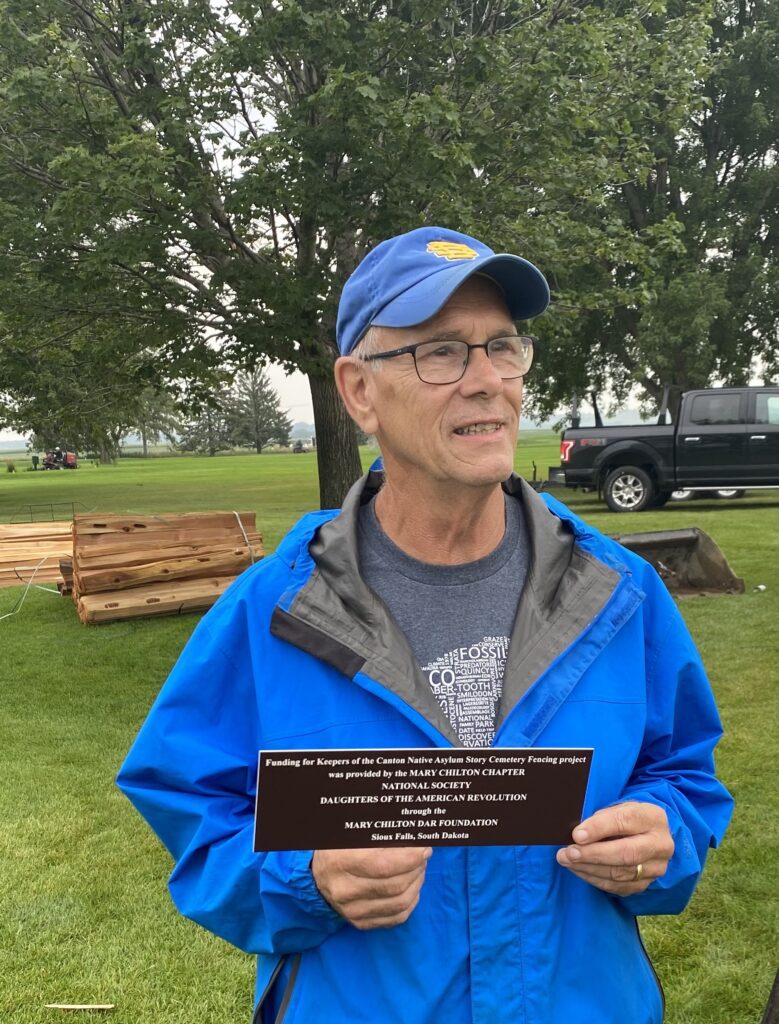
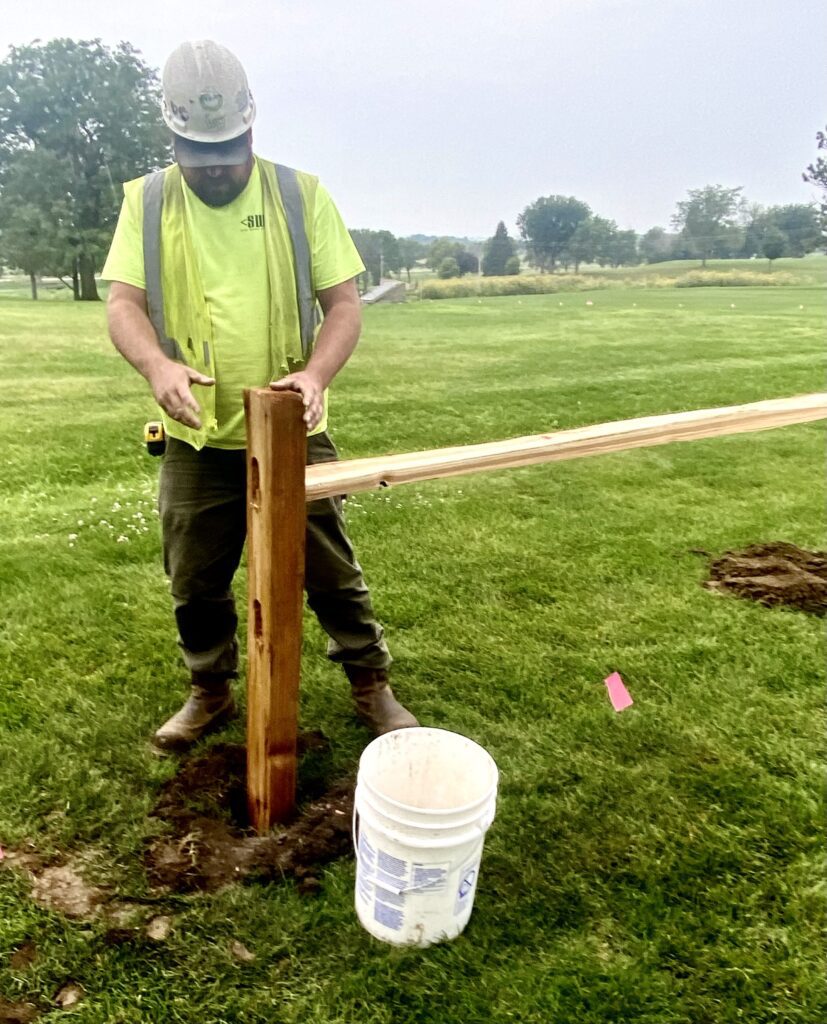
Ross Lothrop of the Keepers group holds the sign that recognizes the Mary Chilton DAR chapter for its donation to the new fence construction as workers from American Fence in Sioux Falls install it.
Most DAR chapters across the country are not in a position to give away grants, Noordermeer said. The Mary Chilton chapter is because of a bequest made to it by a member, Dorothy Day Davenport, in the early 1980s. Since 1987, it has awarded more than 1,000 grants totaling over $3 million.
With the money it received, the Keepers of the Canton Native Asylum Story has replaced the old rectangular fence with a cedar split-rail structure that is oval in shape ̶ a design closer to the sacred hoop concept that is important to Native American cultures and traditions.
“The oval was the closest we could come without moving a fifth fairway hole,” Lothrop said. “We’re going off a pattern that was designed to respect and honor the spiritual practices of the Native American tribes. The sacred hoop is essentially the circle of life. It involves the four directions as well. Everything in tribal life revolves around that element of the sacred hoop.”
Plaques commemorating the DAR chapter’s contribution will be placed at the four entrances to the fence. Its dedication will be part of the annual honoring and remembrance ceremony starting at noon Saturday, Aug. 24, at the golf course 1 mile east of Canton, followed by a potluck meal. The tradition of that ceremony was started in 1988 by Harold Iron Shield, and has been an annual event except for a three-year lull after Iron Shield died in 2007.
With the new fence in place, Lothrop said the Keepers will move forward with other goals. There is work to be done yet on the former entrance to the asylum grounds, where the Hiawatha Golf Club sign now stands. That entrance includes the original first step into the asylum, as well as decorative stones from the entrance to the asylum front doors. The Keepers volunteers intend to put a plaque there telling the history of the asylum.
The volunteer group also wants to continue its outreach efforts, getting into schools, churches and civic organizations to tell the story of the asylum and the people who lived and died there. Members also are trying to make even stronger connections with the 53 tribes that have been identified as having ancestors buried in the cemetery.
Perhaps those tribes might want to repatriate their ancestors. The group would work with them on that, Lothrop said.
At the very least, the volunteers want to make an even stronger case to those tribes that these are more than just bodies buried in a cemetery. They were people with stories. Thanks to publications and other public records that have been released, the Keepers now can share information beyond their names, such as when they came to the asylum, what their diagnosis was and more.
“We want to make that bigger connection for the tribes in hopes of getting more involvement from them,” Lothrop said. “We want them to be able to say, ‘Yeah, that was somebody who belonged to our tribe, but we didn’t know a whole lot about them.’ Now they can know more.”
Time will tell if that work proves fruitful. But time has finally brought the Keepers success with its dreams of a new fence. And they’re not done dreaming.
“There are,” Lothrop said, “a lot of things that are swirling around in our heads.”
Preserving dark past becomes mission for keepers of Hiawatha Asylum’s story
Share This Story
Most Recent
Videos



Looking amazing @dtsiouxfalls and @washpav! Thanks to @jpickthorn for capturing an incredible night.
Nov 26

Enjoy this glow headed into Halloween week! 📸: @jpickthorn
Oct 31
Hope you had a wonderful summer weekend and are recharged for the week ahead! 📸: @jpickthorn
Jun 27
Beautiful way to start a week! 📸: @jpickthorn
Jan 10
Favorite flyover of the year! Merry Christmas from our entire @pigeon605news flock. 🎄🐦 📸: @actsofnaturephotography
Dec 24
They definitely deserve to be treated like holiday royalty and they were! ❤️ these scenes from tonight’s lighting celebration at @sanfordhealth Children’s Hospital. 🎄
Dec 1
The holidays are here! Perfect night @dtsiouxfalls
Nov 27
Happy Halloween from @avera_health NICU babies! Link in bio to see more! 🎃
Oct 31
Did you know @dtsiouxfalls is filled with 👻 stories? Link in bio … if you dare 😱
Oct 8
When it comes to kids parties nobody wants to be cookie-cutter. Link in bio for the story on what’s trending.
Sep 28
Want to stay connected to where you live with more stories like this?
Adopt a free virtual “pigeon” to deliver news that will matter to you.





Are you a little bird with something to share?

Delivering news that matters to you
Years ago, homing pigeons were used to bring us news we needed. Today, your virtual “pigeon” will deliver what you want to know about the place you call home.
All pigeons are free to good homes!
Our Partners