Is my mole OK? Check using these 5 rules
This paid piece is sponsored by Avera.
The new year is a great time to take stock of your health, and one thing to consider is your skin.
You can do this by giving your skin a once-over for any changes, particularly moles. But what are you looking for? That’s one reason why scheduling a skin check with a dermatologist can be helpful.
It takes years of looking at moles and other skin lesions to be able to tell what is harmless and what needs to be removed.
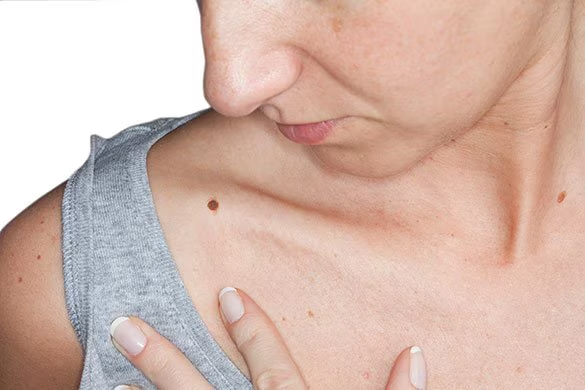
According to Avera dermatologists, you should use these rules to initially evaluate your moles at home. You’ll learn more about your skin, what’s normal for you and when to reach out to an expert.
Rule No. 1: The ABCDEs of melanoma
This is the most well-known guideline for patients. Follow these ABCs when checking your moles:
- Asymmetry: If you fold your mole up like a taco shell and the two sides don’t match, this is considered asymmetry and is a sign of an abnormal mole.
- Border: The outside borders of a mole should be nice and round, not scalloped like a flower.
- Color: Moles ideally are one uniform color — not a mix of different colors or shades.
- Diameter: In general, most cancerous moles, known as melanomas, are larger than a pencil eraser.
- Evolution: This is one of the most important rules. If your mole is changing, get it checked out!
Rule No. 2: The ugly duckling
Many people have hundreds of moles — and that’s OK. However, if one of your moles sticks out like a sore thumb from all the others, it’s worth getting it checked. This is one reason why a dermatologist will ask to see all your moles when you come in for a skin check — they not only want to look at the mole in question, but they also want to compare that mole to all the other moles on your skin.
Rule No. 3: The itching or bleeding mole
A mole can itch or bleed for a number of reasons. It might have been caught on clothing or scratched in the shower, it might have a mosquito bite nearby, or it might have developed a pimple within it. But sometimes, an itchy, bleeding mole is a sign of something worse — maybe even skin cancer — so get these moles checked out.
Rule No. 4: The ‘it just doesn’t seem right’
Maybe your mole doesn’t look that bad, doesn’t itch or bleed and isn’t changing at all — but you just can’t stop wondering if it’s OK. This is a perfectly good reason to get your mole checked. Sometimes, patients have an intuition about their bodies that can’t be explained.
Rule No. 5: The family history
If there is a positive family history of a first-degree relative — parent, sibling or child — who experienced melanoma, it is especially important to implement all of the previous rules.
“Become familiar with your skin and moles, monitor for the ABCDEs of melanoma, and avoid sunburns,” said Dr. Valerie Flynn, Avera dermatologist. “Even just one severe sunburn earlier in life can significantly increase your risk of developing melanoma later in life.”
Pay attention to your skin. If you see a mole that causes you concern, get it checked out.
Get more wellness tips from the experts at Avera.org/Balance.
Share This Story
Most Recent
Videos



Looking amazing @dtsiouxfalls and @washpav! Thanks to @jpickthorn for capturing an incredible night.
Nov 26

Enjoy this glow headed into Halloween week! 📸: @jpickthorn
Oct 31
Hope you had a wonderful summer weekend and are recharged for the week ahead! 📸: @jpickthorn
Jun 27
Beautiful way to start a week! 📸: @jpickthorn
Jan 10
Favorite flyover of the year! Merry Christmas from our entire @pigeon605news flock. 🎄🐦 📸: @actsofnaturephotography
Dec 24
They definitely deserve to be treated like holiday royalty and they were! ❤️ these scenes from tonight’s lighting celebration at @sanfordhealth Children’s Hospital. 🎄
Dec 1
The holidays are here! Perfect night @dtsiouxfalls
Nov 27
Happy Halloween from @avera_health NICU babies! Link in bio to see more! 🎃
Oct 31
Did you know @dtsiouxfalls is filled with 👻 stories? Link in bio … if you dare 😱
Oct 8
When it comes to kids parties nobody wants to be cookie-cutter. Link in bio for the story on what’s trending.
Sep 28
Want to stay connected to where you live with more stories like this?
Adopt a free virtual “pigeon” to deliver news that will matter to you.




Are you a little bird with something to share?
Delivering news that matters to you
Years ago, homing pigeons were used to bring us news we needed. Today, your virtual “pigeon” will deliver what you want to know about the place you call home.
All pigeons are free to good homes!
Our Partners