
Food bank with national reach expands to serve Sioux Falls
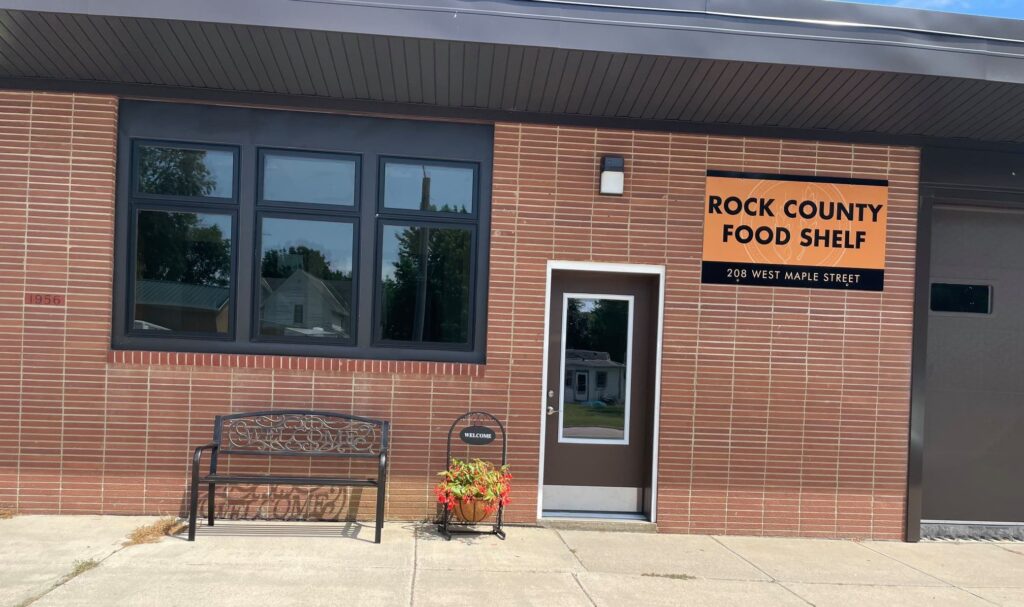
In one two-hour period in late November, the Rock County Food Shelf sent 63 families home with the groceries they needed to put meals on their tables.
The next day, co-director Mary Gehrke drove from Luverne, Minnesota, to Sioux Falls to replenish the shelves with the first monthly donation of food from the Midwest Food Bank. All it cost her food shelf was the gas it took to travel from one community to another.

The food itself was absolutely free.
That’s right — free.
When Gehrke first learned of the food distribution, she admits to being skeptical.
“I kind of thought, this is too good to be true, what’s the catch, etcetera,” she said. “Then I thought, well, we’re going to get a free load of food; let’s see what happens.”
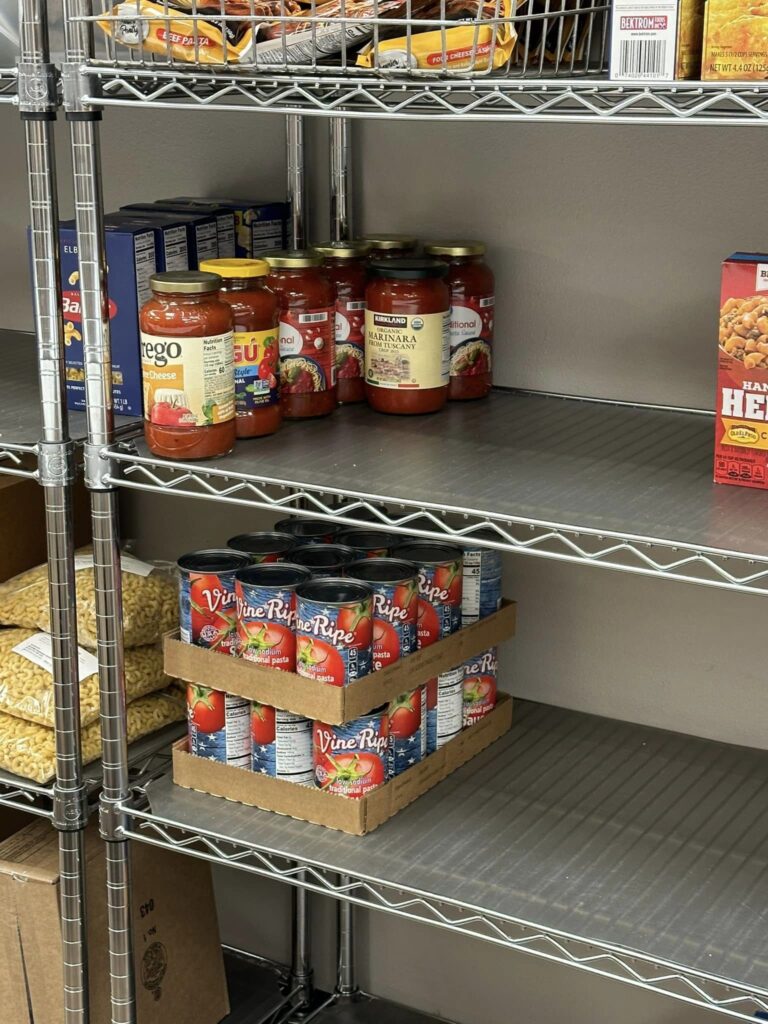
What happened was that Gehrke transported goods such as saltine crackers and chicken broth, Pop Tart Bites and Reese’s Peanut Butter Cups, fresh apples and canned grapes in syrup, cereal and Starbucks coffee drinks that volunteers loaded in her vehicle.
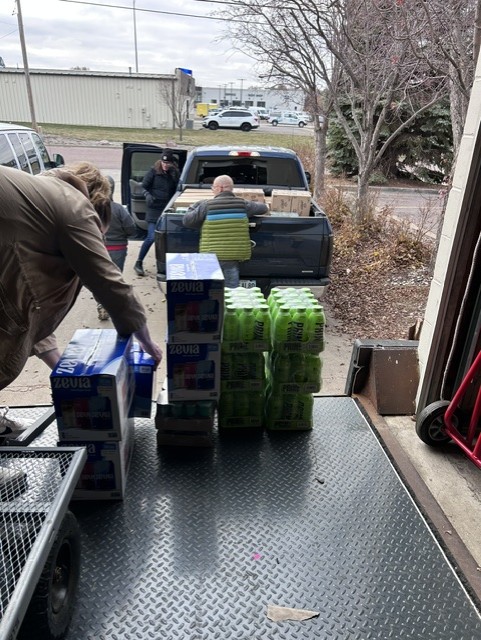
“I was in absolute awe when they filled up the back of my car,” Gehrke said.
The Rock County Food Shelf wasn’t the only beneficiary of the first shipment of goods from the Midwest Food Bank, a charity that seeks to feed the hungry and end malnutrition across the globe. Other nonprofits included Messiah New Hope Lutheran Church, the University of Sioux Falls, St. Katharine Drexel Parish and Faith Temple Church, all in Sioux Falls, and food pantries in Baltic, Dell Rapids and Marty.
MFB, based in Illinois, has expanded to Sioux Falls and will serve the tri-state area of South Dakota, Minnesota and Iowa, said Kristin Johnson, an advisory board member for the Sioux Falls location. Johnson is also executive director of Fair Market, which offers discounted grocery and nongrocery items.
As a former Illinois resident, Johnson was familiar with MFB. She reached out to the nonprofit to see if it was interested in a separate opportunity to assist in Sioux Falls; instead, Midwest Food Bank expressed an interest in expanding into a new state.
“They have 10 divisions, and they have the eastern half of the United States covered and the southern bit. Their eyes are set to the west a bit, and they see this as an opportunity for growth,” Johnson said.

Sioux Falls is an ideal location because it sits at the intersection of two interstates, she said.
In addition, another connection existed. Its founder is connected with the church Johnson attends, the Apostolic Christian Church of Lester, Iowa. With Johnson’s passion for feeding the hungry, it didn’t take long for her to agree to join the local board.
“It was the intersection of need and ability and knowledge,” Johnson said. “Everything got us together in a boardroom in April.”
According to the Midwest Food Bank’s annual report for 2023, its program had a $482 million impact in free food distributed. MFB served 1.3 million people through 2,400 distribution partners, all nonprofit agencies. Its distribution reach spanned 23 states and three counties, and the nonprofit received a 99.4 percent efficiency rating in stewardship.
In 2023 alone, MFB expanded its reach with 300 new nonprofit partners and two new remote distribution centers. It secured new partnerships and nurtured existing agreements with food donors. It sources food nationally, increasing the variety and supply for the tri-state region, Johnson said.
With the expansion to Sioux Falls, the area will have a food program that crosses state lines. Johnson is reaching out to other food pantries, such as those in Inwood and Rock Rapids, Iowa, and also will expand within South Dakota.
“It’s a way to take care of more than just here in Sioux Falls,” Johnson said. “That’s not to throw shade on Feeding South Dakota. We’ll be working alongside Feeding South Dakota. I’ve spoken with them in different settings, and they see more need than they have resources right now. It alleviates pressure on their system, so they can focus on the entire state.”
Johnson describes the relationship between Feeding South Dakota and Midwest Food Bank as a collaboration, not a competition.
Receiving free food distributions monthly means that food shelves and pantries can stretch the cash they receive and use the funds to purchase goods, Gehrke said. Donations of canned goods, especially this time of year, help stock shelves, but the need to buy essential items is always pressing, she said.
“I would say all told our grocery bill between store supplies and getting a truck two times a month from Second Harvest (a food bank in the Twin Cities) probably doubled in the last six to 12 months,” Gehrke said. “We used to spend $3,000, and it’s probably twice that now.”
Her food shelf receives wonderful support in donated goods, Gehrke said, and in January, it will look like it could never possibly run out of food.
“But in a month, we’ll be out,” she said.
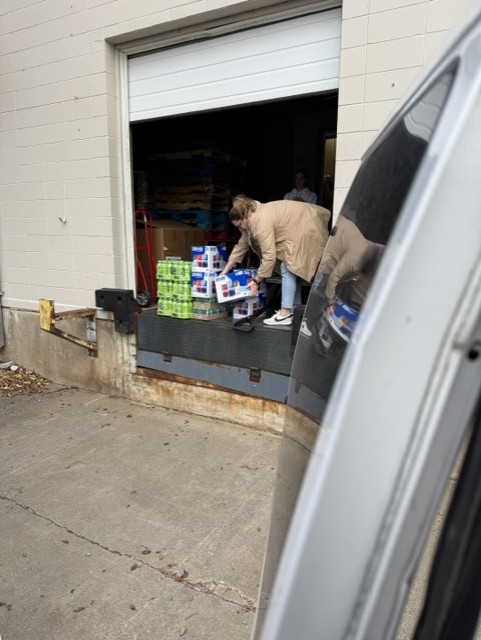
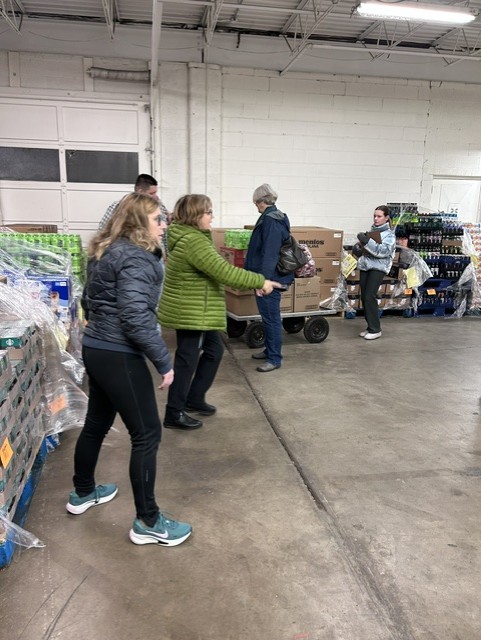
The Midwest Food Bank truck arrived at a Fair Market warehouse because Johnson had the space for it, and within about three hours, it was unloaded, and all goods were loaded into other vehicles. Advisory board member Linda Duba was one of the volunteers helping unload and load.
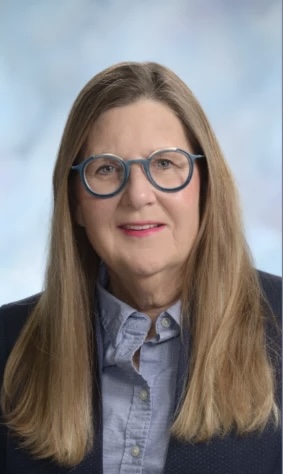
A retiring state legislator from District 15, Duba knows how prevalent food insecurity is in the area.
“People who are food insecure are near and dear to my heart. Think about the landscape in 15,” she said. “There are so many working poor and children and adults. There’s the food giveaway on Fridays for individuals and Feeding South Dakota, but the important critical thing here is we’re going to be providing food for nonprofits who serve even a bigger swath of individuals. We’re getting food into the hands of organizations that can use it. They don’t have to pay. Their budgets are so tight already.”
Not a single item brought in by Midwest Food Bank went unclaimed. Volunteers from the Faith Temple food giveaways on Fridays came and took anything that was left. The Banquet and Feeding South Dakota also can benefit from the nonperishable items that food shelves don’t use, Duba said.
Johnson hopes to expand to 20 food pantries in the initial stages of distribution. Eventually, she would like it to include 24 to 30 food shelves.

To qualify, agencies must be 501(c)(3) organizations, give away — not sell — the food, serve at least 40 families and be able to pick up the monthly shipment from the distribution site.
The next MFB truck should arrive a week before Christmas, Johnson said. This is a wonderful time of year for Midwest Food Bank to expand to this area.
“In the words of one of my customers, you can’t hardly afford to be alive anymore,” Johnson said. “With heating and feeding and gifts, it takes up a lot of people’s resources. One pantry in September saw a 37 percent increase in visits. Not necessarily new customers, but people showing up that can’t make it work. The weather isn’t great for it to be starting this time of year, but the need is great.”
Share This Story
Most Recent
Videos



Looking amazing @dtsiouxfalls and @washpav! Thanks to @jpickthorn for capturing an incredible night.
Nov 26

Enjoy this glow headed into Halloween week! 📸: @jpickthorn
Oct 31
Hope you had a wonderful summer weekend and are recharged for the week ahead! 📸: @jpickthorn
Jun 27
Beautiful way to start a week! 📸: @jpickthorn
Jan 10
Favorite flyover of the year! Merry Christmas from our entire @pigeon605news flock. 🎄🐦 📸: @actsofnaturephotography
Dec 24
They definitely deserve to be treated like holiday royalty and they were! ❤️ these scenes from tonight’s lighting celebration at @sanfordhealth Children’s Hospital. 🎄
Dec 1
The holidays are here! Perfect night @dtsiouxfalls
Nov 27
Happy Halloween from @avera_health NICU babies! Link in bio to see more! 🎃
Oct 31
Did you know @dtsiouxfalls is filled with 👻 stories? Link in bio … if you dare 😱
Oct 8
When it comes to kids parties nobody wants to be cookie-cutter. Link in bio for the story on what’s trending.
Sep 28
Want to stay connected to where you live with more stories like this?
Adopt a free virtual “pigeon” to deliver news that will matter to you.






Are you a little bird with something to share?

Delivering news that matters to you
Years ago, homing pigeons were used to bring us news we needed. Today, your virtual “pigeon” will deliver what you want to know about the place you call home.
All pigeons are free to good homes!
Our Partners