

At 135,000 haircuts and counting, city’s long-serving barber keeps cutting
The number is somewhere north of 135,000, but who’s to be sure.
It’s the kind of number that takes a minute to process, whether you’re talking about cars, jelly beans or people.
In this case, it’s an estimate of the number of haircuts that Steve Olson has given in his career as a barber that started in 1965. It’s hard to know, but it’s likely he’s the longest-serving barber in Sioux Falls.

Olson took his first dollar for a haircut – they were a dollar each in 1965 – after six months of training at the South Dakota Barber College, then at Sixth Street and Main Avenue.
He’s not a stylist. This ain’t no salon.
It’s the West Sioux Barber Shop, and Tuesday through Saturday, you’ll find Olson ready for anyone who walks through the door, provided what they want is a trim and maybe a shave.
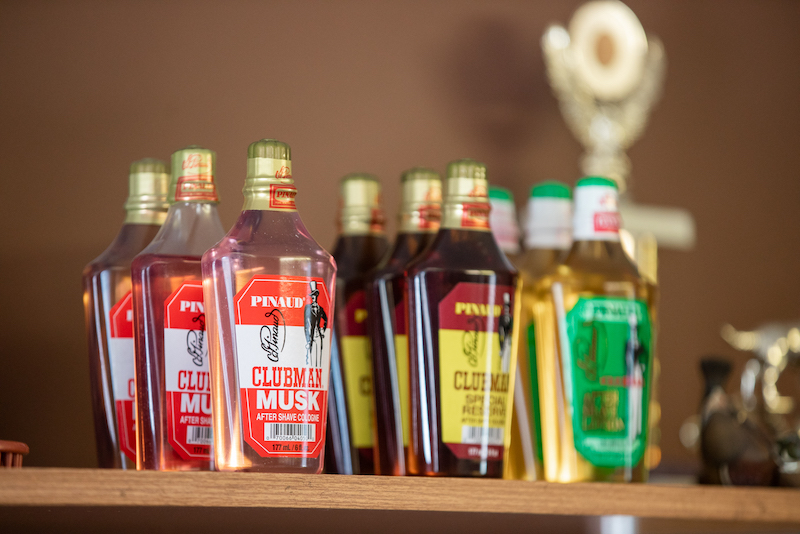
Flattops are still the specialty of the house.
So how does a barber get to 135,000 haircuts?
Time, my friends.
Time and persistence, and the support of a family, who knows that going to this barbershop in this old neighborhood that many residents of Sioux Falls never see, this is what he needs. It’s the routine, and the conversation with the regulars about things that don’t matter in the big picture but are ever-so-important to our daily lives.

Farming. The weather. Cool old cars.
A man does 10 haircuts a day for 55 years, and it starts to add up.
Fifty a week for 50 weeks for 55 years.
The number is actually 137,500 if you’re doing the math. But for the past few years, the walk-ins don’t walk in as much as they used to.
And 2 ½ years ago, Olson had to take some time off after a stroke.
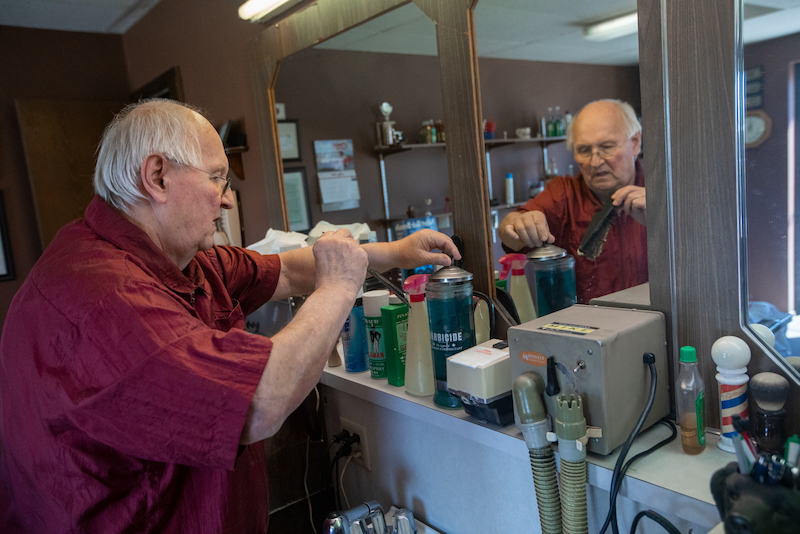
This is where luck bought Olson some time to pad that number. He had the stroke at work while giving a regular the usual cut and shave.
“He was being quiet on that day, which wasn’t anything unusual,” said Olson’s wife, Brenda, in recounting the story as it was told to her by the customer.
“He was giving him a flattop, and he went in with the clipper and took out a big gouge out of his hair,” she said.
The customer looked at Olson and, being a regular, knew something wasn’t right.
“You know Steve, why don’t we sit down here and talk for a while,” he said.
The man had come in with his oldest daughter, who called 911 for help.
“(The customer) knew something was wrong when he picked up a piece of pizza and tried to turn the TV on with it,” Brenda Olson said.
She can tell the story now with a bit of laugh because Olson recovered through rehab. He can still drive and go to work.
He has lost a bit of language and social skills, but that’s a small price when considering what might have happened if Olson had been alone, waiting for customers, when the stroke took hold.
“He’s doing good,” his wife said. “If this gentleman wouldn’t have called when he did, and they hadn’t gotten him in, it would have been worse.”
The West Sioux Barber Shop is tucked into a nondescript building where Burnside Street merges into Madison Street at the intersection with Lincoln Avenue.

It’s a unique confluence of streets that was once the center of commerce for the West Sioux neighborhood. The area was platted in 1889 by the president of what is today the University of Sioux Falls to raise money for the college, according to the Minnehaha County Historical Society.
It grew as a free-standing town within a town.
By the end of World War I, there was a 40-acre amusement park, a dance pavilion and thriving businesses. The grassy areas were used for landing sites by barnstormers, including air shows with stunt flying, wing walking, parachuters and aerial acrobatics.
West Sioux Hardware was the center of business, where customers could find about anything you could need for the operations of daily life. Henry Brockhouse displayed his collection of mounted wild animals he’d hunted from around the world, which today is part of the Delbridge Museum of National History at the Great Plains Zoo.
Business doesn’t bustle here the way it once did.
The hardware store is long closed. The Dairy Dream ice cream stand that stood on the point of the intersection was razed several years ago.
There is some new business activity. There’s a new Native American restaurant across the street, and Rosie’s Cafe is still a major attraction, famed for its traditional, home-cooked staples.
In the same strip of shops, which includes a laundromat and a tattoo shop on the first floor and apartments on the second floor, you’ll find Steve Olson.
If the old barber’s pole hanging outside is spinning, West Sioux Barber Shop is open for business.
After graduation from the barber college and finishing his two-year apprenticeship, Olson worked at a few shops around town before landing at West Sioux in the mid-1970s. He and Harlan Lien cut hair together there until Lien retired a decade ago.
“We used to have a pretty good little business here,” Olson said.
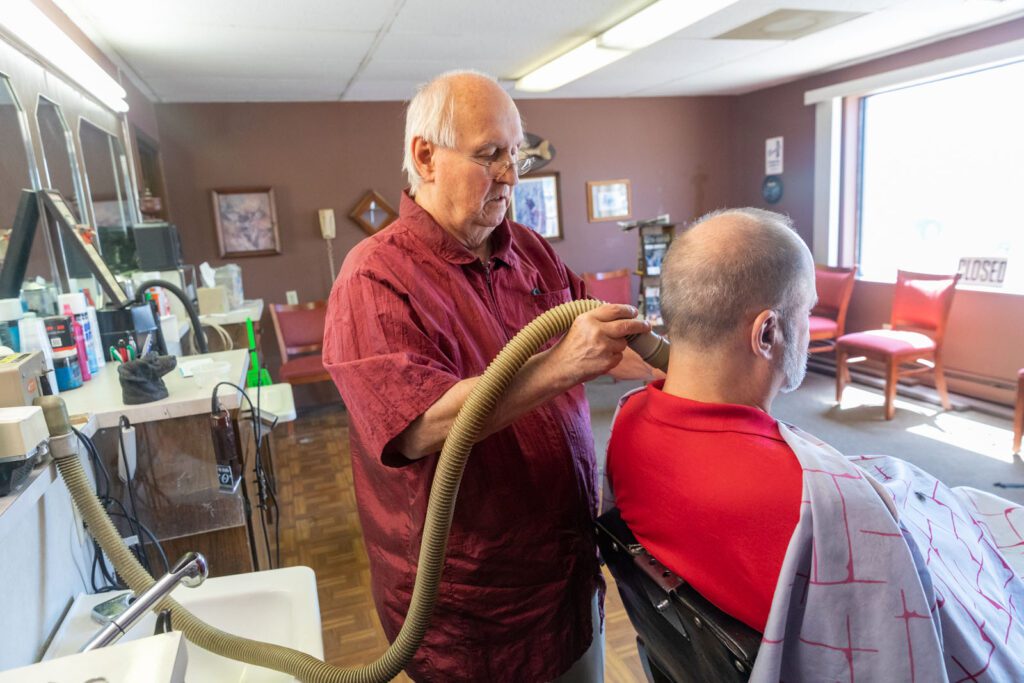
Saturdays were always the busiest days, when they might hit 20 or more haircuts. They also did a good business with guys from the Air National Guard, what with the flattops and all.
On slower days, they’d clean up or do some maintenance. But often, they’d sit in their chairs, looking out the window at the intersection and chatting with whomever stopped by.
Though, to hear Brenda Olson tell it, it wasn’t the quantity of words that made for conversation.
“One grunted and the other groaned,” she said.
Of course, those were different days.
“You come in here, and you could hardly see through all the smoke,” said daughter Holly Brue.
A haircut today is $15, up from $12 before the stroke.

A man doesn’t get rich off those prices, but you can have a pretty good life, buy a house, raise a family.
Steve and Brenda met in high school where they grew up in Hendricks, Minn.
Brenda went to hairstyling school in 1967 but then started having kids.
“Back then, moms stayed home, which was fine,” she said. “It was a different way of doing things. I enjoyed it.”
There were about 10 years though, when their three daughters were still at home, that Olson also worked nights loading trucks.
He’d cut hair in the morning, go home and maybe take a nap and then work the 3 to 11 p.m. shift.
“Sometimes, I went all night,” he said.
The family needed benefits, Brenda Olson explained. She had different jobs along the way to supplement their income, and it was hard, but they made it.
And they did well enough that they bought a house, where they still live today, and Olson had a few cool cars to enjoy. There was the 1948 Plymouth with a 350 engine that “went pretty good,” he said. And a purple 1967 Malibu that his wife “put the first crunch in.”
Today, there’s a yellow 2000 Chevy Corvette in the garage.
Fifty-five years is a long time.
But Olson doesn’t plan to stop anytime soon. At least not tomorrow.
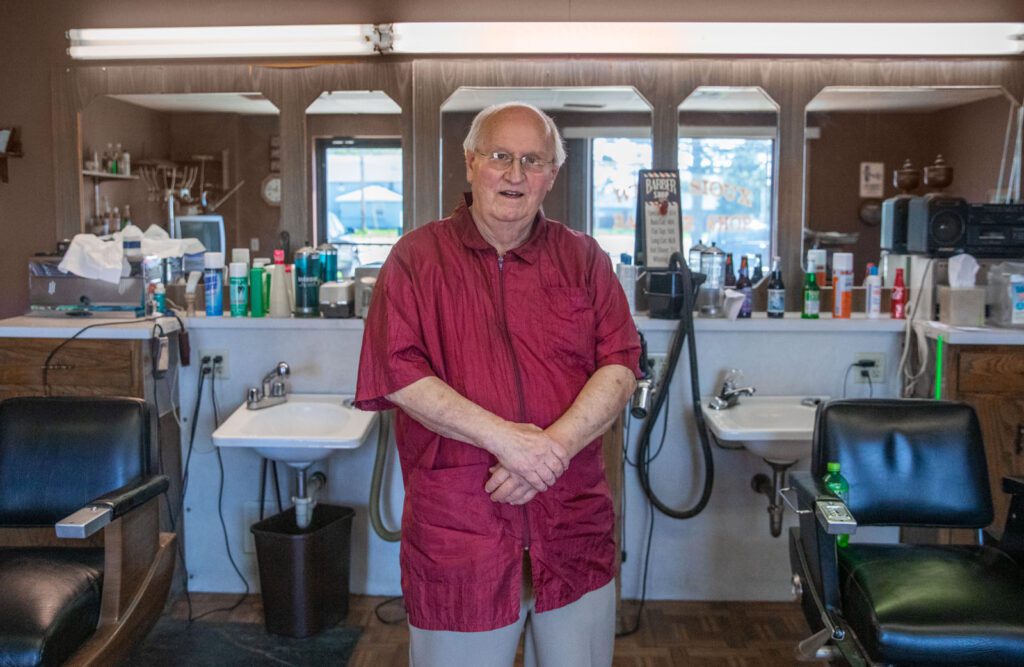
The day Olson came back to work after the stroke, they weren’t expecting much. They didn’t really tell anybody or advertise it. Just get back into the routine, and see how things go.
But they turned on the pole and it was like Commissioner Gordon signaling Batman.
Olson did 16 haircuts that day.
“It was really something,” he said, leaning back in the old barber chair. “They just kept coming.”
Share This Story
Most Recent
Videos
Looking amazing @dtsiouxfalls and @washpav! Thanks to @jpickthorn for capturing an incredible night.
Nov 26

Enjoy this glow headed into Halloween week! 📸: @jpickthorn
Oct 31
Hope you had a wonderful summer weekend and are recharged for the week ahead! 📸: @jpickthorn
Jun 27
Beautiful way to start a week! 📸: @jpickthorn
Jan 10
Favorite flyover of the year! Merry Christmas from our entire @pigeon605news flock. 🎄🐦 📸: @actsofnaturephotography
Dec 24
They definitely deserve to be treated like holiday royalty and they were! ❤️ these scenes from tonight’s lighting celebration at @sanfordhealth Children’s Hospital. 🎄
Dec 1
The holidays are here! Perfect night @dtsiouxfalls
Nov 27
Happy Halloween from @avera_health NICU babies! Link in bio to see more! 🎃
Oct 31
Did you know @dtsiouxfalls is filled with 👻 stories? Link in bio … if you dare 😱
Oct 8
When it comes to kids parties nobody wants to be cookie-cutter. Link in bio for the story on what’s trending.
Sep 28
Want to stay connected to where you live with more stories like this?
Adopt a free virtual “pigeon” to deliver news that will matter to you.





Are you a little bird with something to share?

Delivering news that matters to you
Years ago, homing pigeons were used to bring us news we needed. Today, your virtual “pigeon” will deliver what you want to know about the place you call home.
All pigeons are free to good homes!
Our Partners