
‘As real as it gets.’ SDSU students tackle real-life problems for NASA
This paid piece is sponsored by South Dakota State University.
The south pole of the moon is a place with extreme cold and near-permanent darkness.
It’s also where NASA envisions the landing site for manned Artemis missions, part of the broader goal of a sustained human presence on the moon by the end of the decade.
Before that can happen, though, several technology gaps must be solved, including developing a robotic system for excavation that can withstand the harsh environment.
Enter the Break the Ice Lunar Challenge, a NASA-backed competition to help design a robotic system for digging and moving large quantities of icy moon dirt, or regolith, found in the darkest places on the lunar surface.
“I looked at the topic and thought, this is something we can accomplish,” said Todd Letcher, associate professor in the mechanical engineering department at South Dakota State University.
“We come up with really clever ideas, and it just seemed perfect for us.”
Never mind that this wasn’t even a student-focused competition — the SDSU team would be competing against professional aerospace engineering firms. Letcher put together a group of undergraduate mechanical and electrical engineering students and let them get to work.
“They were all really interested in aerospace, and I thought this was a perfect way to get them immersed in a project,” he said. “This is as real as it gets. They’re up against aerospace engineers who have been doing this for decades. They do this for a living, and we’re doing it as an undergraduate project.”
And they’re succeeding. The SDSU team, called Space Trajectory, recently was named one of 15 finalists in the Break the Ice Lunar Challenge. Only a few universities made the list. The rest are private aerospace companies, and teams are represented from as far away as India and the Netherlands.

Zechariah Bergjord works outside the AME Production Lab to rewire circuits for the actuators on the Space Trajectory excavator. The aluminum-based excavator is part of the equipment the student team has built to compete in a NASA contest.
SDSU already won $25,000 for its placement in an earlier phase of the competition and now will receive an equal share of $500,000 in the second. The funds will be combined with a $10,000 grant from the South Dakota Space Consortium and smaller sponsor contributions to support SDSU’s effort to build an excavator, dump truck, battery-swapping rover and a battery-charging station for the next round.
“It’s so much different than any other class we take because it’s all teamwork. You have to collaborate a lot more,” said recent graduate Allea Klauenberg of Ogden, Iowa.
“The designs we have to come up with are not even close to what we have to do in other engineering classes.”
The teams have until early fall to build and test their prototypes. Equipment must be able to run 15 days straight and excavate 1,760 pounds of icy lunar soil per day and transport it to the drop site about one-third of a mile away, Letcher said.
From there, qualifying teams will put their prototypes to the test in a head-to-head on-site competition for a shot at $1.5 million in prizes.
Letcher said the excavator’s job is to grind away at a soft concrete ditch that is 8 feet wide and 150 feet long.
“I was really happy we got into the latest round and phase of the competition,” he said. “I felt really good about our proposal, and I’m really happy our seniors got to have this awesome experience to close out their college career and end on a really high note.”
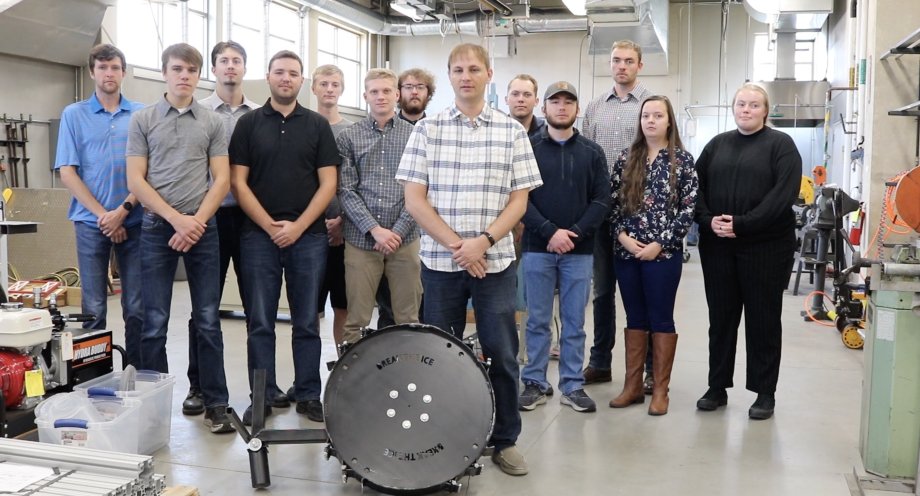
Space Trajectory team members pose by the excavator wheel that will be used in their Break the Ice Lunar Challenge project. Members are, from left, Max Selbach, Ben Louwagie, Tom Neumeister, John Ziegelski, Devin Lundberg, Parker Brandt, adviser Todd Letcher, Brock Heppner, Tate Mueller, Austin Lohsandt, Elaine Hines and Allea Klauenberg. Not pictured are Ben Diersen, Zac Bergjord, Dante Tarabelsi, Carter Waggoner and Eric Derr.
Now, his challenge is rebuilding his student team, which also is appealing to new undergraduates choosing SDSU.
“I’m losing all my brain (with seniors graduating), so I have to transplant that information, and we’ve been documenting the best we can,” he said. “A lot of students told me one of the reasons they came here in the first place is because they toured and got to see earlier projects and liked the type of work and wanted to do it themselves, so we are seeing that interest.”
Other NASA success
NASA holds multiple competitions more specifically designed for students, and SDSU teams recently have fared well in those too.
“I chose to have students work on newer topics that they offered where I see a lot of room for innovation,” Letcher said. “We’ve just started competing, and we’ve done really well so far with all three NASA competitions we’ve entered.”
One, the Revolutionary Aerospace Systems Concepts — Academic Linkage or RASC-AL competition, challenged the students to create a lunar cargo vehicle. The SDSU team was one of 15 finalists in four categories and will compete in Florida next week.
“They’ll give a 30-minute presentation and have 20 minutes of Q&A with the NASA judges, and then there’s a poster session where anyone can ask questions, and we’ll do a demonstration with our prototype,” Letcher said.
The students developed a highly customized forklift. In their executive statement, they wrote: “Our lunar cargo transporter features an innovative drivetrain, flexible wheels, a cargo locking mechanism and a universal attachment mechanism for auxiliary systems. The vehicle is adaptable not only for missions on the moon, but for Mars and beyond.”
The name of the SDSU project is Artemis Navigating Transporter System, and the theory behind the project draws heavily on its acronym — ANTS — as in the insects.
“We really didn’t discuss ants very much until we were thinking about collaborative robots,” said Nick Stegmeier, a recent graduate from Sioux Falls. “Then, we realized that ants work together to lift objects many times their body size and weight, and decided to design our system to emulate the abilities of ants.”
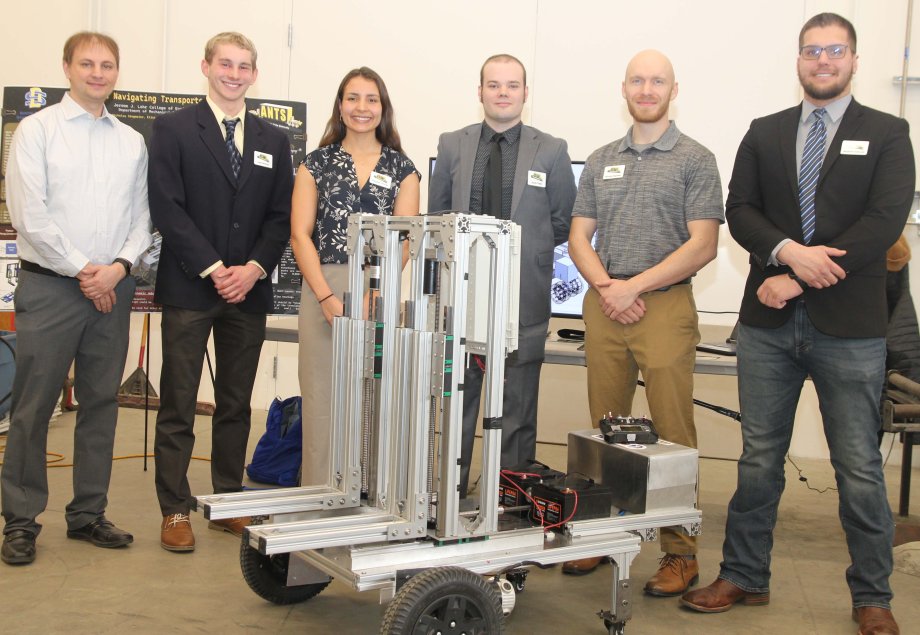
Members of the Artemis Navigating Transporter System team gather around the prototype of their lunar forklift during the SDSU Engineering Expo on April 26. Pictured, from left, adviser Todd Letcher, Liam Murray, Elisabeth Timmer, Jacob Pettit, Nick Stegmeier and Ben Sobczak.
The prototype is about the size of a go-cart, “while a full-scale ANT would be as large as a Volkswagen Bug, which is quite fitting,” he continued. “Two key features of the ANTS system are the collaborative lift capability, allowing the ANTS to lift very large and heavy payloads such as astronaut habitats, and the use of linear actuators and screws to enable the lifting systems, rather than the typical hydraulic systems that Earth-based forklifts use.”
All the students are recently graduated seniors off for full-time jobs, master’s degrees or an internship at Johnson Space Center in Houston.
The other SDSU NASA project is dubbed the FLOATing DRAGON Balloon Challenge, which stands for Formulate, Lift, Observe And Testing; Data Recovery And Guided On-board Node.
SDSU is one of six finalists in the competition, which challenged teams to autonomously detach a 2.2-pound data recovery vault from a large balloon 120,000 feet in the stratosphere and safely steer that 3-by-4-inch box back to a designated landing spot undamaged.
The Project Jack Drop team uses a two-stage system that combines a drag chute and a parafoil, similar to a parachute but which behaves in flight more like an airplane wing.
“A lot of what we’re doing is tried-and-true technology. But there is not a lot of information on parafoils at that elevation,” said Zack Strong, a recent graduate from Britton. “They’re mostly used by people jumping off high buildings.”
These students also are new graduates, so Letcher will help guide their project through the next stage of competition.
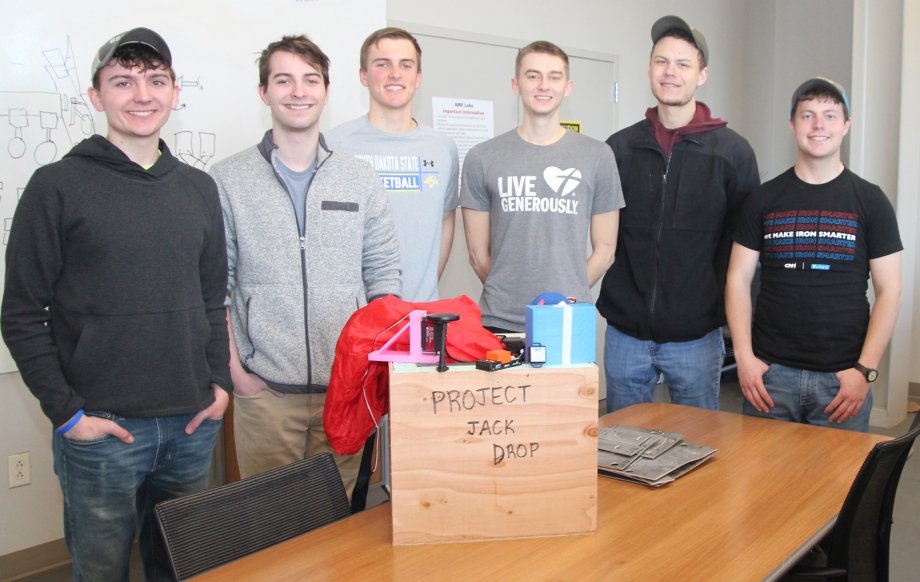
Members of Project Jack Drop gather around the protective box, parachute, data storage vault, computer and motors that will be taken to 120,000 feet on a NASA balloon and then released. The students are one of six teams chosen in the NASA contest. Pictured, from left, are Zack Strong, Adam Forman, Evan Talcott, Brett Wartner, Braydon Crawford and Ben Brainard.
“We have a couple of design reviews yet; NASA is very careful about what goes up on their balloons,” he said. “Assuming all goes well, we’ll go to New Mexico later this summer for testing on their balloon. The students are in full-time jobs, so it will be a little bit of a joint effort, but much of the event is over a weekend, so we’re hoping they can attend even if they may have to go back to work while I stay for the launch.”
The students’ job placement isn’t surprising, he said.
“We’re working them hard and teaching a lot of good things, and they’re ready to go,” Letcher said. “I wanted them to stick around this summer to help on the projects, but they have too many good offers and have to go to work. There’s 100 percent job placement.”
And the students’ hands-on, real-life experience is a definite contributing factor.
“When they went to their job interviews, I heard a lot that all the interviewer wanted to talk about was their NASA project,” Letcher said. “At most schools, you don’t get to do real projects like this – especially as an undergraduate. This is as real as it gets.”
To learn more about the mechanical engineering program at SDSU, click here.
Share This Story
Most Recent
Videos

Looking amazing @dtsiouxfalls and @washpav! Thanks to @jpickthorn for capturing an incredible night.
Nov 26

Enjoy this glow headed into Halloween week! 📸: @jpickthorn
Oct 31
Hope you had a wonderful summer weekend and are recharged for the week ahead! 📸: @jpickthorn
Jun 27
Beautiful way to start a week! 📸: @jpickthorn
Jan 10
Favorite flyover of the year! Merry Christmas from our entire @pigeon605news flock. 🎄🐦 📸: @actsofnaturephotography
Dec 24
They definitely deserve to be treated like holiday royalty and they were! ❤️ these scenes from tonight’s lighting celebration at @sanfordhealth Children’s Hospital. 🎄
Dec 1
The holidays are here! Perfect night @dtsiouxfalls
Nov 27
Happy Halloween from @avera_health NICU babies! Link in bio to see more! 🎃
Oct 31
Did you know @dtsiouxfalls is filled with 👻 stories? Link in bio … if you dare 😱
Oct 8
When it comes to kids parties nobody wants to be cookie-cutter. Link in bio for the story on what’s trending.
Sep 28
Want to stay connected to where you live with more stories like this?
Adopt a free virtual “pigeon” to deliver news that will matter to you.





Are you a little bird with something to share?
Delivering news that matters to you
Years ago, homing pigeons were used to bring us news we needed. Today, your virtual “pigeon” will deliver what you want to know about the place you call home.
All pigeons are free to good homes!
Our Partners