
25 years later: How Avera came to be
This piece is sponsored by Avera.
This year marks Avera’s 25th anniversary as a health system. These big anniversaries are a good time for reflection of what brought the Benedictine and Presentation Sisters together as sponsors of Avera.
Though some of the hospitals within the Avera system date back to the early 1900s, the Avera health system is rather young.
Before Avera was formed in 2000, the Sisters operated two separate health systems, which together comprised 13 hospitals and nursing homes. Today, Avera is a $3.2 billion organization with 315 locations in 100 communities, including 37 hospitals and 40 senior living facilities. Avera serves a population of 1 million across a 72,000-square-mile footprint.
Twenty-five years ago, Sister Jacquelyn Ernster was prioress of the Benedictine Sisters of Yankton and Sister Virginia McCall was congregational president of the Presentation Sisters of Aberdeen. Both shared some “living history” about the formation of a unique co-sponsorship model. (The Sisters were interviewed in 2020; Ernster passed away in 2021.)
Collaboration became imperative in the 1980s
Even as early as the 1980s, the Sisters started working together in some ways through the Benedictine and Presentation Health Alliance. It was more like a collaboration than co-sponsorship.
“Bringing our ministries together in a stronger way seemed like it was a good idea – but more than that, it was almost an imperative. Health care was becoming more complicated,” Ernster said.
In the early 1990s, the Presentation Sisters had assigned a task force to begin looking into different options. “We knew to be significant we needed to be something bigger,” McCall said. “When the Benedictines approached us and wanted to consider entering into joint sponsorship, we were not yet ready to do that. We needed time to work with our hospitals to unite them.”
Conversations bring realization of common goals
Four years later, the Benedictines were still interested, and the time seemed right for the Presentation Sisters as well.
“We saw this as a ministry of the church, not ours. We wanted to offer Catholic health care in this area, in rural areas and to serve the underserved and poor,” McCall said.
For decades, the Sisters had co-existed in South Dakota. But until they started talking about co-sponsorship, they didn’t realize how much they had in common.
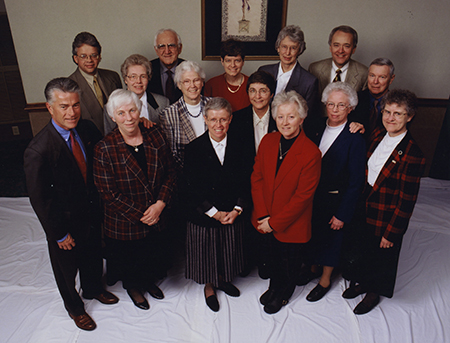
In the early 1880s Bishop Martin Marty went to Ireland and brought Presentation Sisters to the Dakotas to serve as teachers; during that same time frame, he also went to Switzerland and brought Benedictines to the Dakotas as educators. Both orders were called into the ministry of healing by the turn of the century and were founding new hospitals on the plains of the Upper Midwest.
They learned they shared a common culture and common values in operating a health care system: compassion, care for the poor, collaboration, empowerment of lay leaders and local autonomy.
“Initially, I don’t think we knew each other very well,” Ernster remembered. Some social events gave the Sisters time to engage in conversations. “For us to be comfortable, we needed to feel like the mission would be carried on – in whatever form this would be.”
Focusing on the mission in big business of health care
“Our Sisters were concerned the mission could be lost in the big business of health care. We wanted to make sure it remained Catholic,” McCall agreed.
“Our Sisters prayed together and individually and would listen to where the Spirit was leading us. It was a decision made by all of us, not just the leaders,” she said.
While it was a visionary decision for both orders, no one could have predicted what Avera would become. Over the years, the Sisters have focused on growth that serves the health system’s mission and what’s in the best interest of patients, employees, communities and facilities.
“I think part of the success of it came because there was an openness on both sides that allowed it to happen,” Ernster said. “The Presentation Sisters were willing to see us as equal partners in this new entity. More than once, I was impressed by their sincerity and their foresight.”
“Very soon after we formed the system, the Sisters felt a sense of pride in being part of it,” she said. “The Sisters enjoyed having an equal voice at all of the various levels.”
Accomplishing more together than alone
After the formation of Avera, McCall went to Zambia in 2006 and spent most of the next 12 years there. On her visits back to South Dakota, she remembers being amazed by the new partnerships that were formed and the innovative technology that was evolving at Avera such as telemedicine.
She also is amazed at how the employees have followed in the footsteps of the Sisters by putting the mission at front and center.
“Working together for the good of all was our priority. We knew we could do more together than each sponsor could alone,” Ernster said.
“We have learned from each other and supported each other through some hard issues that had to be faced over the years,” McCall said. “I remember it as a life-giving time.”
Learn more about Avera at Avera.org/Balance.
Share This Story
Most Recent
Videos



Looking amazing @dtsiouxfalls and @washpav! Thanks to @jpickthorn for capturing an incredible night.
Nov 26

Enjoy this glow headed into Halloween week! 📸: @jpickthorn
Oct 31
Hope you had a wonderful summer weekend and are recharged for the week ahead! 📸: @jpickthorn
Jun 27
Beautiful way to start a week! 📸: @jpickthorn
Jan 10
Favorite flyover of the year! Merry Christmas from our entire @pigeon605news flock. 🎄🐦 📸: @actsofnaturephotography
Dec 24
They definitely deserve to be treated like holiday royalty and they were! ❤️ these scenes from tonight’s lighting celebration at @sanfordhealth Children’s Hospital. 🎄
Dec 1
The holidays are here! Perfect night @dtsiouxfalls
Nov 27
Happy Halloween from @avera_health NICU babies! Link in bio to see more! 🎃
Oct 31
Did you know @dtsiouxfalls is filled with 👻 stories? Link in bio … if you dare 😱
Oct 8
When it comes to kids parties nobody wants to be cookie-cutter. Link in bio for the story on what’s trending.
Sep 28
Want to stay connected to where you live with more stories like this?
Adopt a free virtual “pigeon” to deliver news that will matter to you.





Are you a little bird with something to share?

Delivering news that matters to you
Years ago, homing pigeons were used to bring us news we needed. Today, your virtual “pigeon” will deliver what you want to know about the place you call home.
All pigeons are free to good homes!
Our Partners