

From football hopeful to filmmaker, Isaac Schubert sees stories worth telling
By John Hult, for Pigeon605
Filmmaker Issac Schubert gave half his life to a football career that never blossomed.
The Madison High School standout tore an Achilles tendon during his freshman season at the University of Sioux Falls, sidelining him into the years of physical therapy it took to retrain his body to do the things it had done since he first fell in love with football at age 10.
He lived a football life through it all. He spent three years “going to every lift, meeting, practice and workout to get back from that injury,” but the journey was a long one.
“Even after I was healed, that ability to not think about what I wanted to do and instead just do it … that wasn’t there for like three years,” Schubert recalled during a recent interview.
By his senior year in 2019, the special teams playmaker and running back hopeful was finally ready to rejoin his team.
It wasn’t to be. He blew out a knee in a punt drill that fall, putting an end to both his season and his dreams of collegiate gridiron glory. As fate would have it, however, the coaches and support staff at USF had another opportunity for Schubert. The school had video cameras and editing software, but no one to use it.

After intense weeks of self- and instructor-guided media training, Schubert became the Cougar football team’s official videographer. He had free rein to use the school’s equipment, on-field and locker room access to everyone on his team and the coaching staff, and a seat on the bus or plane for every game. He later would expand his coverage to the USF basketball squad.

He spent hours on YouTube to learn about lighting, camera angles and editing techniques, vowing to incorporate at least one new editing skill into each highlight video.
When he graduated with an exercise science degree, Schubert decided to go all-in. He launched Umba Productions, a company that specializes in sports videography, social media marketing and brand development consultation. His first set of post-collegiate projects saw Schubert documenting the day-to-day lives and matches of minor league mixed martial artists with the Las Vegas-based Legacy Fighting Alliance.
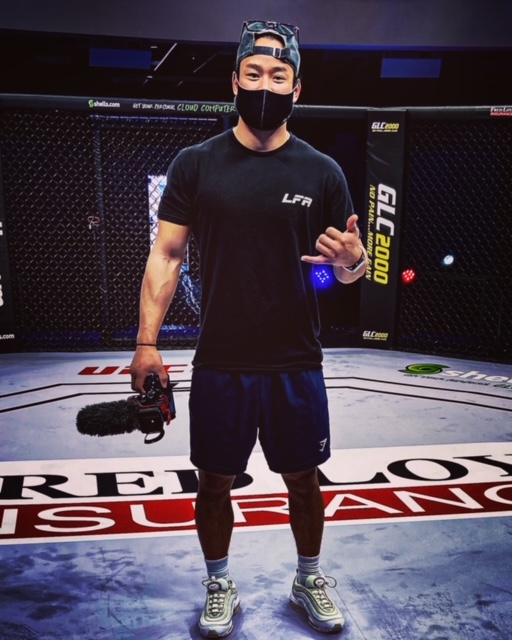
“I used that season to learn those skills,” Schubert said. “Now, I’m using those skills and turning it into a business.”
The name “Umba” is Swahili for “story,” a business name inspired by his early years in Tanzania. Born in Seoul, South Korea, and adopted by missionary parents from Hills, Minnesota, and Lobethal, South Australia, Schubert and his family eventually would settle in Madison, where his physical size gave him a built-in advantage on the football field.
He loved the game over nearly everything and never gave a thought to something like filmmaking, but one childhood memory stands out as oddly prescient as he looks back on it today. His mother once bought him a disposable camera for a Boy Scout camp, which he used to snap a photo of a friend cruising down a slide. When she developed the photos, his mother picked that snapshot out from the pile and mentioned that it was particularly well-composed.
He didn’t think much about that moment until years later, when he got similar feedback for some of his first video work.
Schubert started to realize that he may have been built for something more than football after all: he had a natural eye.

The positive feedback on those initial USF videos, his connection to the team and his access to a high-end production allowed Schubert the chance to build his own style, inspired by influencers like travel vlogger Sam Kolder.
“I basically tried to mirror everything I saw on Instagram,” Schubert said. “I was in a position where I was able to try a lot of the same things they were trying.”
His commitment to learning stood out to Nancy Sutton, a media professor at USF who saw Schubert join her communications students in two classes his senior year. Schubert was like a sponge, she said, soaking up lessons from class and seeking his own in his free time.
Much of that time was spent in the school’s studios, one of which Schubert rearranged to suit the higher-end audio needs of musicians. Schubert not only edited his videos but also recorded music to soundtrack the clips.
“He would stay there every night until security kicked him out,” Sutton said.
Schubert had gone along on the USF media department’s international trip before his senior year, and Sutton suspects he was “bitten by the bug” of video production along the way. Between his passion in class and his rapidly growing skill set, Sutton was happy to back him up when the time came to approach the athletics department about the possibility of the “extraordinary young man” serving as the football team’s videographer.
“He was my student, but really he’s my peer,” said Sutton, who spent more than three decades in television production across the U.S. before returning to her home state as a teacher. “He has an uncanny knack for the business side of things. He did everything he needed to do, learned what he needed to learn, and then he found his niche.”

That keen business sense became even more apparent after his initial stint as the USF team videographer. His next big opportunity came through sideline connections built at the Sanford Pentagon and, oddly enough, the COVID-19 pandemic.
He’d gotten to know Sanford media specialist Terry Vandrovec while covering basketball practices at the Pentagon. Shortly before a Legacy Fighting Alliance event at the facility, Vandrovec rang Schubert to tell him he’d be getting a call from a Las Vegas number and that he’s “gonna want to pick up.”
The LFA’s photographer had a positive COVID test, Schubert learned, and the promoter needed a photographer. He hadn’t taken stills in years, but he said yes and spent the next few weeks immersed in self-taught photography boot camp.
“I shot that event, then I stuck around for a few more in Sioux Falls,” Schubert said. “After that, the higher-ups in the company said ‘let’s bring this kid along.’”
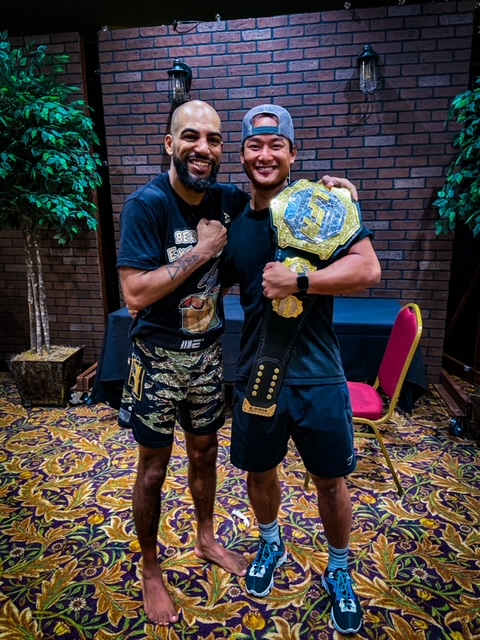
In the months that followed, Schubert spent weeks at a time in Kansas and New Mexico, filming training camps and events. He successfully pitched the concept of “LFA Diaries,” a video series that trailed up-and-coming fighters to tell the stories of their daily lives, their wins and losses, and the personal joy and heartbreak that goes along with living an athlete’s dream.
He documented winners like Kamuela Kirk, who calls himself “the Jawaiian” for his Jamaican and Hawaiian heritage and recently made his Ultimate Fighting Championship debut, and fighters who’ve done the work but have yet to find success.
On either side of that continuum, Schubert’s goal is to cut through the statistics and tell the story. The stories of athletes are built on hard work, passion and big dreams, regardless of the outcome. That’s something to which Schubert, whose own career was plagued by injury, has a deeply personal connection.
“A lot of those stories go untold,” he said. “There are kids going through things that you wouldn’t believe, but we don’t hear about it because they’re on the sidelines.”
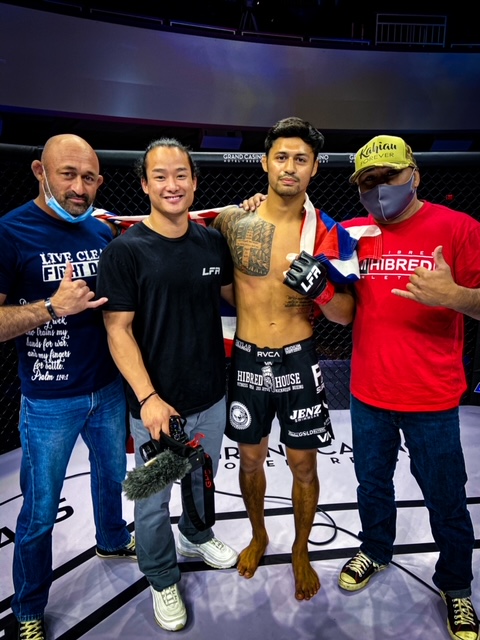
Schubert hopes to continue working with MMA in the future, but his real goals today aim even lower on the sporting food chain, with high school and college athletes. Aspiring and current collegiate standouts need to be cognizant of their brand early on, Schubert said, especially now since the U.S. Supreme Court ruling over the summer that cleared the way for college athletes to profit from their name, image and likeness. High school athletes need to be aware that their future coaches may consider their social media feeds when assessing their potential as a public representative of a college team; collegiate athletes may well be able to turn social media savvy into financial compensation.
Schubert could give those athletes the kind of basic training in video, lighting and editing that would help improve their image online, he could go all-in for clients to produce videos and marketing materials, or he could meet clients somewhere in between.
Considering the investments that athletes and their parents already make in different aspects of their development, Schubert sees an opportunity to fill a gap that has become increasingly important to higher-level success.
“Parents and kids spend so much time and money on personalized training or personalized dieting, but they’re not usually investing in personalized marketing,” he said. “My goal is to really help build these brands for these kids.”
Share This Story
Most Recent
Videos



Looking amazing @dtsiouxfalls and @washpav! Thanks to @jpickthorn for capturing an incredible night.
Nov 26

Enjoy this glow headed into Halloween week! 📸: @jpickthorn
Oct 31
Hope you had a wonderful summer weekend and are recharged for the week ahead! 📸: @jpickthorn
Jun 27
Beautiful way to start a week! 📸: @jpickthorn
Jan 10
Favorite flyover of the year! Merry Christmas from our entire @pigeon605news flock. 🎄🐦 📸: @actsofnaturephotography
Dec 24
They definitely deserve to be treated like holiday royalty and they were! ❤️ these scenes from tonight’s lighting celebration at @sanfordhealth Children’s Hospital. 🎄
Dec 1
The holidays are here! Perfect night @dtsiouxfalls
Nov 27
Happy Halloween from @avera_health NICU babies! Link in bio to see more! 🎃
Oct 31
Did you know @dtsiouxfalls is filled with 👻 stories? Link in bio … if you dare 😱
Oct 8
When it comes to kids parties nobody wants to be cookie-cutter. Link in bio for the story on what’s trending.
Sep 28
Want to stay connected to where you live with more stories like this?
Adopt a free virtual “pigeon” to deliver news that will matter to you.




Are you a little bird with something to share?

Delivering news that matters to you
Years ago, homing pigeons were used to bring us news we needed. Today, your virtual “pigeon” will deliver what you want to know about the place you call home.
All pigeons are free to good homes!
Our Partners