
Former carnival worker: ‘Don’t judge a book before you read it’
In school, classmates pegged Maryah Tople and her brother as the “weird kids” once word got out their parents were carnival workers. But to two kids who grew up traveling from town to town, that background just meant they had a second family.
McKenzie Mitcham never imagined that one day she would be one of the workers who assembled the rides that drew kids and adults to experience adrenaline-pumping thrills, but a teenage passion led her to experience carny life firsthand. Now, she looks back at those weeks of living out of a semi with a little nostalgia and a lot of amazement.
The two Sioux Falls women are only a few months apart in age, but their life paths through carnivals, such as the one now set up at the annual Sioux Empire Fair, both unites and divides them in experiences.
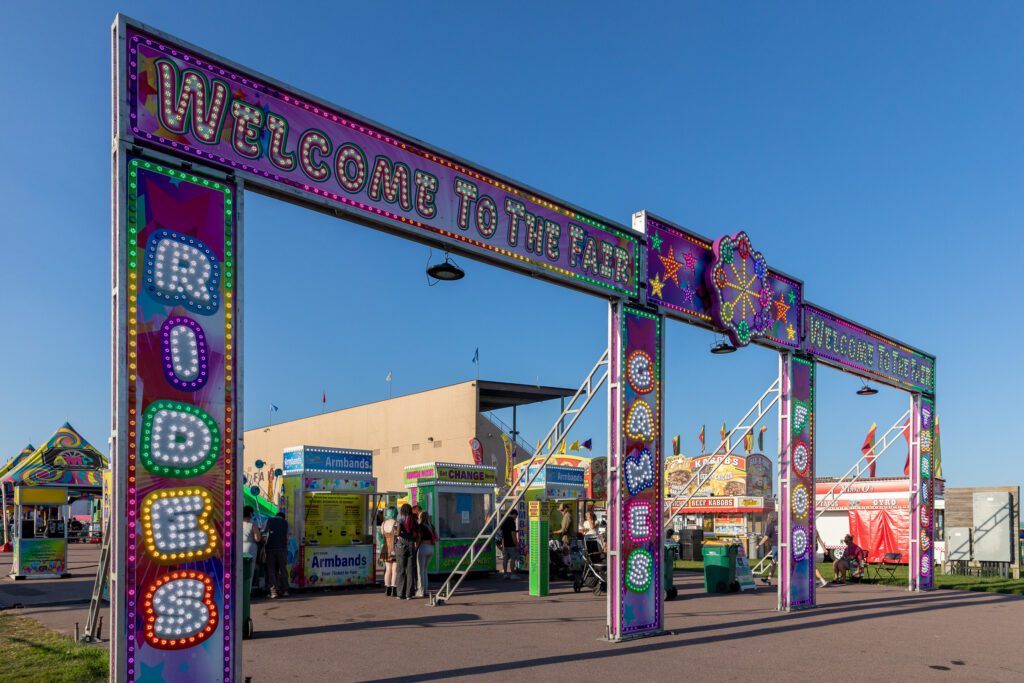
What they do share is an understanding that those who choose the lifestyle of carnival workers do so for a variety of reasons. Some enjoy the chance to travel around the country, others are self-admitted square pegs who don’t fit into the typical 9-to-5 workday round holes, others see it as a job that brings others genuine joy.
“If there’s one thing I want people to know, carnies are people too. They just have a very different lifestyle, a way of making money that is not the status quo of 9 to 5, what people would consider rat race,” Tople said. “Their main mission is to bring joy to children.”

Mitcham calls the stigma around carnival workers unfair.
“Don’t judge a book before you read it,” she advises of attitudes toward her former co-workers. “A lot of people are just trying to make a living, and maybe they didn’t have a chance to make a living in their own town. Sometimes, they’re just doing what they love. They did it for one fair and started traveling.”
‘Island of Misfit Toys’
Tople said she and her older brother are “carnival babies.” Their parents, the late Jon Spry and Heather Embry, met while working at a carnival, then married and had them. When Tople and her brother were old enough to enroll in school, Embry settled in Sioux Falls while her then-husband continued to travel year-round.
Spry was a magician and sideshow man who wrote a book, “48 States and One Trick,” about his life with carnivals. He worked at a balloon stand, urging fairgoers to try their luck popping the fluttering orbs with a dart.

His “one trick” was to use a glib line of patter to encourage people to give the game a try.
“Dad always said he lived the life of a rock star, and his main goal was to make people smile,” Tople said. “But the life of a rock star is not always glitz and glam. He did get into drugs while he was traveling from place to place, and it’s hard to get out of that lifestyle.”
Spry died in 2022 of a fentanyl overdose at the age of 48. It was May 8, Tople’s birthday.
Despite that tragic ending, Tople remembers her early years with fondness. When she was 7 and her brother 8, they joined their dad in his carnival booth. Father and children bonded then, Tople said, plus “We got to ride the rides before anyone else. That was the best payment ever.”
She also worked the goblet game, selling wiffle balls to customers who then threw them at a table full of goblets. Different colors of cups indicated what prize the person would win. Her brother would work the “wacky wire,” with a circle in the middle. Touch it, and you lose the game.
To this day, Tople, now 27, remembers the tricks behind each game. And there are tricks, she said, but that doesn’t mean the games are rigged and fairgoers can’t win, she said. Instead, they need to listen closely to the carnival worker giving out instructions.
“A lot of people go based off of their own thinking of how to win the game,” Tople said. “There’s a specific way you have to do it, and the carny shows you how. (For example,) everybody beans the ball at the board, but you have to throw it soft. A lot of it is like physics stuff and a basic knowledge of games. The ladder game, you try to make it at a certain point on the ladder. The trick is to put one foot in each corner of ladder, then one hand in each corner and keep yourself balanced.”
Tople describes the carnival workers she knew as “a second little family.” Her father would joke that they were like the Island of Misfit Toys, people who never would have met except for having one common purpose: bringing genuine joy to others, particularly children.
“When you’re able to hand a prize to a little kid and see a big smile,” Tople said. “My dad was very big on trying to make people smile. It was never about ripping people off. Dad was the type to adjust the rules a little bit.”
Tople’s mother kept a careful watch on her children, however, setting up “a million and one rules” and making sure they were safe. Tople learned that not everyone is trustworthy and that there were some people she needed to avoid.

Few carnival workers had children with them, Tople said, but she made friends she never would have known otherwise.
“I still talk to people that I’ve met from carnivals all over,” she said. “I have lifelong friendships with children that I would never have met otherwise. A carnival attracts kids.”
Tople’s family generally worked carnivals in the Midwest, such as Fairmont in Minnesota, Sioux City and Omaha. The farthest they traveled was Myrtle Beach, South Carolina.
As an adult, Tople has adapted to a 9-to-5 job, working in settlement negotiations at a financial institution. In the banking world, she sticks out, Tople admits, as a “red-headed, outspoken kid with tattoos.”
“If I’m good at what I do, it’s because of his gifts,” she said of her father.
Tople expects to visit the Sioux Empire Fair for four or five days over its nine-day run. She will take her 7-year-old son and share some of the knowledge she learned from his grandfather.

Tople has heard complaints about the increasing costs of attending carnivals. It’s a business like every other, she counters, affected by the cost of travel, money spent on food and lodging, the need to support families.
Carnivals have intangible benefits too, she said.
“You see a carny for only a few minutes at a time, but they bring joy and happiness,” Tople said. “You walk away with a prize or stuffed animals or a goldfish. People remember the day they won that giant stuffed pig for a long time.”
‘Free travel and fun’
McKenzie Mitcham had graduated from high school in Sioux Falls and was working at a convenience store when she decided some extra cash would come in handy. A friend got her a job operating one of the carnival rides at the Sioux Empire Fair.
What started out as a temporary weeklong job changed her life. Mitcham fell head over heels for a fellow carnival worker, and when the carnival packed up, so did she.

“I went home, packed up a duffle bag and took off,” Mitcham said. “Until about October of the same year, when unfortunately, I was pregnant. It turned out to be a blessing because it was enough to see it was enough. But I was able to see a lot of different places.”
That was in 2017. Mitcham, now 26, is the mother of a 6-year-old and a 2-year-old and works as a nursing assistant at Sanford Health. She and her husband, whom she met at the carnival, are divorcing.
Her life today is far removed from the weeks she spent traveling from Aberdeen to Tennessee, Louisiana, Alabama and Texas. One of the first lessons she learned: Most people belittle carnival workers and with no good reason.

“People judge very harshly,” Mitcham said. “They look down on a lot of — in air quotes — carnies. They see that stigma of ‘they’re all drug users who can’t get actual jobs to supply their drug habit.’ Not all do. For some, it’s a way of free travel and fun.”
Mitcham’s original role with the carnival was as a “ride jock,” putting up and taking down the rides and acting as the operator. Near the end of her time with the carnival, having proven her trustworthiness, the owners put her in positions to manage money. She spent a week in a company-owned food truck. That was near the start of her pregnancy, however, and proved to be an unfortunate location.

“I still can’t handle corn dogs,” Mitcham said.
Being a ride jock meant hard manual labor — and a lot of it with long days. Training was scant, with workers figuring things out as they went along.
“Toda,y I still know what to look for to see if a ride is set up safely,” Mitcham said. Don’t worry, they are, she added.
“There’s a lot of pieces and things you have to make sure are the right way. You can tell as you look at it, you can tell if something’s not put together right. Those rides do get tested daily. If it’s not running properly, they don’t typically open that ride for the day. They’re testing it and getting it fixed.”

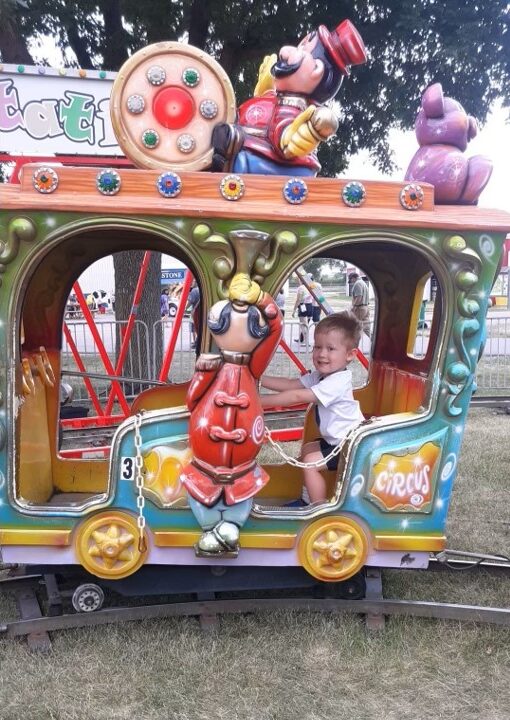
As a ride jock, Mitcham’s day could start at 8:30 or 9 a.m. and began with testing the rides and doing maintenance to make sure every ride was operational when the midway opened. She worked in the kiddie ride area, so she would scour the grounds to make sure nothing harmful had been left behind. The midway usually closed at midnight, but the ride jocks checked the equipment once more before their days ended at 12:30 or 1 a.m.
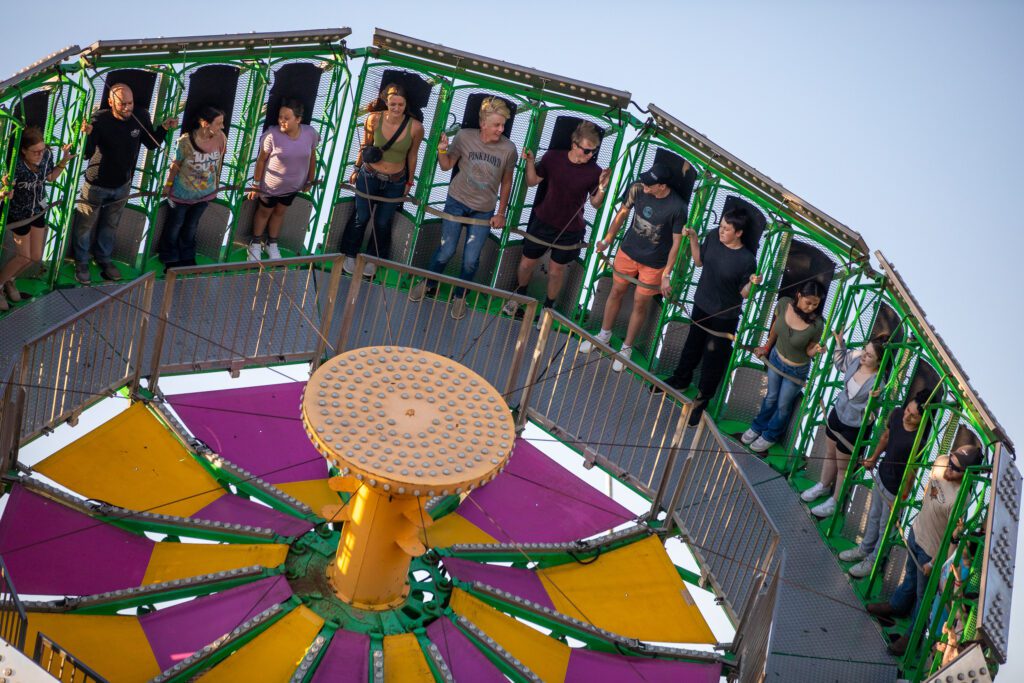
“The hours are longer than being a nurse,” Mitcham said.
Mitcham worked for two companies. One offered a “bunkhouse” for its workers, a semi-trailer with rooms in it for the carnies’ quarters. With the other company, she stayed in motel rooms during the fair and in a semi when traveling.
It wasn’t a get-rich-fast lifestyle, she said.
“Even back then, we didn’t make a lot. We made pretty much minimum wage,” Mitcham said.
A carnival is expensive to run, especially with the electricity it costs to operate the rides, she said. A carnival owner must pay for all necessities.

When it comes to choosing a ride for herself, Mitcham’s philosophy is to keep her feet as near the ground as possible. Those rides that go super-high in the air? She says no thanks.
What Mitcham misses about being a carny is the laughs she shared with her co-workers. The rides are spaced apart, so it’s possible to talk with a co-worker operating an attraction 10 feet away. It wasn’t unusual for the workers to judge fairgoers the way they knew they themselves were being judged, Mitcham said.
She knew some of her fellow carnival workers were into drugs, and friends who worked only the Sioux Falls fair told her who was safe and who to avoid.
When Mitcham tells people about her carnival experience, she knows she will face a mixture of reactions.
“A lot of people unfortunately ask me how long I’ve been sober,” she said. “A lot of people have the stigma of glorified homelessness. I try to assure them that’s not 100 percent the case. I was talking to my co-worker about it the other day, and it was a very heated conversation.”

As with others who work in retail, sometimes the public treats those who chose the carnival lifestyle with disrespect, Mitcham said.
“They’re people, too, just trying to do their jobs,” she said. “They’re trained, so listen to them. If you’re not going to listen, you shouldn’t go. If you’re not being safe, you shouldn’t go.”
Mitcham plans to take her children to the Sioux Empire Fair if she can fit it around her work schedule. She wants to see the fair again through their eyes.
“When my oldest was younger, we were able to go out a bit more often than the last two years,” Mitcham said. “She loves the lights and just being out there and just the sounds. I’m going to love to see how she reacts now that she’s older and able to go on the rides.”
Fiesta Latina, massive slide among new additions at Sioux Empire Fair
Share This Story
Most Recent
Videos



Looking amazing @dtsiouxfalls and @washpav! Thanks to @jpickthorn for capturing an incredible night.
Nov 26

Enjoy this glow headed into Halloween week! 📸: @jpickthorn
Oct 31
Hope you had a wonderful summer weekend and are recharged for the week ahead! 📸: @jpickthorn
Jun 27
Beautiful way to start a week! 📸: @jpickthorn
Jan 10
Favorite flyover of the year! Merry Christmas from our entire @pigeon605news flock. 🎄🐦 📸: @actsofnaturephotography
Dec 24
They definitely deserve to be treated like holiday royalty and they were! ❤️ these scenes from tonight’s lighting celebration at @sanfordhealth Children’s Hospital. 🎄
Dec 1
The holidays are here! Perfect night @dtsiouxfalls
Nov 27
Happy Halloween from @avera_health NICU babies! Link in bio to see more! 🎃
Oct 31
Did you know @dtsiouxfalls is filled with 👻 stories? Link in bio … if you dare 😱
Oct 8
When it comes to kids parties nobody wants to be cookie-cutter. Link in bio for the story on what’s trending.
Sep 28
Want to stay connected to where you live with more stories like this?
Adopt a free virtual “pigeon” to deliver news that will matter to you.





Are you a little bird with something to share?

Delivering news that matters to you
Years ago, homing pigeons were used to bring us news we needed. Today, your virtual “pigeon” will deliver what you want to know about the place you call home.
All pigeons are free to good homes!
Our Partners