

Family puts a face on the need to end child sexual abuse in South Dakota
This paid piece is sponsored by Children’s Home Society.
Trigger warning: Child sexual abuse
Tyler’s* family was living at a long-term-stay hotel with other unhoused individuals and families. He and his older two siblings were old enough to stay in their room while their parents went to the grocery store.
While his parents were out, Tyler, 11, went out into the hallway. He happened to run into a man who also was staying at the hotel. The man, who was in his 30s, asked Tyler if he wanted a toy. Tyler followed the man to his room.
Once he was in the room, the man gave Tyler a toy and said he had more gifts for him and his family. He said they could be buddies. They sat on the bed together talking, and Tyler relaxed a little.
Gradually, the man took off Tyler’s shoes. He said as buddies, they could touch each other in a friendly way. He pulled Tyler’s pants down and eventually his underwear. He asked Tyler to get on top of him, and when Tyler tried to get off, the man held him tightly in place, touched his genitals and digitally penetrated him. Tyler finally got out of the man’s room. When his parents returned, he told them what happened, and immediately they took him to the hospital.
Children’s Home Child Advocacy Center received a referral the following day from local law enforcement. Because of the acute nature of the case, Tyler was forensically interviewed the same day the referral came in. Lead forensic interviewer Brandi Tonkel conducted the interview, and family advocate coordinator Jennifer Arnold met with the family.
“The situation was traumatic for the family, and as we connected with them, we realized that they had many other needs,” Arnold said. “We provided hygiene products, winter coats and a gift card for groceries (thanks to our generous donors). I referred Tyler for counseling with Monica Eaton-Harris and the family to our intensive case management program, which helps families at risk for system involvement obtain access to resources necessary for success.”
Family engagement specialists Loree Crawford and Sarah Crawford helped the family with parenting skills, housing, behavioral problems in school, financial and credit issues, life skills and employment. Other family members began counseling as well.
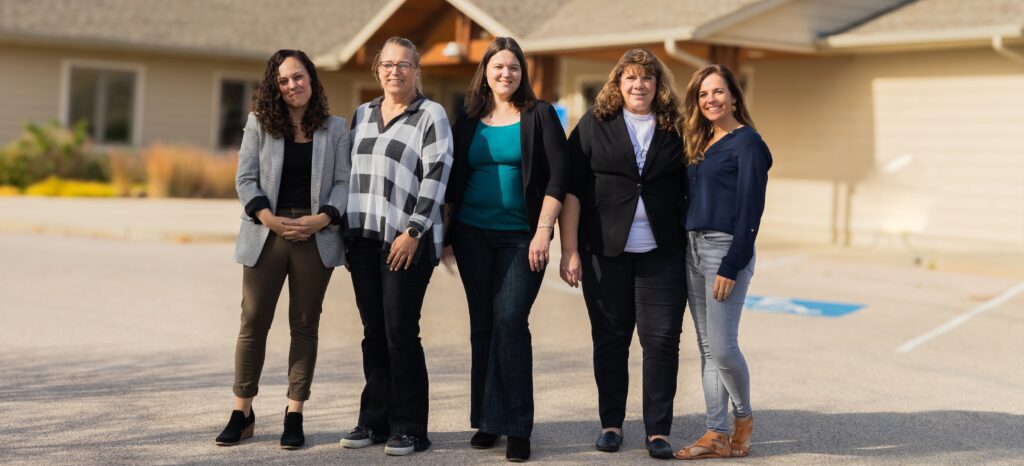
Lead forensic interviewer Brandi Tonkel, family engagement specialist Sarah Crawford, forensic interviewer Monica Eaton-Harris, family engagement specialist Loree Crawford and family advocate coordinator Jennifer Arnold of Children’s Home Society.
“It can be a challenge for families to get back on their feet and make lasting changes when their circumstances require them to focus on meeting daily needs such as food and shelter,” Arnold said. “Case management was a blessing for this family as they were able to get plugged into services at a volatile time in their life.”
Justice is served
Today, Tyler’s father has a good job. The family has moved into an apartment. The children are doing well in school. Tyler responded well to therapy. It helped him process his feelings about the abuse. When it came time to testify, he was more confident and felt mentally safer.
The offender pled to a charge of sexual contact and received an 18-year sentence. A conviction is rare in sexual abuse cases — less than 5 percent. “Justice is defined differently by every victim and victim’s family,” Arnold said. “We know a conviction can never take away a victim’s experience, so we meet families where they are and encourage their journey of healing.”
Jennifer Arnold shares her perspective
“Children’s Home Child Advocacy Center is a safe place where children and teens can share what happened to them. It’s also where caregivers can feel heard, empowered and supported. A child’s resilience is based solely on how well their caregiver is doing, so it’s imperative to include them every step of the way,” Arnold said.
“Many moms and caregivers end up revisiting their own abuse, which often bubbles to the surface when something like this happens. They’ll say, ‘I wish there had been a place like this to tell my story because it was handled so differently.’ I refer a lot of caregivers to counseling to work through those memories.
“If we approach the family holistically, the child’s trajectory is much more favorable. Not only do children and families have a better chance to heal and thrive, but the community benefits as well.”
Report child abuse at 877-244-0864, or call 911 if the child is in danger.
What is a Child Advocacy Center?
The purpose of Child Advocacy Centers, first created in 1985, is to provide children with a safe place to share their story of trauma to experts who will listen and help them heal.
Before CACs existed, children relived the trauma of abuse by repeating their story numerous times to police, medical professionals, child protection specialists and others. Today, there are more than 900 CACs nationwide. CACs typically accept referrals only from law enforcement.
Children’s Home Child Advocacy Center is located in Rapid City. Its Sioux Falls counterpart is Child’s Voice at the Sanford USD Medical Center. The Child Advocacy Center in Pierre is the Central South Dakota Child Assessment Center, and in Pine Ridge, it is the Oglala Lakota Children’s Justice Center.
Multidisciplinary teams and co-location
Child abuse cases are complex and often involve many organizations throughout the process. Communication and coordination are key in these situations to better enhance positive outcomes for children/youths and their caregivers.
Under the CAC model, a multidisciplinary team works together in a coordinated manner to ensure an effective response to reports of child abuse and neglect, including the following collaborative disciplines: law enforcement, child protective services, mental health, medical health, prosecution and victim advocacy.
Partners co-locate at Children’s Home Child Advocacy Center on a rotating basis. These include the State’s Attorney, County Sherriff’s Office, Division of Criminal Investigation and Child Protective Services. Other identified team members such as other law enforcement, mental health professionals or medical professionals also use the co-location office as needed.
Learn more about child sexual abuse
Abuse occurs in all neighborhoods and communities, regardless of economic class, ethnicity or religion. Unfortunately, only 20 percent to 40 percent of child sexual abuse is ever reported to authorities.
What is sexual abuse?
Sexual abuse is any sexual activity with a child in which consent cannot be given or is not given. This includes all sexual contact between an adult and a child; sexual contact between two children if there is a significant difference in age, development or size; and sexual contact with a child that is accomplished by force or threat of force, regardless of the perpetrator’s age.
Sexual abuse can include physical contact and noncontact behaviors such as exposing the child to pornography, talking in sexually explicit ways to children or inappropriately watching a child undress or use the bathroom. Sexual abuse can occur in person, over the phone or online.
Who are perpetrators?
In over 90 percent of child sexual abuse cases, perpetrators know the child victim personally. They are family members, teachers, child care providers, friends or neighbors. These perpetrators gain children’s and caregivers’ trust and have permission to be around the child on a regular basis.
How does abuse happen?
Abuse most often starts with “grooming,” a series of manipulative behaviors that escalate over time. For example, a perpetrator may begin by giving the child extra attention such as buying them gifts and playing games. Grooming behaviors establish trust between the perpetrator, the child and the child’s caregivers. This trusting relationship makes it more likely that the abuse will be overlooked, dismissed or kept secret.
Signs that a child may be sexually abused
Children often disclose abuse through unusual behaviors or changes in behaviors, not words. Because many forms of abuse are not physically evident, adults should recognize certain behavioral cues as signs of potential abuse. Consider the possibility of abuse when a child is:
- Hesitant about being alone with a specific adult or child.
- Showing sophisticated or unusual sexual knowledge or behavior.
- Refusing to change for or participate in physical activities.
- Having nightmares, trouble sleeping or bed-wetting.
- Experiencing pain when sitting, walking or using the bathroom.
- Showing signs of depression, anxiety, aggression or suicidal ideation, including cutting and other forms of self-harm.
- Pregnant or contracts a sexually transmitted infection, particularly if younger than 14.
If you suspect abuse, call the child abuse hotline at 877-244-0864 right away. It is not your responsibility to investigate abuse, interview the child or get all the facts. Just contact the authorities with your suspicion so that children and families get the support and care they need. If a child is in immediate danger, also call 911.
If a child discloses abuse
DO:
- Practice your response before the situation arises.
- Ensure your body language conveys to the child that you hear and believe what they are telling you.
- Write down the exact words the child used in the disclosure.
- Thank the child for having the courage to tell you.
- As soon as possible, inform the child what will happen next with reporting.
- Report the abuse.
- Protect the child by not discussing the disclosure with others.
DO NOT:
- Use shocked or disbelieving body language.
- Express doubts to the child if you are skeptical.
- Record the child’s statement.
- Ask the child to repeat their statement.
- Suggest or guess that the child might have been abused.
- Make a conclusion about the validity of the allegation.
- Ask the child any questions.
Reasons why children may not tell
There are many reasons why children may not disclose abuse. Because most abusers have a close relationship with the child and their family, the child may worry about getting their abuser or themselves in trouble. Many abusers make threats to ensure that victims do not tell.
Other reasons victims may not tell include:
- Shame or embarrassment.
- Fear that they will not be believed.
- Fear that they will be blamed.
- Worry that their parents will be upset or angry.
- Fear that disclosing will disrupt or separate the family.
- Limited language or developmental ability.
Remember, children often indicate something is wrong through behaviors, not words. It can take a child weeks, months, years or an entire lifetime to fully reveal abuse using words.
Facts about disclosures
- Very young children tend to accidentally reveal abuse.
- School-aged children tend to tell a caregiver.
- Adolescents are more likely to tell friends.
- Children with intellectual disabilities tend to show through changes in behavior.
- Many children have not been given the tools to understand that the abuse was wrong.
Truth in disclosures
Children seldom lie about abuse. If a child discloses abuse, report what you know to the authorities; they will determine the facts and evidence. In rare instances when a child does lie about abuse, it can be an indication that something else is wrong.
In many cases, there are no physical signs that sexual abuse has occurred. If there are signs, they may include redness, abrasions, lacerations, evidence of semen or sexually transmitted infections.
Internet safety
Child sexual abuse happens online too. As adults, we can prevent abuse by staying informed about children’s online activities and maintaining open communication. Ensure that your children know that they can come to you if anything makes them uncomfortable.
Recognize warning signs of online abuse
Abuse most often starts with a series of manipulative behaviors that escalate over time. Warning signs of potential abuse can include:
- Sudden excessive amount of screen time that is not typical.
- Extreme emotions related to devices or particular aspects of internet use.
- Withdrawing from friends and family.
- Minimizing screen or turning off monitor when others enter the room.
- Communicating with or receiving gifts in mail from unknown people.
- Having private passwords.
Internet safety reporting
Online safety violations should always be reported to the National Center for Missing and Exploited Children’s National CyberTipline: 800-843-5678, which is answered 24/7, or report.cybertip.org.
Preventing child sexual abuse
We can create communities where sexual harm does not impact children by taking a few important steps ourselves and encouraging those around us to do the same. Learn more about preventing child abuse here.
Report child abuse at 877-244-0864, or call 911 if the child is in danger.
* Privacy policy: To protect the privacy of the children and families we serve, it is our practice, unless otherwise noted, to use names and photos that represent our stories and ensure confidentiality.
Share This Story
Most Recent
Videos



Looking amazing @dtsiouxfalls and @washpav! Thanks to @jpickthorn for capturing an incredible night.
Nov 26

Enjoy this glow headed into Halloween week! 📸: @jpickthorn
Oct 31
Hope you had a wonderful summer weekend and are recharged for the week ahead! 📸: @jpickthorn
Jun 27
Beautiful way to start a week! 📸: @jpickthorn
Jan 10
Favorite flyover of the year! Merry Christmas from our entire @pigeon605news flock. 🎄🐦 📸: @actsofnaturephotography
Dec 24
They definitely deserve to be treated like holiday royalty and they were! ❤️ these scenes from tonight’s lighting celebration at @sanfordhealth Children’s Hospital. 🎄
Dec 1
The holidays are here! Perfect night @dtsiouxfalls
Nov 27
Happy Halloween from @avera_health NICU babies! Link in bio to see more! 🎃
Oct 31
Did you know @dtsiouxfalls is filled with 👻 stories? Link in bio … if you dare 😱
Oct 8
When it comes to kids parties nobody wants to be cookie-cutter. Link in bio for the story on what’s trending.
Sep 28
Want to stay connected to where you live with more stories like this?
Adopt a free virtual “pigeon” to deliver news that will matter to you.
Read More






Are you a little bird with something to share?
Delivering news that matters to you
Years ago, homing pigeons were used to bring us news we needed. Today, your virtual “pigeon” will deliver what you want to know about the place you call home.
All pigeons are free to good homes!
Our Partners