

As e-bikes rise in popularity, communities and industry grapple with policies
It’s a more controversial subject than you might think.
Do electric-assist bicycles belong on the bike path? The street? Should you have to be a certain age to ride them? How much can you modify them before they turn into a motorcycle or moped? What kind of tax credit should you get if you buy one?
These are the questions cyclists, city government officials, parents and manufacturers are trying to answer. E-bikes, or human-powered bicycles with a motorized assist, have exploded in popularity, seeing a 145 percent rise in sales in 2020 and outselling electric cars that year at a rate of 2-to-1, according to The New York Times.
In Sioux Falls, e-bikes have seen a similar rise in popularity – and concern.

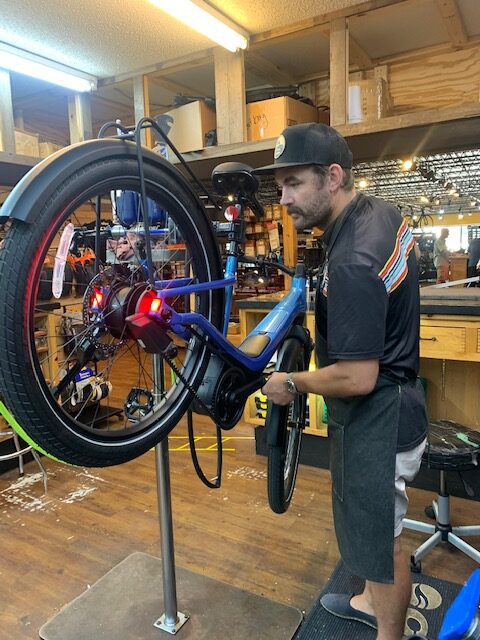
“On average, about 50 percent of our conversations at the store are about e-bikes — curiosity on what they are and how they work and where you can use them,” said Chad Pickard, owner of Spoke-N-Sport. “It might be someone coming in to buy a pedal bike, but they maybe want their husband to ride with them, or someone has health issues and can ride a little bit but wants to ride more.”
That’s how it started for Bridget Page. She and her husband, Elisha, have always been cyclists. But when their children were born, like many new parents, they struggled with new logistics.
“Do we get a bike trailer, or how does this work with kids,” Page said. “Also, I’ve never been a super-confident biker. I have fun, but I worry what if I can’t get up this hill, and then add a kid to it, and it was just overwhelming.”
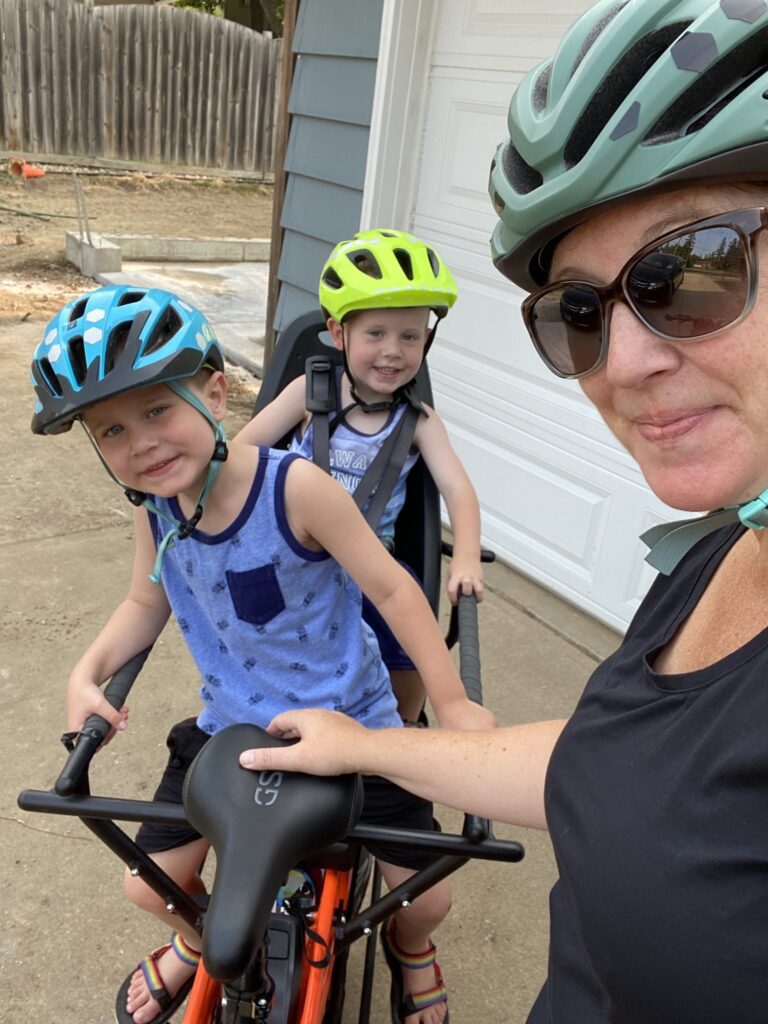
She saw a neighbor with an e-bike, and after a bit of trial and error, she found one that fit her and her lifestyle. “I feel so much more confident, knowing that I am not going to get stuck somewhere. Our street has a big hill.”
She and her two sons ride to the park and around the neighborhood.
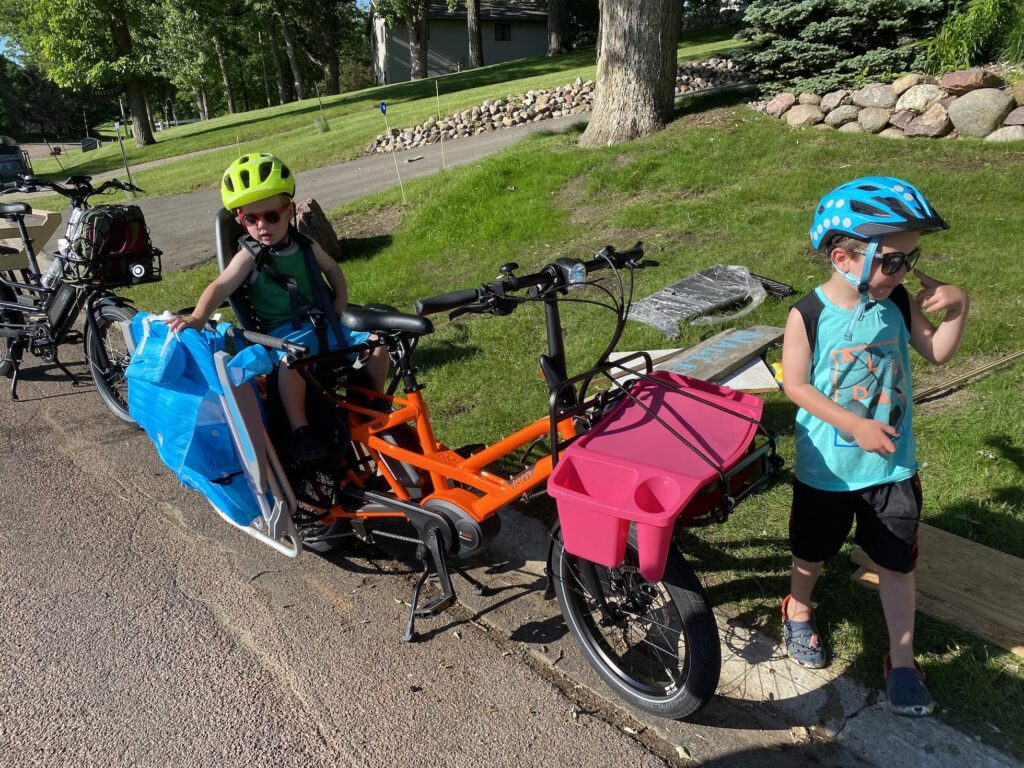
Pickard said she’s exactly like many of his e-bike customers. “We see parents buy cargo e-bikes because they want a healthy alternative to putting the kids in the car and driving somewhere,” he said.
For others, it’s to make what might be a long commute into something doable with a little motorized assistance. E-bikes start at about $2,500, and Pickard recommends buying from a local shop rather than online, where you can’t guarantee quality or safety.
Where to ride
Once you buy one, you have to figure out where to ride it. E-bikes come in four classes: 1, 2, 3 and “out of class.” Class 1 e-bikes allow assist up to 20 mph, which means you have to be pedaling for that to work. Once you hit 20 mph, the assist stops, and you rely on your own power. Class 2 allows for a throttle-based system, meaning you don’t have to pedal for the assist to work, but it still cuts off at 20 mph. Class 3 is pedal assist, but it goes up to 28 mph. Anything outside of those parameters is considered “out of class.”
“Anything that doesn’t fit in that class system and goes more than 20 mph with a throttle only is a motorcycle,” Pickard said. “It’s going to need insurance and have a licensed rider and mirrors and headlights and turn signals and anything that a motorcycle has. I don’t think people realize that.”
Class 1 e-bikes are the only ones allowed on the bike trail. “They can be ridden anywhere a bike can be ridden,” Pickard said. Class 2 and 3 are allowed only on the road, and “out of class” technically isn’t allowed anywhere.
“A lot of people are going to look at this and say, ‘my kid is on a motorcycle, and it’s supposed to be an e-bike,’” Pickard said. “As new things are invented, we need to change our laws accordingly at the city and state level.”
Cycling advocates and business owners met with city officials to allow Class 1 e-bikes on the bike trail. “There is a growing category of people who want to be outside and want to do what the bike trail was designed for, which is recreation,” Pickard said. At the state level, class 1 and 2 bikes are allowed on state trails, such as in a state park.
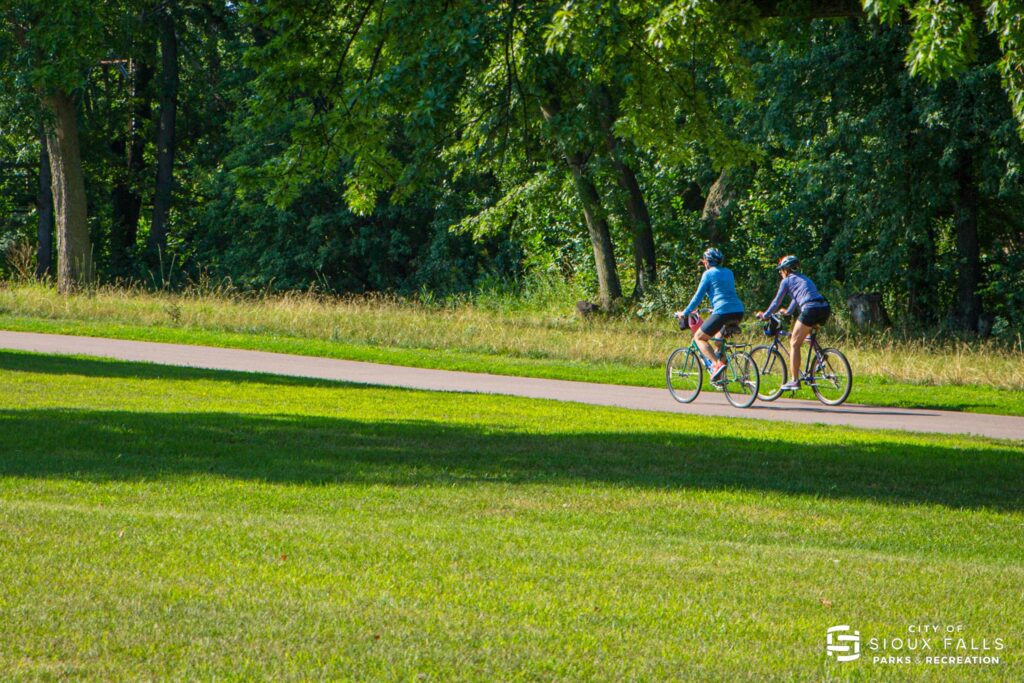
In Sioux Falls, the bike trail is designated a multiuse trail, and it has a posted 15 mph speed limit. Not every cyclist – e-bike or not – respects that. But it was one of the recent moves to set expectations for those who use the trails.
“We’ve been seeing there are a lot of different e-bikes out there than what there were in the past several years,” said Sam Trebilcock, transportation planner with the city of Sioux Falls. “There are a lot that are like a moped. You wonder if someone has to pedal at all on some of them. So those are bringing forward more questions about how those are being regulated.”
Trebilcock said Class 1, 2 and 3 e-bikes all are allowed on the road. “But those out of class ones, I don’t think we know how to regulate it yet because it doesn’t match anything,” Trebilcock said. “Generally, the view of the city is, especially on trails, there has to be some human power to the e-bike. You can’t be out there just using a throttle to get around. It’s the speed limit too. Some of them are capable of going over 20 mph, and when that happens, that’s a problem too.”
Policy shifts
Sioux Falls isn’t unique in trying to match city ordinances to advances in e-bikes. Those considerations nationally are everything from rider safety to environmental concerns. At the federal level, the Build Back Better climate policies, originally proposed last fall, included a $900 tax credit for e-bikes. That didn’t make it into the final legislation, but it shows the growth of incentive programs for e-bikes.
“A lot of states and municipalities are trying to show progress on climate initiatives, and this is an easy and tangible way” to do that, said Ash Lovell, electric bike policy and campaign director at PeopleForBikes, Axios reported.
The same report noted that about 80 e-bike incentive programs are active, have been proposed or completed across the U.S. and Canada, according to a tracker maintained by Portland State University’s Transportation Research and Education Center.
Many of those are meant to reduce commuting costs and car dependence for low-income people, the report said. Incentives range from rebates to point-of-sale discounts.
While those are all positive developments for cycling advocates, cities still need to adapt their ordinances and infrastructure to keep riders safe. The same Axios story noted that cities tend to build infrastructure with traditional two-wheelers in mind, and emerging e-bikes present a challenge.
Recently, the parents of a 12-year-old girl who died from injuries while riding an e-bike with a friend have filed a wrongful death suit in California against the manufacturer, alleging the bike was defective and the death was caused by negligence. As Outside reports, the suit claims that the bike’s design made it hard for the girls to control their speed as they sped downhill, specifically because of where the steering axis is placed in relation to the front wheel. They also argue the bike was marketed inappropriately to minors.
Trebilcock said the Active Transportation Board, which should convene later this year, likely will look at these issues and make recommendations to the City Council. He also noted e-bikes aren’t the only issue – there also are motorized scooters and one-wheel scooters.
“They don’t fit anywhere really either,” Trebilcock said. They don’t fit on sidewalks very well and the same thing on the street. Really where they should be is in a dedicated bike lane, and, of course, we don’t have all that many of those. And on trails, again, there’s no way you can human power them; they are electric scooters, so they don’t fit on the trail. That’s another thing that is really an emerging issue.”
While there are issues to work out, it doesn’t change the fact that e-bikes make cycling and the outdoors more accessible to people, Pickard said.

“The most rewarding thing is to see someone go ride one and then come back so happy. They are smiling ear to ear,” he said. “You can tell they are already thinking, ‘I can do this now. I can ride this.’ It just opens up different opportunities.”
He cautions potential buyers to do their homework and buy from a reputable bike shop. “There’s a reason there are low-priced e-bikes out there, and it’s because they are going around certifications and finding cheaper materials to make their bikes out of, and there is a huge risk of battery fires,” Pickard said. There is a push by the National Bicycle Dealers Association, which he serves on, to educate retailers and vendors.
Still, don’t lose sight of how the right e-bike can be a lot of fun, he said.
“We are a place with four heavy seasons,” Pickard said. “It’s not always fun, especially if you are commuting. But an e-bike can be the answer to that. If there is a favorite type of riding you have, there is an e-bike matched up to that – road, mountain – it’s a blast.”
Page, who rides with her kids, agrees.
“When we are out, I think the kids like that we can talk about the things we see, and they are constantly asking questions,” she said. “You just see different things on a bike than you see in a car, so you just have different questions.”
Share This Story
Most Recent
Videos

Looking amazing @dtsiouxfalls and @washpav! Thanks to @jpickthorn for capturing an incredible night.
Nov 26

Enjoy this glow headed into Halloween week! 📸: @jpickthorn
Oct 31
Hope you had a wonderful summer weekend and are recharged for the week ahead! 📸: @jpickthorn
Jun 27
Beautiful way to start a week! 📸: @jpickthorn
Jan 10
Favorite flyover of the year! Merry Christmas from our entire @pigeon605news flock. 🎄🐦 📸: @actsofnaturephotography
Dec 24
They definitely deserve to be treated like holiday royalty and they were! ❤️ these scenes from tonight’s lighting celebration at @sanfordhealth Children’s Hospital. 🎄
Dec 1
The holidays are here! Perfect night @dtsiouxfalls
Nov 27
Happy Halloween from @avera_health NICU babies! Link in bio to see more! 🎃
Oct 31
Did you know @dtsiouxfalls is filled with 👻 stories? Link in bio … if you dare 😱
Oct 8
When it comes to kids parties nobody wants to be cookie-cutter. Link in bio for the story on what’s trending.
Sep 28
Want to stay connected to where you live with more stories like this?
Adopt a free virtual “pigeon” to deliver news that will matter to you.




Are you a little bird with something to share?
Delivering news that matters to you
Years ago, homing pigeons were used to bring us news we needed. Today, your virtual “pigeon” will deliver what you want to know about the place you call home.
All pigeons are free to good homes!
Our Partners