
Downtown viaduct replacement weighs alternatives for ‘visionary project’
It will be more than a decade until both downtown viaducts are fully replaced — but a key milestone in the design process is underway and scheduled to wrap up this year.
A project team that includes the city of Sioux Falls and South Dakota Department of Transportation is working through the major investment study necessary to move the road project forward and determine feasible replacement scenarios for the structures.
“This is a visionary project,” said Shannon Ausen, principal transportation engineer. “This is an easy project to think about the vision.”

But to focus, “the simple rationale is we’re replacing two bridges and making them better as best we can,” she said.
The actual project currently is scheduled in two phases, beginning with 10th Street in 2032 and followed by 11th Street in 2036.
It’s a collaborative effort involving not just the city and state but also the South Eastern Council of Governments/Sioux Falls Metropolitan Planning Organization and Federal Highway Administration.
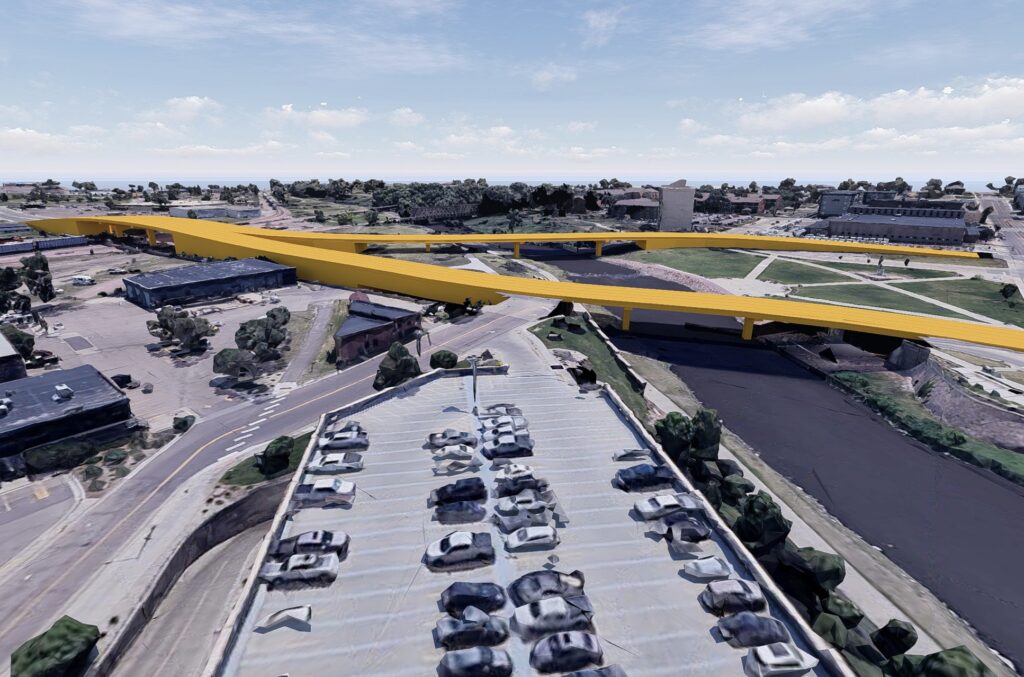
The most recent open house last month identified options for realigning the viaducts when they are rebuilt.


“We had a lot of good feedback,” said Jon Wiegand, traffic engineer and project manager for HDR, which is serving as the study lead.
“That essentially lays the foundation for what we’re doing on the next phase when we get into the details. There was a lot of support for the graphics that were shown.”
There also was discussion about “do we extend bridges over Franklin (Avenue),” Ausen said. “Do we have one over or one under? And different variations of the end treatment that were identified. We realize it’s information overload, but we wanted to get some feedback on their priorities.”


The 10th Street viaduct dates back to 1930, the shorter 10th Street bridge over the Big Sioux River was built in 1934, and the 11th Street viaduct was built in 1971. The roadways are the final piece of an agreement from the mid-2000s between the city and state to transition maintenance of state highways within city limits to the city of Sioux Falls.
Achieving a final design will involve a blend of engineering reality, urban planning desires and a broad cross-section of public input.
“For the last 25 years, a lot of our market research surveys have been … supporting east-west traffic flow and north-south flow,” Ausen said.
“So when we continue to look at the growth of downtown and just the amount of turns at Phillips and Main and Dakota, essentially we need to keep those one-ways and keep the three lanes. But our focus is trying to calm the traffic as best we can.”

The project is of particular interest to the downtown community, said Brandon Hanson, CEO of Downtown Sioux Falls Inc.
“From DTSF’s perspective, one of the biggest opportunities here is the ability to calm traffic through thoughtful design — not just signage,” he said.
Currently, the average vehicle speed through downtown is 32 mph, “even in areas posted at 20 or 15,” he continued.
“That tells us the current approach isn’t working, and we need to not only think but design differently. We’re advocating for solutions that prioritize safety, support walkability and keep people in downtown — not just moving them through it.”
The biggest change likely will be the height of the roads, Ausen said. Various options show the bridges being lowered at different levels.

“And for us, it’s minimizing the flood plain and the flood wall adjacent to 10th Street. Environmentally, there will be things we have to take a look at that the public doesn’t necessarily know about,” she said. “It’s a tough balance because these are bridges that are going to be here the next 100 years, so it’s important to consider the feedback to get what all of us want.”
From a downtown perspective, “it’s critical this project isn’t treated solely as a transportation corridor but also as a placemaking opportunity that enhances access, livability and long-term economic growth for the city’s core,” Hanson added.
“This is a once-in-a-generation opportunity to shape how people experience downtown.”
He sees opportunity to create “a more connected, people-centered downtown” that supports small businesses, enhances safety and promotes long-term economic vitality, he said.
“Walkability, connectivity and people traffic aren’t fringe amenities — they are essential infrastructure,” he said. “If we get this project right, we create a ripple effect of growth and resilience for the entire city.”

The downtown organization has encouraged its membership and others with an interest in downtown to give input through the project team’s survey and to consider attending public meetings.
“People care deeply about the future of this area,” Hanson said, adding that it can be hard for some to focus on a project up to 12 years away in the thick of trying to keep businesses operating and focus on other day-to-day needs.
“The project team has been very open to hosting additional meetings, extending surveys and hearing the need for long-term thinking, including prioritizing connectivity, safety and vibrancy at the heart of our city,” he said.
Next steps
The next phase of work involves refining and evaluating alternatives, then bringing preliminary recommendations forward. Connections for bicycles and pedestrians also will be part of that conversation, and a plan will be developed that also looks at connections such as Reid Street, Second Avenue and Franklin Avenue.
“This is the phase when we’re really getting into the details, and when we come back for the next series of open houses, we will have preliminary recommendations, revised concepts and conceptual layouts and costs associated with each of those,” Wiegand said. “We’ll be looking at that point for feedback on those items before we finalize any recommendations.”
A third set of open houses likely will be held this fall. The plan is to make a final recommendation before the end of the year.
“There’s a lot of instances where the feedback really plays a big role in determining the final recommendations before the end of 2025,” Wiegand said.
After the corridor study is done this year, an environmental process begins, and alternatives will be evaluated for their various impacts. Once that process is complete, design can move forward, followed by construction.
It’s important that input focuses on the actual project under consideration, Ausen added. Much feedback is received on what becomes of 10th and 11th streets apart from the actual viaducts, but those will be city-funded projects scheduled at a later time.
“Those are things we’d have to do outside of the viaduct study,” she said. “We still have surface life (left in the roads), so it’s not in our plans yet.”
Starting this far ahead of when a final project would become a reality isn’t that uncommon, she added.
“When we raised up 26th and Southeastern, we started that eight years before we started construction,” she said. “Same thing with 41st Street, so this is pretty normal in our world.”
To learn more about the project and provide survey feedback, visit here.
Share This Story
Most Recent
Videos
Looking amazing @dtsiouxfalls and @washpav! Thanks to @jpickthorn for capturing an incredible night.
Nov 26

Enjoy this glow headed into Halloween week! 📸: @jpickthorn
Oct 31
Hope you had a wonderful summer weekend and are recharged for the week ahead! 📸: @jpickthorn
Jun 27
Beautiful way to start a week! 📸: @jpickthorn
Jan 10
Favorite flyover of the year! Merry Christmas from our entire @pigeon605news flock. 🎄🐦 📸: @actsofnaturephotography
Dec 24
They definitely deserve to be treated like holiday royalty and they were! ❤️ these scenes from tonight’s lighting celebration at @sanfordhealth Children’s Hospital. 🎄
Dec 1
The holidays are here! Perfect night @dtsiouxfalls
Nov 27
Happy Halloween from @avera_health NICU babies! Link in bio to see more! 🎃
Oct 31
Did you know @dtsiouxfalls is filled with 👻 stories? Link in bio … if you dare 😱
Oct 8
When it comes to kids parties nobody wants to be cookie-cutter. Link in bio for the story on what’s trending.
Sep 28
Want to stay connected to where you live with more stories like this?
Adopt a free virtual “pigeon” to deliver news that will matter to you.




Are you a little bird with something to share?
Delivering news that matters to you
Years ago, homing pigeons were used to bring us news we needed. Today, your virtual “pigeon” will deliver what you want to know about the place you call home.
All pigeons are free to good homes!
Our Partners