

What’s behind Sioux Falls ‘surge’ in gun violence?
Sioux Falls is more violent than it ought to be. There are too many guns and hard drugs floating about, and too many people commit too many crimes with too little punishment.
Those were the clearest takeaways last week when the mayor, police chief, sheriff and state’s attorney appeared at a livestreamed public safety news conference that veered into calls for legislative action, community partnerships and even a vote against the legalization of recreational marijuana in November.
One particular and growing concern? Gun violence. Anecdotally, some of this year’s highest-profile crimes back up the officials’ assertion that repeat offenders and younger people are behind the jump in violence.
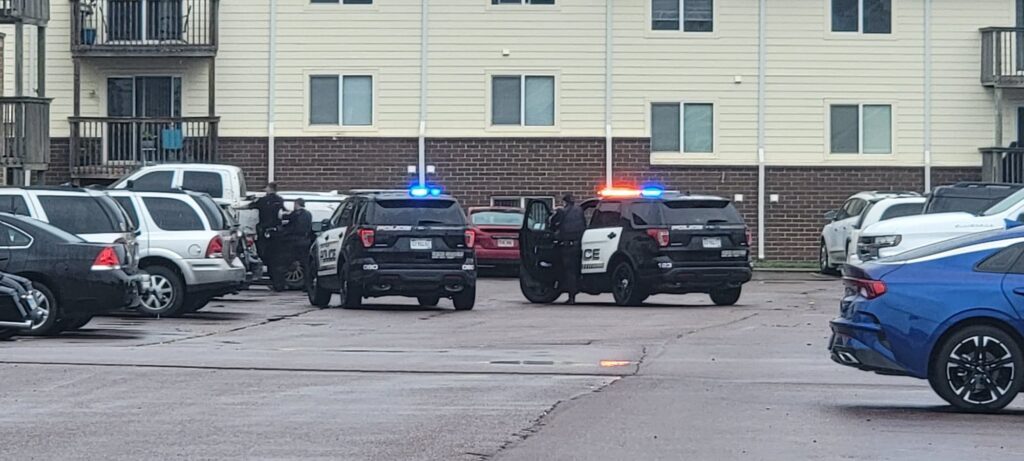
Photo courtesy of Tea Storm Chasers
A summer shootout in broad daylight at Burger King that left one suspect dead resulted in the arrest of nine parolees and probationers who’d lost touch with their supervising officers and the seizure of four firearms. On Labor Day, a parolee allegedly shot a man to death when he found him at an ex-girlfriend’s apartment.
Hours after the Sept. 19 news conference, Sioux Falls police shot a 17-year-old boy who’d aimed a fake shotgun at officers after calling 911 and telling dispatchers to “send a cop and an ambulance because I’m about to commit a felony.”
Minnehaha County Sheriff Mike Milstead said he’s more worried about the safety of officers and the general public than he has been in his nearly 50 years in Sioux Falls-area law enforcement.
So how serious is the problem of gun violence in Sioux Falls, and what’s behind it?
A dig into statistics from multiple agencies suggests a real problem, but one whose scope and causes defy simple explanation.
Gun crimes on the rise
Gun-related incidents – or at least reports of them – have risen in Sioux Falls, according to statistics on file with the Sioux Falls Police Department.
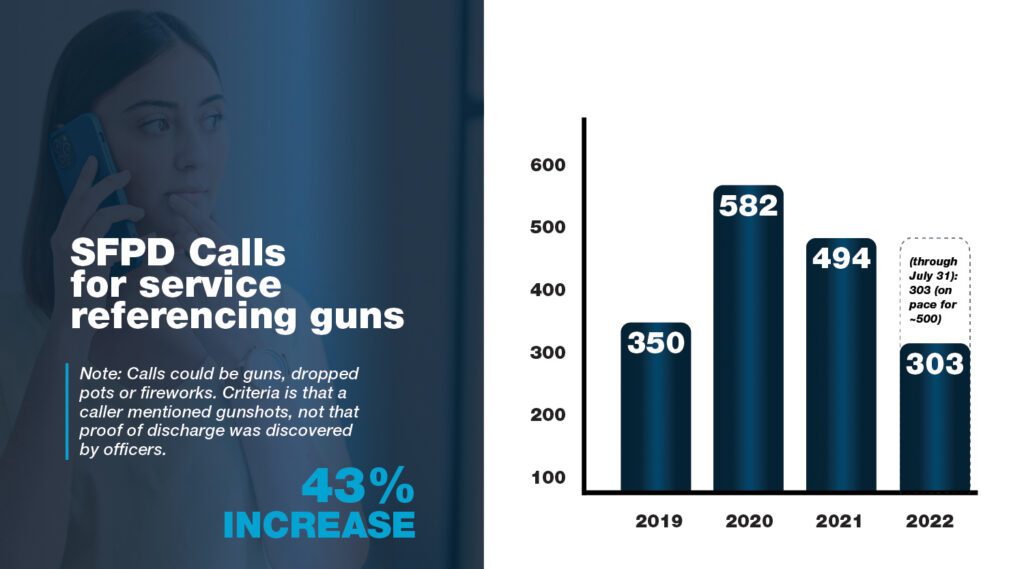
Gunshot calls to Metro Communications are on pace for a 43 percent increase since 2019.
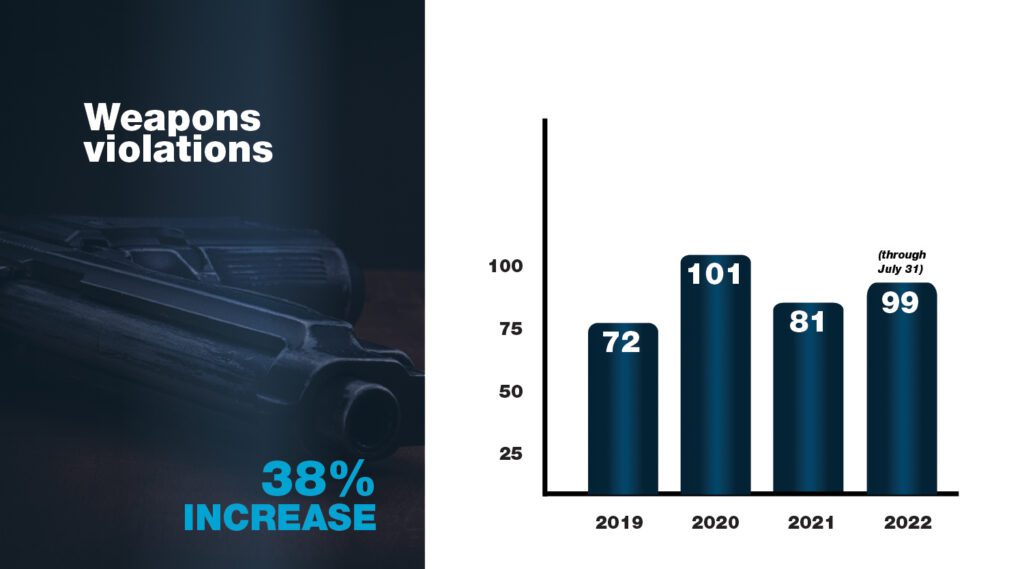
Weapons violations already are up 38 percent compared with 2019.
Crimes in which a gun is used? Already up 3 percent compared with 2019.
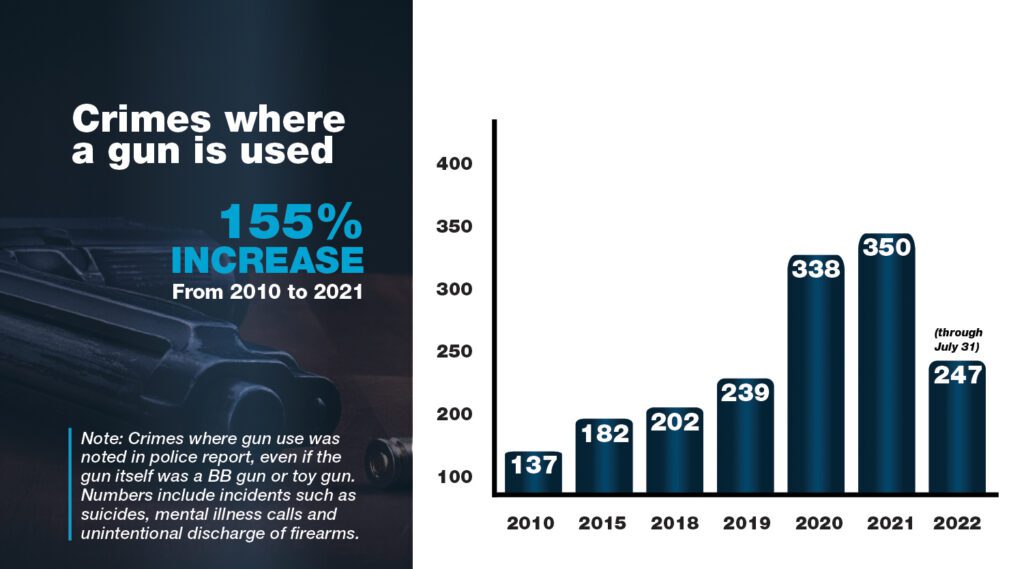
Those figures are imperfect measures, though, according to police spokesman Sam Clemens.
For one thing, there’s no blanket “gun violence” charge in South Dakota law. Threatening someone with a gun could lead to a charge of aggravated assault but so could a threat with a knife. Attempted murder could involve a gun but could just as easily involve a knife, rope, broken beer bottle or vehicle. Serious injury inflicted with or without the aid of a weapon also falls under aggravated assault.
The category for “crime in which a gun is used” is broad, Clemens said – and includes incidents most wouldn’t immediately recognize as “crime.” It could be a gun fired into the air, a robbery, aggravated assault or simply a person carrying a gun who’s not lawfully allowed to possess one.
It also includes suicides, unintentional discharge and calls that become mental health holds after officers arrive on scene.
“That includes all calls,” Clemens wrote when sharing the data. “Everything.”
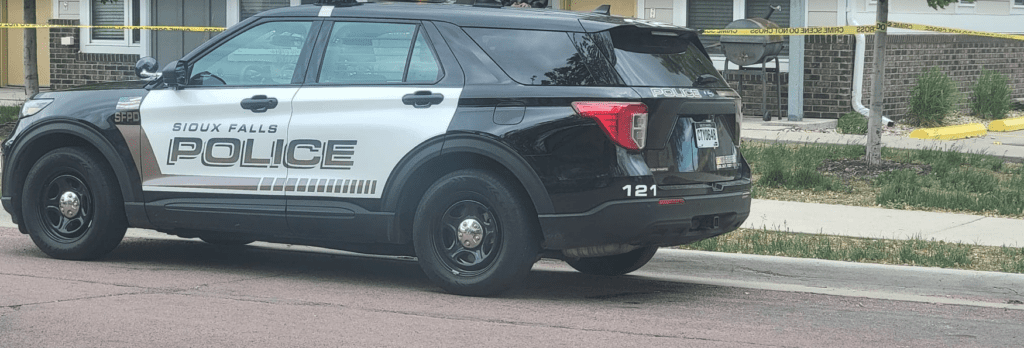
That category also includes cases in which the gun isn’t a real gun. Robbing a casino with a BB gun could be tagged a “crime in which a gun is used.”
That’s one reason Minnehaha County Public Defender Traci Smith was hesitant to offer a comment on the gun violence numbers without digging into the details of each case.
The statistics sometimes say as much about the manner in which they’re collected as they do about the incidents they’re connected to.
“Charges are simply one person’s opinion, and all that’s required to make an arrest is probable cause,” Smith said. “I saw an aggravated assault case this week where the alleged weapon was a pencil.”
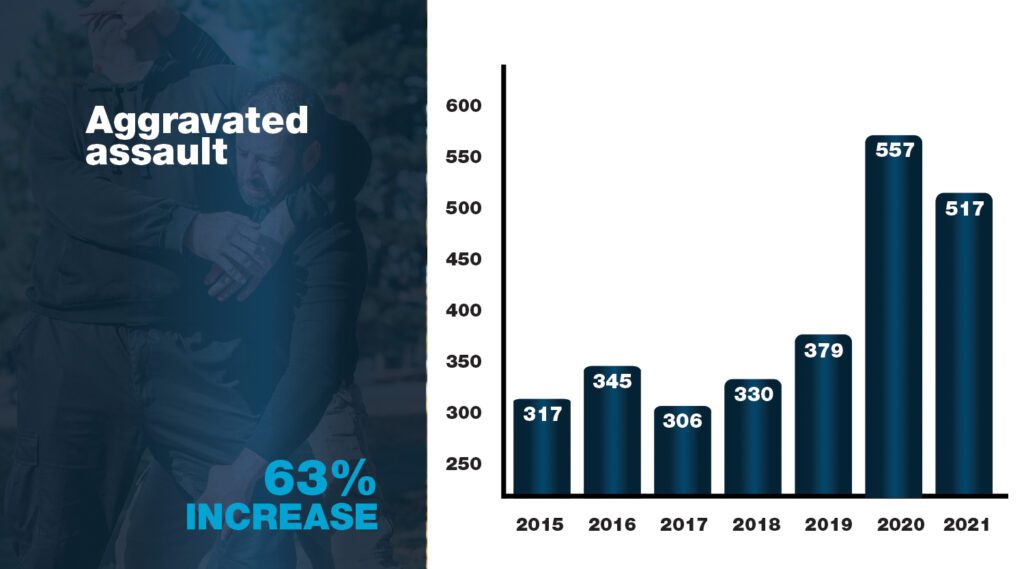
Smith noted that the pandemic and its associated stressors could be a factor – another point backed by the data. Aggravated assault cases are up 63 percent since 2015, but well over 46 percent of that increase came between 2019 and 2020.
Gunshot reports have their own caveats.
A reported gunshot doesn’t always turn out to be a gunshot. Sometimes it’s a firecracker. Police Chief Jon Thum suggested that public worries about gun violence – and perhaps even headlines about high-profile gun crimes – might contribute to a willingness to report an overheard “bang” as a gunshot.
“Are we seeing more gunshot calls? Yes,” Thum said. “But are we also seeing an increased willingness to call in anything that sounds like a gunshot? Yeah.”
By contrast, weapons violations involve guns, just not necessarily violence. Felons, people with drug convictions or those with certain domestic violence crimes on their record aren’t allowed to have guns. Those charges also could be tied to the act of firing a gun at a building or firing from a vehicle.
Caveats aside, the imperfect metrics bear out this much: Gun crimes are on the rise, and local public safety officials are taking it seriously. Local leaders have reached out to Gov. Kristi Noem’s office and Department of Corrections Secretary Kellie Wasko to offer support for more prison beds in hopes of detaining people with violent criminal histories or histories that point to a risk of future violence for longer periods of time.
Sheriff Milstead, whose jail houses several dozen parolees and probationers on any given day, is a vocal supporter of more prison beds and stiffer sanctions.
Of a new state prison, Milstead said, “I just hope they don’t build it too small.”
More parolees on the lam
Data from the DOC confirms that more parolees are indeed ducking supervision.
The number of parole absconders, meaning people with whom parole officers have lost contact, jumped 50 percent from June 2019 to June 2022, and 138 percent since June 2015.
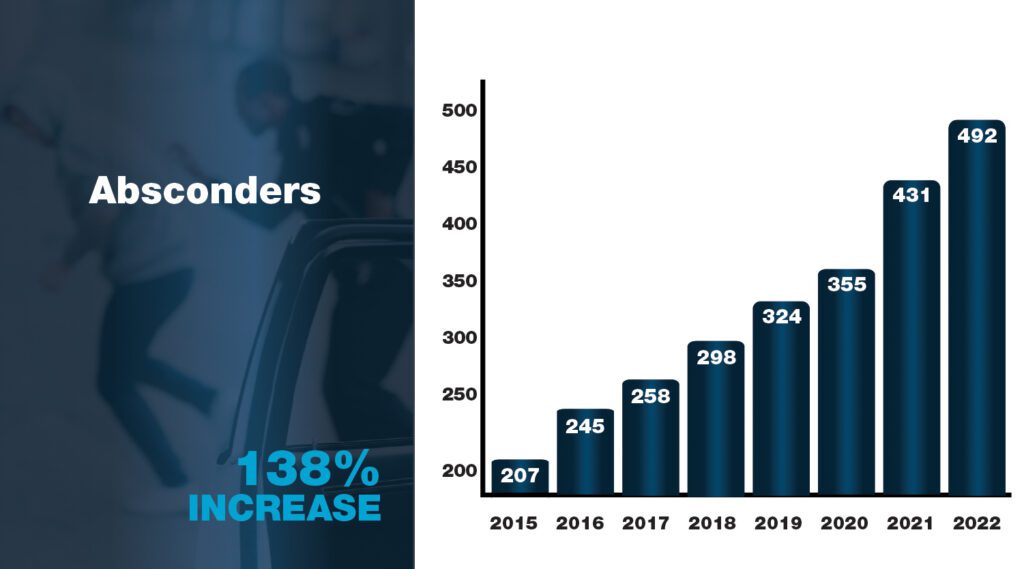
The figures offered to Pigeon605 by DOC spokesman Michael Winder represent a snapshot in time at the end of the fiscal year, not an average. Even so, they point to a clear uptick in absconding parolees.
There has been an increase in parolees overall since 2015 but a far smaller one at 36 percent.
But even with absconder statistics, there are wrinkles that make it difficult to draw a straight line from the statistics to the violence. When someone loses touch with their parole officer, Winder said, that makes them an absconder. Taken alone, “absconder” status doesn’t point to the commission of new violent crimes. A former inmate could stop showing up for meetings or stop taking calls because they’ve resumed their prior drug habits.
“There are many factors which could lead to an increase in offenders absconding, such as economic issues, a lack of resources and supports in the community, increased availability of illicit drugs in the community,” Winder said.
The DOC spokesman had another data point on the department’s handling of absconding parolees that points to changes in recent years: around 20 percent of absconders were in custody in 2022 and 2021. The year before, that number was 13 percent.
“The significant increase of absconders in custody reflects the increased efforts made by parole agents and local law enforcement to quickly locate and detain absconders,” Winder said.
There is one more wrinkle to the supervision figures as well. The total number of parolees, while up 32 percent since 2015, is down almost 7 percent since a peak in 2020.
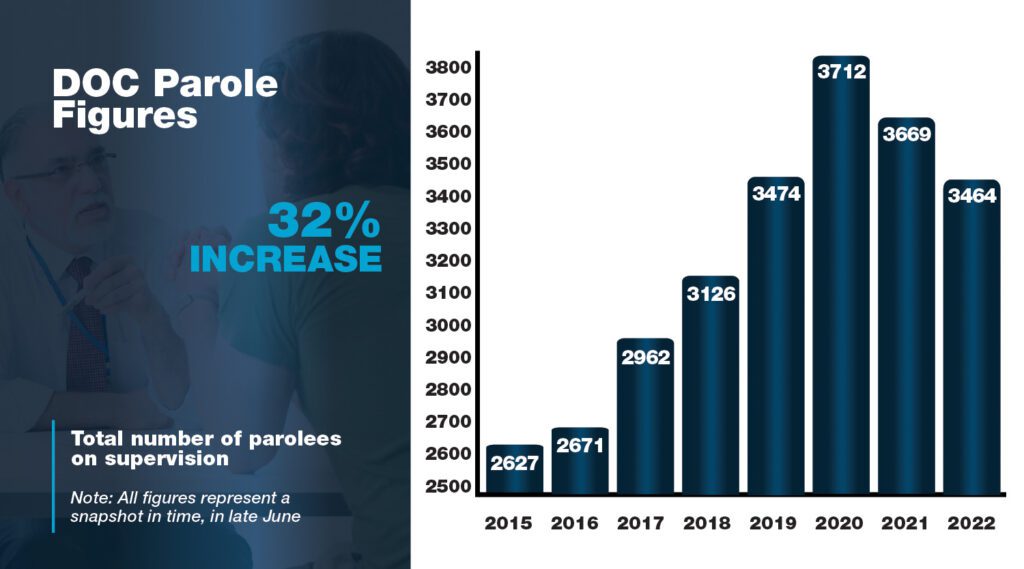
Sheriff Milstead mentioned that a large number of parolees from other parts of the state choose Sioux Falls as their home upon release, but Winder said the DOC does not track where parolees settle.
As for probationers, meaning people who are supervised at the county level rather than by the DOC, the numbers are down significantly. In the Second Judicial Circuit, which includes Minnehaha and Lincoln counties, there has been a 23 percent drop in probationers since fiscal 2018 – from 4,625 to 3,768.
Those figures include all cases, adult and juvenile, meaning they could encompass not just felony crimes pled down for probation or felonies with a presumption of probation, but cases as minor as repeat teenage shoplifting.
Motions to revoke, filed when probationers violate the terms of their supervision or duck their supervising court services officer, also are down. Since fiscal 2018, there has been a 16 percent drop in motion to revoke filings in Minnehaha and Lincoln counties.
General crime trends moving in the wrong direction
Gun crime is just one aspect of the trends now troubling officials, of course.
Crimes beyond the gun-related have picked up significantly this year, Chief Thum said. Crime rates rose in Sioux Falls and nationwide in 2020, dropped slightly in Sioux Falls the following year, but “for whatever reason, ’22 is picking up right where ’20 left off.”
Like Milstead and Minnehaha County State’s Attorney Daniel Haggar, Thum lays a share of the blame on repeat offenders.
“Most of the people we see involved in these things have a history with our criminal justice system,” Thum said.
Another recurring theme has been the willingness of younger people to use firearms and their growing distrust of police. For example, two teenagers showed up at the hospital on the last day of August with gunshot wounds and no interest in telling officers how they were injured.
It’s difficult to pinpoint the long-term societal and cultural shifts that may explain that shift in behavior, Thum said.
“We could probably write a doctoral thesis on it, just how youth in society has been kind of desensitized to some of these gun crimes now, where it really seems like it is more of a viable option,” Thum said.
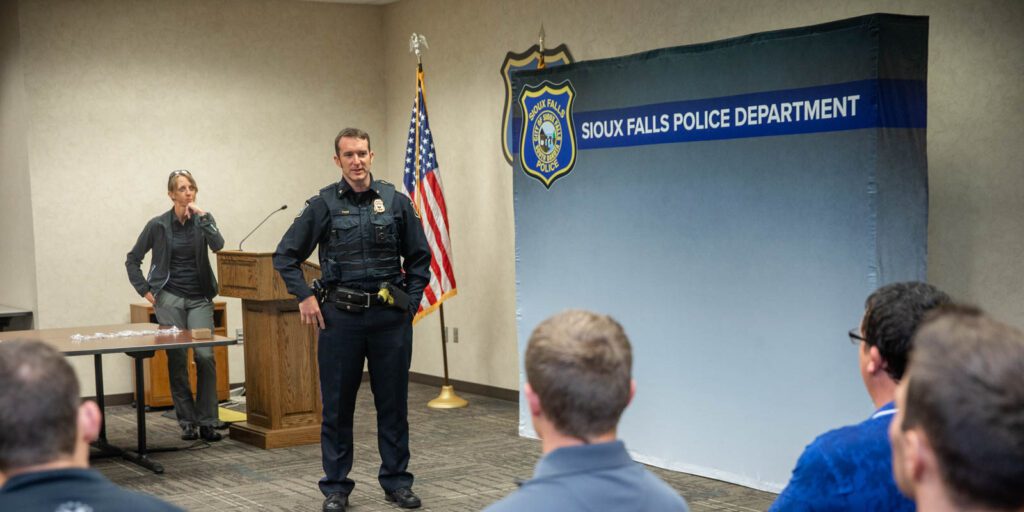
The chief sees mentorship and community partnerships, as well as the SFPD’s school resource officers, as opportunities for tackling some of the underlying issues in youth that lead to gun violence later in life.
Thum, Milstead, Haggar and Mayor Paul TenHaken hope to push the DOC to revisit policies on parole and presumptive probation as part of a public safety push in Pierre during next year’s legislative session.
They’re also pushing for deeper community partnerships to address more of the root causes of crime, such as drug use and abuse, a lack of positive adult role models for youth and housing struggles for people who have been incarcerated.
During the news conference, TenHaken read a letter from a DOC inmate asking the mayor to make sure he’d have a place to stay upon release.
“He needs housing, he needs a job, and if he doesn’t get those things, he’s going to be one of those cyclical offenders that we see in our community,” TenHaken said. “That’s why when we talk about about crime and public safety, it’s very much a holistic issue,” involving multiple approaches, agencies and partnerships.
Smith, the public defender, said “psychological safety” and disconnection within the community as a whole often go unaddressed during community safety discussions. Poverty, unaddressed trauma and racial disparities in prison and jail populations drive a sense of mistrust.
Smith said she’d hesitate to pin blame on any specific group of people, “especially those who are already marginalized like those who have been justice-impacted.”
“Rather than speaking anecdotally about probationers, parolees or young people being the problem, I think it’s important to remember that when any group of people is constantly told they don’t belong, or are given labels like felon, offender, or if any person is made to feel as a lesser, that sense of disconnection can have long-lasting traumatic effects,” she said.
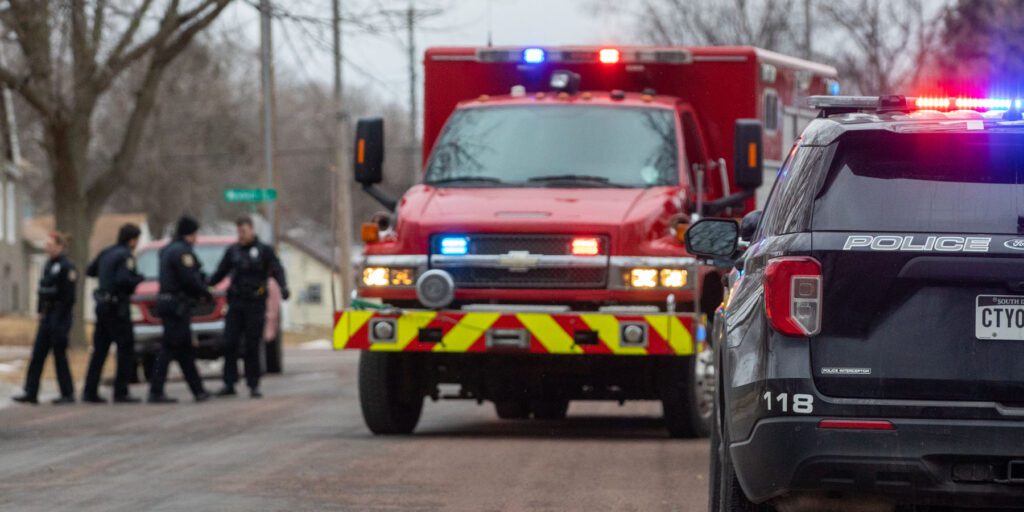
The issues are deeper than parole and probation, or youth role models. There are myriad factors that drive crime, including drug addiction that fuels robberies and burglaries, poverty, housing and more.
Minnehaha County Chief Deputy Jeff Gromer, a former jail warden, said he sees drug use and drug availability as the major drivers of criminal behavior. That much was true long before the current spate of gun crimes began catching the attention of law enforcement and the public at large.
“Those thefts from vehicles aren’t just kids fooling around,” Gromer said. “That’s people looking for money or something they can sell to fuel their drug habits.”
Contraband like smuggled drugs has been a constant struggle for jailers for years, he said, and the problem has gotten only worse.
Echoing Mayor TenHaken, Gromer said “it’s such a complicated situation.”
“There’s not any one thing you can put your finger on and say ‘if we fix this, it will all get better.’”
Share This Story
Most Recent
Videos



Looking amazing @dtsiouxfalls and @washpav! Thanks to @jpickthorn for capturing an incredible night.
Nov 26

Enjoy this glow headed into Halloween week! 📸: @jpickthorn
Oct 31
Hope you had a wonderful summer weekend and are recharged for the week ahead! 📸: @jpickthorn
Jun 27
Beautiful way to start a week! 📸: @jpickthorn
Jan 10
Favorite flyover of the year! Merry Christmas from our entire @pigeon605news flock. 🎄🐦 📸: @actsofnaturephotography
Dec 24
They definitely deserve to be treated like holiday royalty and they were! ❤️ these scenes from tonight’s lighting celebration at @sanfordhealth Children’s Hospital. 🎄
Dec 1
The holidays are here! Perfect night @dtsiouxfalls
Nov 27
Happy Halloween from @avera_health NICU babies! Link in bio to see more! 🎃
Oct 31
Did you know @dtsiouxfalls is filled with 👻 stories? Link in bio … if you dare 😱
Oct 8
When it comes to kids parties nobody wants to be cookie-cutter. Link in bio for the story on what’s trending.
Sep 28
Want to stay connected to where you live with more stories like this?
Adopt a free virtual “pigeon” to deliver news that will matter to you.
Read More





Are you a little bird with something to share?

Delivering news that matters to you
Years ago, homing pigeons were used to bring us news we needed. Today, your virtual “pigeon” will deliver what you want to know about the place you call home.
All pigeons are free to good homes!
Our Partners