

How to choose over-the-counter medications for cold, flu
This paid piece is sponsored by Avera Health.
You’re sick. And your body is slammed with aches, fever, chills, sneezing, coughing. Feeling normal might take awhile, but an over-the-counter medication can help relieve symptoms.
But what should you take? With rows and rows of similar-looking boxes and bottles on the shelves, it’s easy to feel overwhelmed. The main purpose of these OTC medications is to alleviate your symptoms as your body fights off the illness.

Jessie Graney, PharmD, a pharmacy supervisor at Avera Pharmacy – Louise Avenue, offers tips on choosing which OTC item might work best for you. This advice is intended for adults, so talk to your family medicine provider or pharmacist to learn about over-the-counter options for children.
Types of over-the-counter medications
When you’re looking at the countless options in the store, slow down, take a deep breath — you can make an informed choice.
Here’s a quick glance of the types of medication you’ll find on the shelf:
- Analgesic – relieves pain or fever.
- Antihistamine – relieves runny nose and sneezing.
- Decongestant – relieves nasal stuffiness and sinus pressure.
- Antitussive/expectorant – relieves coughing.
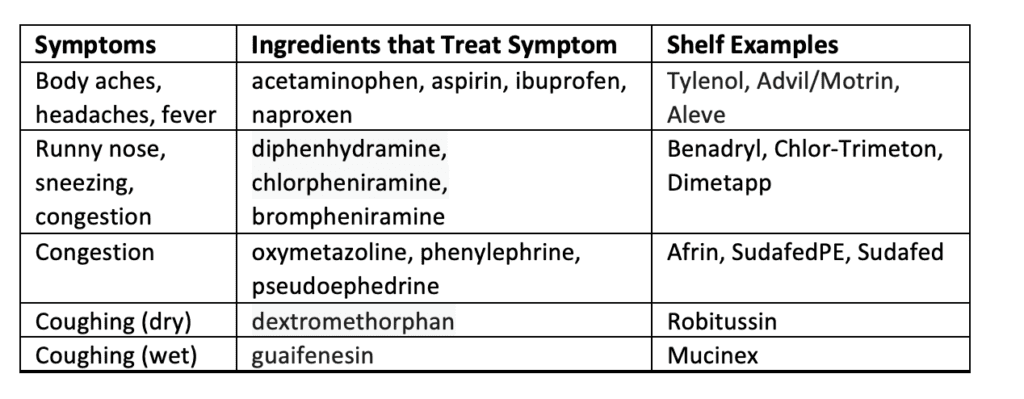
“Read the label like you would a food label,” Graney said. “The label will include active ingredients, and these ingredients can be matched to what is effective in treating specific symptoms.”
Is it possible to overdose?
It’s OK to take multiple single-ingredient medications when you’re sick. However, Graney highly recommends identifying the most aggravating symptom and then choosing one OTC option with that one ingredient for relief.
“Less is more,” Graney said. “You don’t want to overdo it on medications when you’re ill. More ingredients increase the risk of overdosing, duplicating or having an interaction with a prescription you take to manage a chronic condition. Also, symptoms can be interconnected. For instance, if you treat your nasal drainage, your sore throat feels better and you stop coughing, so you don’t need additional medications for relief.”
Multi-symptom OTC medications
Graney endorses caution when choosing multi-symptom OTC options. These medications have multiple ingredients, aiming to alleviate multiple symptoms. This would be great — but what if you don’t have one of the symptoms?
“If you don’t have a symptom that’s listed on the box, choose a different product,” Graney said. “It might be less convenient, but it is better than taking a multi-symptom product that gives you medicine you don’t need.”
Things to consider when taking OTC medications
Analgesic
- Do not exceed the recommended dose. Be especially cautious of double-dosing as multi-symptom medications often contain analgesics.
- If you have liver and kidney issues, reduce the dose and consult your primary care provider.
- Consider taking with food to avoid stomach irritation.
Antihistamine
- Sedating antihistamines are stronger and work faster than non-sedating for cold and flu symptoms but can cause drowsiness. In addition to those listed in the chart, doxylamine is a sedating antihistamine found in multi-symptom cold medicines. Nyquil is one example.
- Non-sedating antihistamines often are more effective for daily, long-term use for allergy symptoms. These ingredients include cetirizine, loratadine, fexofenadine, levocetirizine and desloratadine.
Decongestant
- Do not use a decongestant nasal spray option for more than three consecutive days; after this, your nasal blood vessels become dependent upon it to contract, making the congestion worse.
- Decongestants are a stimulant, so you may have trouble sleeping.
- Oral decongestants can increase heart rate and blood pressure, and affect those with prostate issues, glaucoma and thyroid issues.
- Pseudoephedrine — Sudafed for example — moved to sales “behind the counter” of pharmacies in 2006 in an effort to curb methamphetamine production. Purchasers can buy a limited quantity per transaction by showing their ID at the pharmacy.
- Phenylephrine, the ingredient in the oral decongestant drug SudafedPE, recently was deemed ineffective by the Food and Drug Administration advisory panel. Products with phenylephrine will continue to be sold until the FDA makes a final decision on the drug. The ruling did not include nasal spray formulations of phenylephrine.
Antitussive/expectorant
- Antitussives help with that tickly, dry cough that seems to never go away.
- Expectorants help break up phlegm when you experience “wet coughing.” However, drinking plenty of water can be just as effective.
- Products are sleep neutral, so you can use them day or night.
Get more tips at AveraBalance.org.
Share This Story
Most Recent
Videos



Looking amazing @dtsiouxfalls and @washpav! Thanks to @jpickthorn for capturing an incredible night.
Nov 26

Enjoy this glow headed into Halloween week! 📸: @jpickthorn
Oct 31
Hope you had a wonderful summer weekend and are recharged for the week ahead! 📸: @jpickthorn
Jun 27
Beautiful way to start a week! 📸: @jpickthorn
Jan 10
Favorite flyover of the year! Merry Christmas from our entire @pigeon605news flock. 🎄🐦 📸: @actsofnaturephotography
Dec 24
They definitely deserve to be treated like holiday royalty and they were! ❤️ these scenes from tonight’s lighting celebration at @sanfordhealth Children’s Hospital. 🎄
Dec 1
The holidays are here! Perfect night @dtsiouxfalls
Nov 27
Happy Halloween from @avera_health NICU babies! Link in bio to see more! 🎃
Oct 31
Did you know @dtsiouxfalls is filled with 👻 stories? Link in bio … if you dare 😱
Oct 8
When it comes to kids parties nobody wants to be cookie-cutter. Link in bio for the story on what’s trending.
Sep 28
Want to stay connected to where you live with more stories like this?
Adopt a free virtual “pigeon” to deliver news that will matter to you.
Read More






Are you a little bird with something to share?

Delivering news that matters to you
Years ago, homing pigeons were used to bring us news we needed. Today, your virtual “pigeon” will deliver what you want to know about the place you call home.
All pigeons are free to good homes!
Our Partners