
Know the signs: Why every second counts during a stroke
This paid piece is sponsored by Sanford Health.
Ray Schaefer was lucky one winter morning when his wife, May, didn’t go to work at the usual time.
As a nurse at Sanford Health, May typically goes to work at 6:30 a.m. That day, she wasn’t scheduled until two hours later.
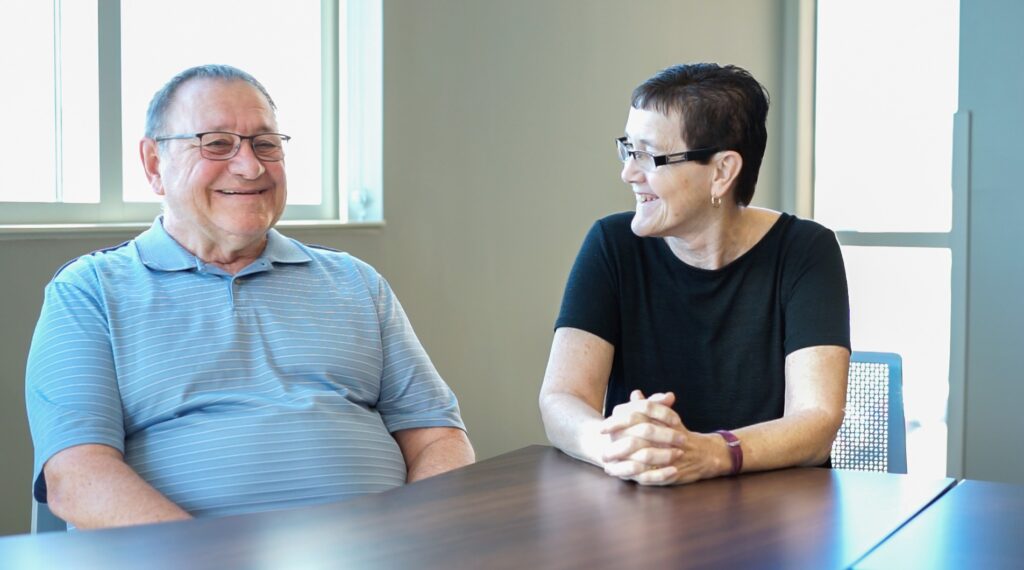
“I was making my morning tea and heard a noise, so I went into the bathroom to check on Ray and found him face down on the bathroom floor,” May said. “I knew right away he was having a stroke.”
Critical moments, critical stroke care
As a nurse with 36 years of experience, May noticed several classic stroke symptoms. Ray was experiencing total paralysis on his right side, accompanied by facial drooping, and he couldn’t speak.
“I tried to pull my hand onto the edge of the countertop to get up, and nothing would work,” Ray said. “My mind was talking, but my voice wasn’t coming out.”
May quickly dialed 911. Ray was unresponsive by the time an ambulance got him to the emergency room at the Sanford USD Medical Center, which is now a Comprehensive Stroke Center. The hospital is certified to provide the highest level of care to stroke patients.
Ray’s care team, led by Dr. Divyajot Sandhu, began treatment immediately. A CAT scan helped locate a blood clot in his left middle cerebral artery, and he was given tPA, a clot-buster drug that breaks up blockages.
“Think of a stroke as a blood flow problem,” Sandhu said. “A clot, which may be formed anywhere in the body, keeps traveling in blood vessels that supply the brain until it can travel no more. Once it gets stuck inside a blood vessel, it starves that part of the brain of oxygen.”
Brain cells deprived of oxygen may never recover.
“Every extra minute that a blood vessel is left blocked, 2 million more neurons are permanently damaged. That’s a massive number, and that’s the gist of why time matters during a stroke,” Sandhu said.
Outcome of stroke? Full recovery
Sandhu retrieved the clot out of Ray’s artery during a procedure called a thrombectomy. By that night, Ray was off life support and waking up. May attributes his recovery to the timeliness of his treatment.
“That’s really the key to his progress,” she said. “Ray was in the hospital within the hour of his symptoms starting. Within three hours, everything was done, and he was up in the intensive care unit. That’s what changed his life — and our life.”
Her quick thinking that morning left both May and her husband thankful she knew the signs of stroke and acted quickly.
“If you think that you have something going on, or if you are with someone and they are confused, they talk different, or they’re unable to walk, get in and get checked,” May said. “They have a small window of opportunity where they can help people, so come in as fast as you can.”
Learn more
Share This Story
Most Recent
Videos


Looking amazing @dtsiouxfalls and @washpav! Thanks to @jpickthorn for capturing an incredible night.
Nov 26

Enjoy this glow headed into Halloween week! 📸: @jpickthorn
Oct 31
Hope you had a wonderful summer weekend and are recharged for the week ahead! 📸: @jpickthorn
Jun 27
Beautiful way to start a week! 📸: @jpickthorn
Jan 10
Favorite flyover of the year! Merry Christmas from our entire @pigeon605news flock. 🎄🐦 📸: @actsofnaturephotography
Dec 24
They definitely deserve to be treated like holiday royalty and they were! ❤️ these scenes from tonight’s lighting celebration at @sanfordhealth Children’s Hospital. 🎄
Dec 1
The holidays are here! Perfect night @dtsiouxfalls
Nov 27
Happy Halloween from @avera_health NICU babies! Link in bio to see more! 🎃
Oct 31
Did you know @dtsiouxfalls is filled with 👻 stories? Link in bio … if you dare 😱
Oct 8
When it comes to kids parties nobody wants to be cookie-cutter. Link in bio for the story on what’s trending.
Sep 28
Want to stay connected to where you live with more stories like this?
Adopt a free virtual “pigeon” to deliver news that will matter to you.





Are you a little bird with something to share?
Delivering news that matters to you
Years ago, homing pigeons were used to bring us news we needed. Today, your virtual “pigeon” will deliver what you want to know about the place you call home.
All pigeons are free to good homes!
Our Partners